Busy wildfire season tests US fire bosses as they juggle resources to stay ahead
Jul 13, 2026, 9:05 PM
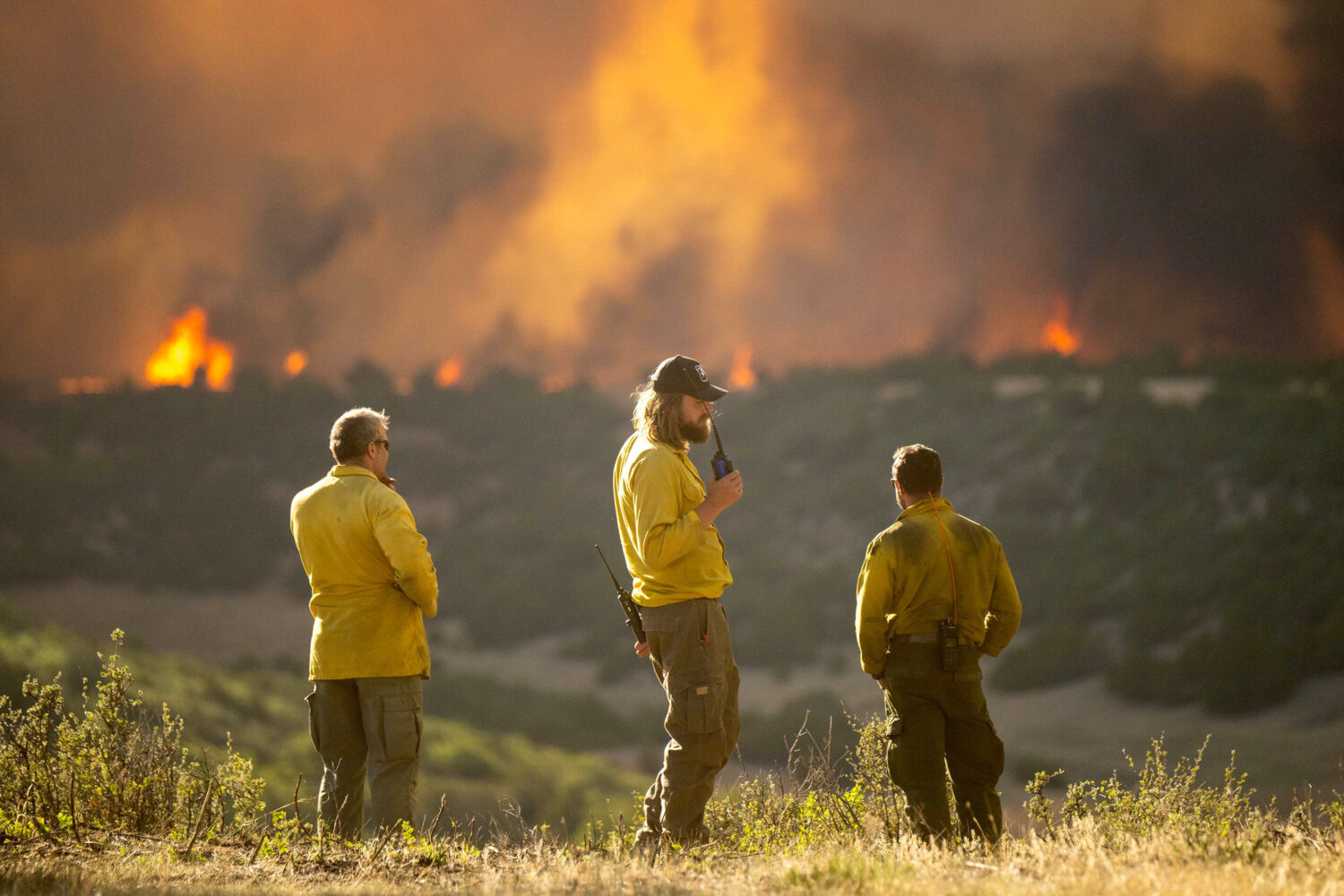
Firefighters monitor the Aspen Acres Fire near Colorado City, Colo., as it begins to grow late on Thursday, July 2, 2026. (Michael Seamans/The Gazette via AP)
Credit: Michael Seamans/The Gazette via AP
(Michael Seamans/The Gazette via AP)

ALBUQUERQUE, N.M. (AP) — It’s already been a deadly year for firefighters, and authorities have been putting resources where they can more quickly pounce on wildfires before they get out of hand and increase the possibility of additional loss of life and property.
Fire managers try to anticipate nature’s next move, placing thousands of firefighters, hundreds of engines, batteries of bulldozers and fleets of helicopters and air tankers where they’ll make the biggest difference.
This year, they’re dealing with persistent drought made worse by record-low snowpack levels and consecutive days of hot, dry and windy weather. Hundreds of homes have burned, three firefighters were killed battling flames in Colorado, and most recently a helicopter helping with another Colorado fire crashed into a reservoir, killing the pilot.
National preparedness has yet to reach its highest level, but resources are getting stretched as new fires pop up daily.
“The U.S. Wildland Fire Service is prioritizing pre-positioning of crews, engines and aircraft in areas with the highest likelihood of wildfire activity,” the agency said in an email to The Associated Press when asked about available resources. “This allows for quicker initial attack when new wildfires ignite, which is often the most effective way to keep fires small.”
The National Interagency Fire Center, a collection of federal and state agencies that supports on-the-ground wildfire firefighting efforts, sets the preparedness level at 1 to 5 based on fire activity, resource demands, weather and conditions on the ground that can be fuel for a fire. By late June, a surge of wildfire activity prompted coordinators to move the needle to level 4 and begin funneling more crews to the hottest spots.
More than 2,000 fires have been confirmed by the national fire center since the beginning of July alone. The explosion of fire activity across the West has resulted in more highly skilled and experienced incident management teams being assigned. Some have traveled from Alaska and California to help with fires in the Great Basin region.
As of Monday, there were 16 such teams overseeing nearly 17,000 people spread across more than a dozen states.
It’s typical to see preparedness increase in July and August, but fire managers are hopeful they can keep juggling resources to avoid maxing out.
Over the past decade, fire managers have reached the top preparedness tier an average of 25 days per year, with the longest stretch happening in 2021, according to federal statistics. The earliest the designation ever occurred was June 21, 2002.
The nation has 10 geographic area coordination centers — or GACCs — that handle the mobilization of firefighters and other resources.
Mike Morgan, director of the Colorado Division of Fire Prevention and Control, noted during a news conference in early July that his state was getting help from an Alaska-based team.
“Thank God that they have the ability to free those resources up,” he said. “So I think at the moment I would say I feel pretty good about where we’re at. But I’m very concerned about where we go.”
In Utah, more crews arrived to help with the Babylon Fire, the largest active blaze in the U.S. at 166 square miles (430 square kilometers). That’s larger than the size of Seattle.
In all, more than 5,600 square miles (14,504 square kilometers) — more than the size of Yellowstone and Grand Canyon national parks combined — have burned in the U.S. so far this year, outpacing the average for the past decade.
The most recent outlook shows above normal wildfire potential in July from the Four Corners Region — where New Mexico, Arizona, Colorado and Utah meet — north to Oregon, Idaho and Washington. It’s not expected to simmer down until September.
Christopher Dunn, an assistant professor of wildfire risk science at Oregon State University, said these outlooks form the basis for determining how and where to mobilize resources. Those resources are shifted as the fire season moves from region to region.
In a busy year, states have to weigh whether to free up resources to help elsewhere or pressure federal officials to keep crews in reserve in case of increased risk. That’s what Dunn described as hoarding resources.
“So there is sort of this delicate balance that has to be walked there, where you share, they share, everybody shares,” he said, “and everybody benefits from that sharing while not overextending your resources so much that you find yourself in a losing position.”
But along with sharing comes added exposure for firefighters who are in the field longer. That means more overtime and greater opportunities for burnout.
“With all this sharing and all of this increase in fire everywhere, we’re just going to see increased pressure on them to work more and work harder and essentially burn out quicker,” Dunn said.
Each fire season reignites the debate over public investment in a permanent wildland firefighting workforce and what agencies can do to retain their most experienced personnel.
“More experience is critical when dealing with extreme conditions,” said Camille Stevens-Rumann, a former wildland firefighter and an associate professor at Colorado State University.
Even with more resources, there’s not much firefighters can do when facing multiple days of strong winds, low humidity and warm temperatures. Stevens-Rumann said that’s where the strategic positioning of resources in advance comes in.
“They can be available for when those conditions die down, like in the evening,” she said. “But when we have day after day of red flag warnings and high winds, it’s really hard to control a fire.”
Even though Stevens-Rumann has been on the front lines and studies wildfires, it’s unsettling when flames are close to home.
“There’s no denying it. It’s easy to disassociate that when you’re on a fire crew and you’re arriving to a place that you don’t have a connection to per se to fight a fire. You know, you’re there to do a job,” she said, “but when you see it in your own backyard, it’s definitely a totally different experience.”
This year, firefighters are being directed to attack every blaze as quickly as possible to limit growth, reversing a decades-long trend in which managers let some fires burn to clear out brush and dead vegetation to reduce future risks. Stevens-Rumann said there are concerns about what that means for firefighter safety and work done on the landscape to slow the flames.
“It doesn’t do us any good to build miles and miles of line that just get burnt over, over and over again,” she said, noting that newer strategies are helping managers figure out where best to take a stand.
Having eyes on the ground — or rather above the tree canopy — can help spot fires early. Despite once numbering in the thousands, there are some 350 lookout towers left in the U.S., with many staffed by volunteers due to dwindling budgets, said Michael Guerin, chairman of the Forest Fire Lookout Association.
They’re not just in the West. New Jersey opened a new one just this year, and they’re also used in Pennsylvania, Maine and other eastern states.
The recent fires have forced the evacuation of some towers in Colorado. Meanwhile, Guerin and fellow volunteers in California are ready for things to pick up in their state when the Santa Ana winds arrive.
They could be getting help in the future from satellites. Officials with the California Department of Forestry and Fire Protection announced in early July that the first satellites have been launched into orbit as part of what will be a space-based wildfire detection system.
For now, the lookout volunteers use a map, compass and their familiarity with landmarks to pinpoint the location for initial attack crews. But their job isn’t done, Guerin said.
“We then become the overwatch — the people that keep them safe while they’re doing the hard work on the ground.”