Five Things to Know About Largest Cell Phone Ban Study
May 5, 2026, 9:27 AM
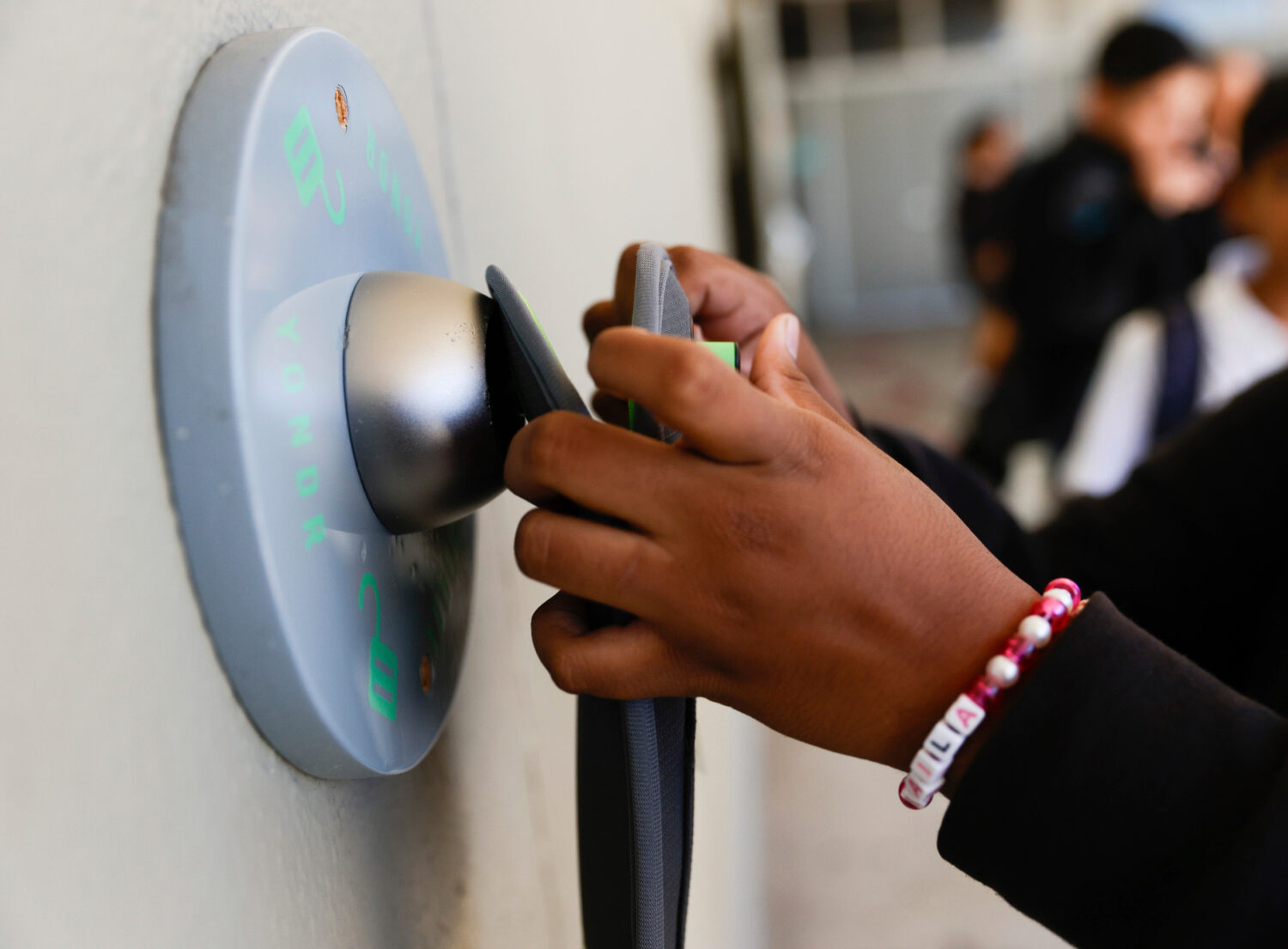
FILE - A middle school student unlocks a Yondr pouch on an unlocking base at Bayside Academy while others wait in line for their turn to unlock their pouch at the end of the school day Aug. 16, 2024, in San Mateo, Calif. (Lea Suzuki/San Francisco Chronicle via AP, File)
Credit: ASSOCIATED PRESS
(Lea Suzuki/San Francisco Chronicle via AP, File)

The largest study ever of school cell phone bans finds that they offer decidedly mixed results, with teachers reporting fewer distractions when students lock their phones away during the school day, but little evidence the bans quickly bring improved academic achievement or better behavior, as many advocates have hoped.
The study, by scholars at Stanford University, Duke University, The University of Michigan and the University of Pennsylvania, compiled data from Yondr, a California startup that makes lockable pouches for schools, businesses and entertainment venues. Published Monday by the National Bureau of Economic Research, it looks at data from about 4,600 schools and is the first nationally representative look at cell phone bans.
It’s also the first to rely on actual data tracking locked-up phones, not just school “no-show” policies that ask students to keep phones hidden in backpacks or pockets, said Thomas Dee, a Stanford economist who co-led the study. No-show policies, he said, are inconsistently and unevenly enforced and not a good basis for research. “We wanted to leverage the data from Yondr because it gives us much more confidence that in-school use of phones is actually being restricted,” he said in an interview.
A 2024 Pew Research study found that about one in three teachers consider students distracted by cell phones “a major problem.” Among high school teachers, that figure rises sharply, to 72%. More recently, Pew researchers found that 74% of U.S. adults say they would support banning cellphones during class for middle and high school students, up from 68% last fall.
Much of that momentum grows from years of efforts by the psychologist Jonathan Haidt, who has pushed for schools to ban phones. Haidt, author of the mega-bestseller The Anxious Generation, has said there’s growing evidence of an “international epidemic” of mental illness that started around 2012, caused in part by social media and teens’ uptake of smartphones in the early 2010s.
As of this spring, at least 37 states and the District of Columbia require school districts to ban or restrict students’ phone use in schools. Teachers and parents typically support the bans, while students, on the whole, oppose them. Students also say schools shouldn’t expect big results.
Here are five key findings from the NBER study:
1. Phone bans work. Teacher surveys in schools that banned phones bell-to-bell found that the share of students reporting using phones in class for personal reasons fell from 61% to 13%. And GPS data suggest phone usage dropped dramatically — a “large and persistent decline” on campuses with bans, researchers noted. These schools saw a roughly 30% drop in total device pings during school hours by the third year after pouch adoption. This change, however, can’t necessarily be read as a direct measure of the change in student phone use, researchers say, since the data also includes use by adults. And pings are often recorded when phones are on but not in use. But the data still suggest that the sheer impact on student use is substantial and that it can be read as a “conservative lower bound” on the magnitude of cell phone policies.
2. Discipline worsened, then improved. In the first year of adoption, schools that banned phones saw about a 16% increase in suspension rates — both in- and out-of-school — but this effect faded in subsequent years, researchers found. The uptick likely reflects the fact that many schools took enforcement seriously — and that students turned to other disruptive behaviors.
3. Student well-being dipped, then bounced back. Subjective well-being declined in the first year of adoption, then rebounded, researchers found. It turned positive by the second year.
4. Academic achievement gains were minimal. Average effects on standardized test scores were “consistently close to zero” across the first three years after adoption, with similar findings across subjects.
5. Attendance, attention and bullying were largely unaffected. Effects on attendance were “close to zero” — researchers also found no measurable improvements in perceived online bullying or self-reported classroom attention.
“I think it’s reasonable to view these results as sobering,” said Stanford’s Dee, who added that not seeing better results at this early stage “is somewhat disappointing.”
But he noted that as schools keep their bans in place, indicators like student well-being and suspension rates improve. In the first year of the phone bans, students’ self-reported well-being dropped substantially, as disciplinary rates rise, Dee said. “But within three years, students’ well-being is actually above what it was at baseline.”
Likewise, he said, the rise in so-called “exclusionary discipline” such as suspension, “really only occurs in the first year of the phone bans. By the third year, exclusionary discipline rates have returned to their baseline levels.”
The study tracked three cohorts of schools, which adopted phone bans in 2022, 2023 and 2024 respectively. Dee noted that the newest cohorts have actually seen test scores rise in a short time. He isn’t exactly certain why, but theorizes that “the entire social context around which we understand phone bans may be changing — I think people are much more likely to see phone bans in a beneficent light now, as something that’s meant to help us rather than constrain us, even relative to several years ago.”
Dee cautioned that the findings are just a glimpse into the early days of phone bans. In the end, phone bans do what they advertise: They drive down student phone use. That in itself has a clear effect, even if other indicators don’t shift right away.
“I firmly believe that getting student phone use down, recapturing their attention in classrooms within schools, is a critical antecedent to realizing their academic potential,” he said, suggesting we need to give them a couple of years to see results.
“We need to not succumb to the usual faddishness that permeates education reform,” he said, “and persist with a robust learning agenda that will allow us to figure out how to manage digital devices and support child development.”
___
This story was originally published by The 74 and distributed through a partnership with The Associated Press.