From all over the planet, they came to the UN with a message: Fix things, particularly yourself
Sep 29, 2025, 1:37 PM
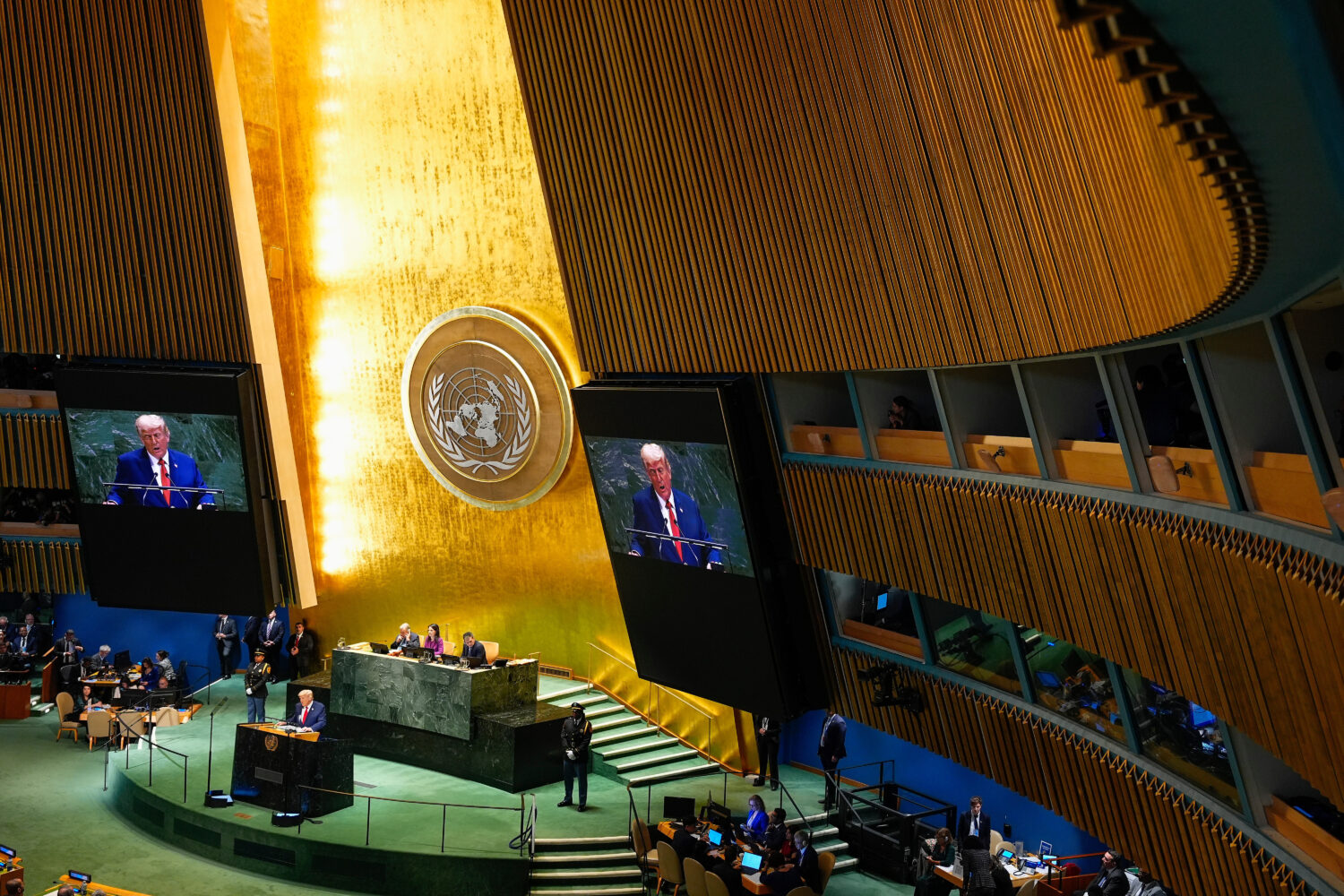
FILE - President Donald Trump address the 80th session of the United Nations General Assembly, Tuesday, Sept. 23, 2025, at U.N. headquarters. (AP Photo/Yuki Iwamura, File)
Credit: ASSOCIATED PRESS
(AP Photo/Yuki Iwamura, File)

NEW YORK (AP) — It’s not polite, as a general rule, to visit your hosts and criticize the way they do things. Unless, that is, you’re helping to pay the rent.
World leaders have spent the past week at the United Nations doing just that, convening at its grandiloquent headquarters to tell each other — and those who administer the planet’s most prominent global institution — that the foundational pillars are cracked, outdated and not in good working order.
Some version of this happens every year. It’s part of the overall theater. Leaders point out the U.N.’s flaws and tell it to buckle down and get things done. Then, at the end of speeches, they congratulate themselves for doing important work and go home saying, effectively, “Good talk!” And the conversation pauses for a year.
Yet in recent years, as the United Nations increasingly becomes one of its members’ favorite subjects at the General Assembly, a particular turn of phrase has been emerging from world leaders’ mouths more and more, aimed at the U.N. itself. It can be mapped sort of like this: We need you, we support you, BUT …
And this year, with Secretary-General Antonio Guterres himself setting the bleak and critical tone after his team proposed major reforms for the instution’s 80th anniversary, the critiques from dozens of nations as they “address this august assembly” feel even more prominent and pointed than usual. Two particularly sharp comments this past week draw that notion out in stark relief.
“We must ask ourselves today: How has the U.N. lived up to expectations? And just look at the state of the world,” said Subrahmanyam Jaishankar, India’s foreign minister. “Where has the U.N. actually made a difference?”
And from Amara Camara, the foreign minister of Guinea: “The best years of our shared organization may be behind us.”
Can that truly be the case?
Much of the criticism focuses on the U.N. generally not getting things done and bending a knee to what Terrance Michael Drew, the prime minister of Saint Kitts and Nevis, called “the large and the loud” while effectively muzzling multiple smaller, quieter nations and thus undermining its mandate of multilateralism. But there are specific recurring complaints as well.
Among them: inequitable representation on the U.N. Security Council, where Africa has a particular beef. For three decades, it has been calling for a permanent, veto-empowered seat on the Security Council, which has only five permanent members while other nations rotate. Each year, African leaders express frustration about being treated with what Botswana President Duma Boko called “affable indifference.”
“We must free the Security Council from this humiliating paralysis,” said Mohamad Hasan, Malaysia’s foreign minister. “Reform is no longer a choice. It is imperative.”
The critical rhetoric came from all geographies. Day after day, leader after leader found things they didn’t like about the U.N. and its operations, even as they often couched it in praise.
“We have reason to honor what has been achieved: rights extended, ladders out of poverty raised, medicines and measures moved across borders,” Drew said. “Yet alongside those triumphs are truths we must not hide: partial pledges, procrastination and the persistent practice of putting profit before people. Where progress has been made, too often it has been piecemeal; where promises have been given, too often they have been broken.”
As with so many organizations, much of the most salient work goes on behind the scenes and even off site. The United Nations has hundreds of programs around the world that do on-the-ground good for many people facing all manner of challenges. And the performative nature of the U.N. General Assembly makes it sometimes politically expedient to criticize the United Nations when things in the world go bad. Certainly that’s what U.S. President Donald Trump, no fan of the U.N. for many years, did in his own speech.
“What is the purpose of the United Nations?” he said. “It has such tremendous, tremendous potential, but it’s not even coming close to living up to that potential, for the most part. At least for now, all they seem to do is write a really strongly worded letter and then never follow that letter up. It’s empty words, and empty words don’t solve war.”
He also added, pointedly: “All I got from the United Nations was an escalator that on the way up, stopped right in the middle.”
Amid the critiques, though, there were many acknowledgments of a different kind of responsibility — that of the nations that belong to it. “The U.N. is only the sum of its parts. Any lack of impact lies at the feet of member states. The solution is not to abandon it, but to fix it,” said Philip Davis, prime minister of the Bahamas.
And from Germany’s foreign minister, Johann Wadephul: “It is up to us — the member states. WE are the United Nations. We want these United Nations to be strong.”
Multilateralism, the main thread of the United Nations since its post-World War II founding, remains the organization’s cornerstone. It’s a particularly potent notion for less powerful states, which rely on the U.N. to level the playing field between smaller countries and the dominant powers.
But Trump’s all but complete rejection of multilateralism set the tone this year for this kind of wide frustration that the U.N. is a bloated functionary that doesn’t really fix things.
“Reform is not only about structures. It is about credibility. And credibility lives or dies with trust in multilateralism,” said Abdulla Khaleel, foreign minister of the Maldives. “That trust is eroding.”
Lurking behind many of the comments is the ghost of the League of Nations, the post-World War I prototype for the United Nations that collapsed under its own failure to prevent World War II and was replaced by the U.N. in 1946. “We all know of the League of Nations. We must not repeat it,” said Romania’s foreign minister, Oana-Silvia Toiu.
Ultimately, the United Nations may be an aspirational institution more than anything else. It is the embodiment of a era past, yes — but also an ever-receding dream that people might be able to stop fighting by working together. Even if the house is, and to some extent always remains, not quite ready for company. And in the meantime, talking bluntly about the problems during such a chaotic epoch stands as one way to nudge the path forward, even if it takes some serious pokes.
“What the U.N. has achieved so far is not a minor feat. They are the very essence of our shared humanity,” said Dato Erywan Pehin Yusof, the foreign minister of Brunei. “Yet we would be dishonest to speak only of successes.”
___
Ted Anthony has written about international affairs for The Associated Press since 1995 and has overseen coverage of the U.N. General Assembly’s annual leaders’ meetings since 2018.