Georgia proposal could take DNA swabs from immigrants in custody for minor offenses
Mar 30, 2026, 9:07 PM
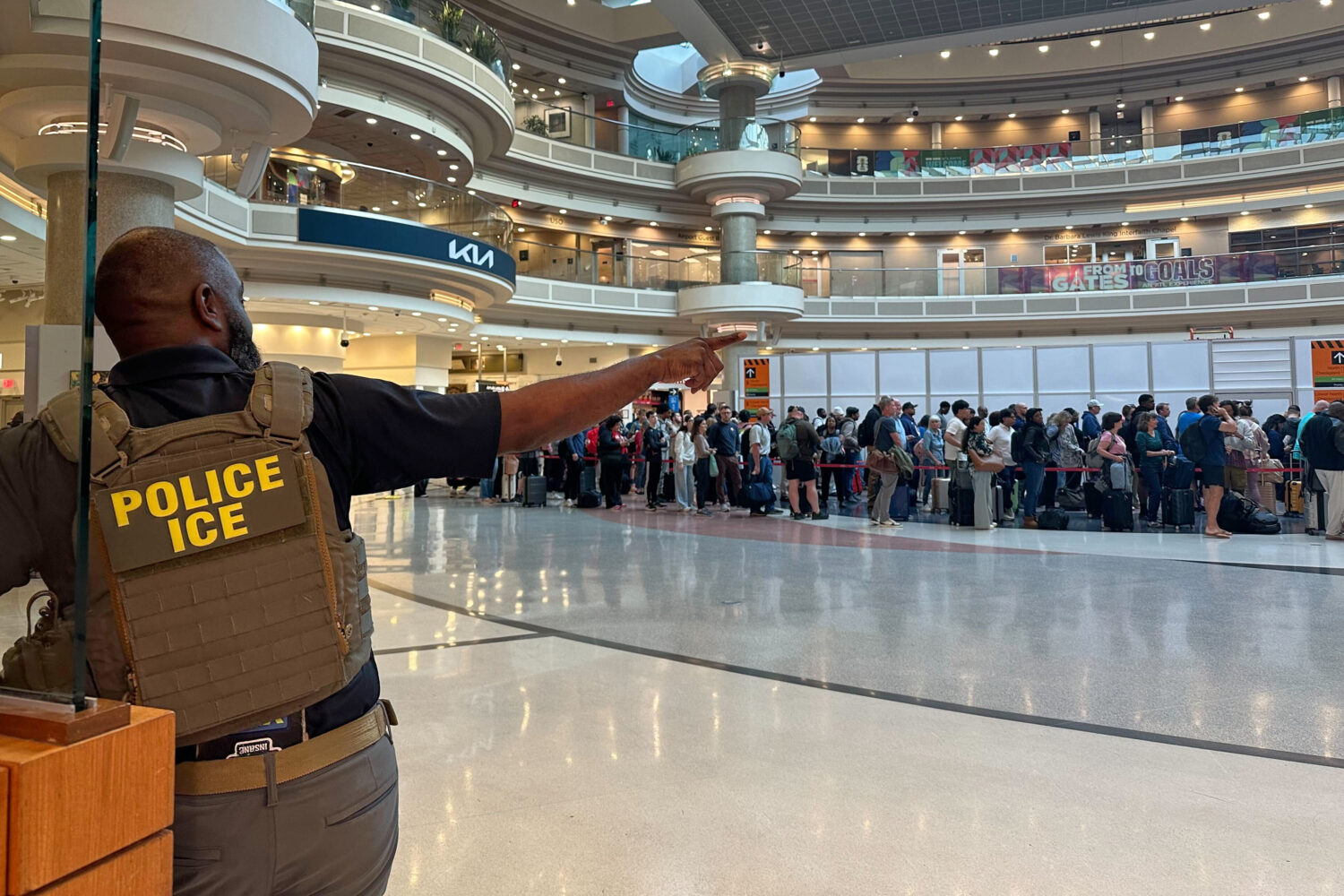
A federal immigration agent is seen as people wait in a TSA line at the Hartsfield-Jackson Atlanta International Airport, Monday, March 23, 2026, in Atlanta. (AP Photo/Emilie Megnien)
Credit: ASSOCIATED PRESS
(AP Photo/Emilie Megnien)

ATLANTA (AP) — Over the past three decades, the collection of DNA from convicted criminals has become standard in the U.S. justice system, and many states now also swab people arrested for serious crimes.
Legislation awaiting a final vote in Georgia would take that a step further by collecting DNA from people charged with less serious misdemeanors — but only if federal immigration authorities want them detained. That could include immigrants not ultimately deported.
If enacted, Georgia’s measure would make it the third state to single out immigrants believed to be in the U.S. illegally for the collection of genetic material that wouldn’t be taken from others. Florida passed a similar law in 2023. And Oklahoma in 2009 authorized DNA collection from immigrants in the U.S. illegally, though it remains subject to funding.
The new legislation comes as President Donald Trump’s administration seeks to expand its use of DNA and biometrics in immigration enforcement as it carries out a plan to deport millions of people from the U.S.
“It is one example of something we are seeing across the landscape, which is government actors at all levels vacuuming up DNA in all available contexts,” said Stevie Glaberson, director of research and advocacy at the Center on Privacy and Technology at Georgetown University law school.
The FBI launched the National DNA Index System in 1998 to compile DNA samples submitted by federal, state and local authorities. It’s grown in size and scope and now contains more than 26 million DNA profiles, many from people convicted of crimes.
A federal law enacted 20 years ago allowed the attorney general to expand DNA collection to people arrested and to noncitizens detained under federal authority. But because of exceptions authorized by federal officials, few immigrants had their DNA collected.
That changed in 2020, during Trump’s first term, when a new Department of Justice rule took away much of that discretion. Over the next five years, the Department of Homeland Security added the DNA profiles of more than 2.6 million detainees to the national database, according to an analysis by the Center on Privacy and Technology.
The department did not answer questions from The Associated Press about the percentage of detained immigrants whose DNA has been collected during Trump’s second term.
But the department is looking to expand its authority. A proposed rule would allow it to collect DNA, including from U.S. citizens, to determine family relationships in immigrant benefit cases.
Though many states collect DNA from people arrested for felonies, just 10 states collect it from people arrested for certain misdemeanors, such as sex offenses, and none collect it for all misdemeanor arrests, according to an AP analysis of data compiled by the Boise State University Department of Criminal Justice.
But under the Florida and Oklahoma laws, any arrest could lead to DNA collection for immigrants subject to federal detainer requests. Officials in the Florida Department of Law Enforcement and Oklahoma State Bureau of Investigation did not respond to questions about whether those laws are being used.
The Georgia legislation would require DNA collection from immigrants facing any misdemeanor or felony charges if U.S. Immigration and Customs Enforcement has issued a detainer request but has not picked up the person within 48 hours.
Georgia state Sen. Tim Bearden, a Republican sponsoring the bill, described the measure as a means of solving crimes.
“Technology is changing quickly, and DNA is one of those things that help us tremendously when we’re trying to make sure to bring justice to victims in this state and across this country,” Bearden said at a March hearing.
The Department of Homeland Security said in a statement that “partnerships with law enforcement are critical to having the resources we need to arrest criminal illegal aliens across the country.”
A 2024 Georgia law mandates that local law enforcement cooperate with federal authorities to identify and detain immigrants in the U.S. illegally, or else lose state funding. This year’s legislation would build upon that.
Some legal experts say it could result in DNA collections from immigrants taken into custody for minor violations. Traffic offenses that are penalized as civil violations in some states are considered misdemeanors in Georgia, making them subject to the new law, said Mazie Lynn Guertin, executive director and policy advocate with the Georgia Association of Criminal Defense Lawyers.
“We don’t think that swabbing a person who’s committed a traffic violation is a boon for public safety,” Guertin said. “The correlation between a broken tail light and a crime that’s solvable with DNA is pretty attenuated in most cases.”
People subject to federal immigration detainer requests aren’t necessarily undocumented or deportable, because they may later prove their legal presence, said Kyle Gomez-Leineweber, director of policy for Common Cause Georgia. But such people could have their DNA collected under the Georgia legislation.
“What this really does is it creates a two-tiered system where some of the DNA would be collected based off of the perception of an individual’s immigration status,” said Gomez-Leineweber.
The U.S. Supreme Court in 2013 upheld a Maryland law allowing DNA to be collected from people charged — but not yet convicted — of certain serious crimes. That law allows DNA to be added to a database after it’s determined there is probable cause to detain someone, provided it’s deleted if the person is not ultimately convicted.
The Maryland case often is cited as justification for an expansion of DNA collection. But some immigrant advocates question whether civil immigration detainers meet the probable cause threshold to make DNA collection acceptable under the U.S. Constitution’s Fourth Amendment protection against unreasonable searches and seizures.
“There doesn’t appear to be any kind of meaningful justification for states to step in to require the collection of DNA — of genetic material — from noncitizens in their custody who have merely been accused of a crime, even a low-level crime,” said Jorge Loweree, managing director of the American Immigration Council. “It seems like this is just an effort to increase the surveillance of noncitizens.”
___
Lieb reported from Jefferson City, Missouri. Kramon is a corps member for The Associated Press/Report for America Statehouse News Initiative. Report for America is a nonprofit national service program that places journalists in local newsrooms to report on undercovered issues.