How twin disasters reshaped Habitat for Humanity under CEO Jonathan Reckford in the past 20 years
Oct 24, 2025, 12:25 PM
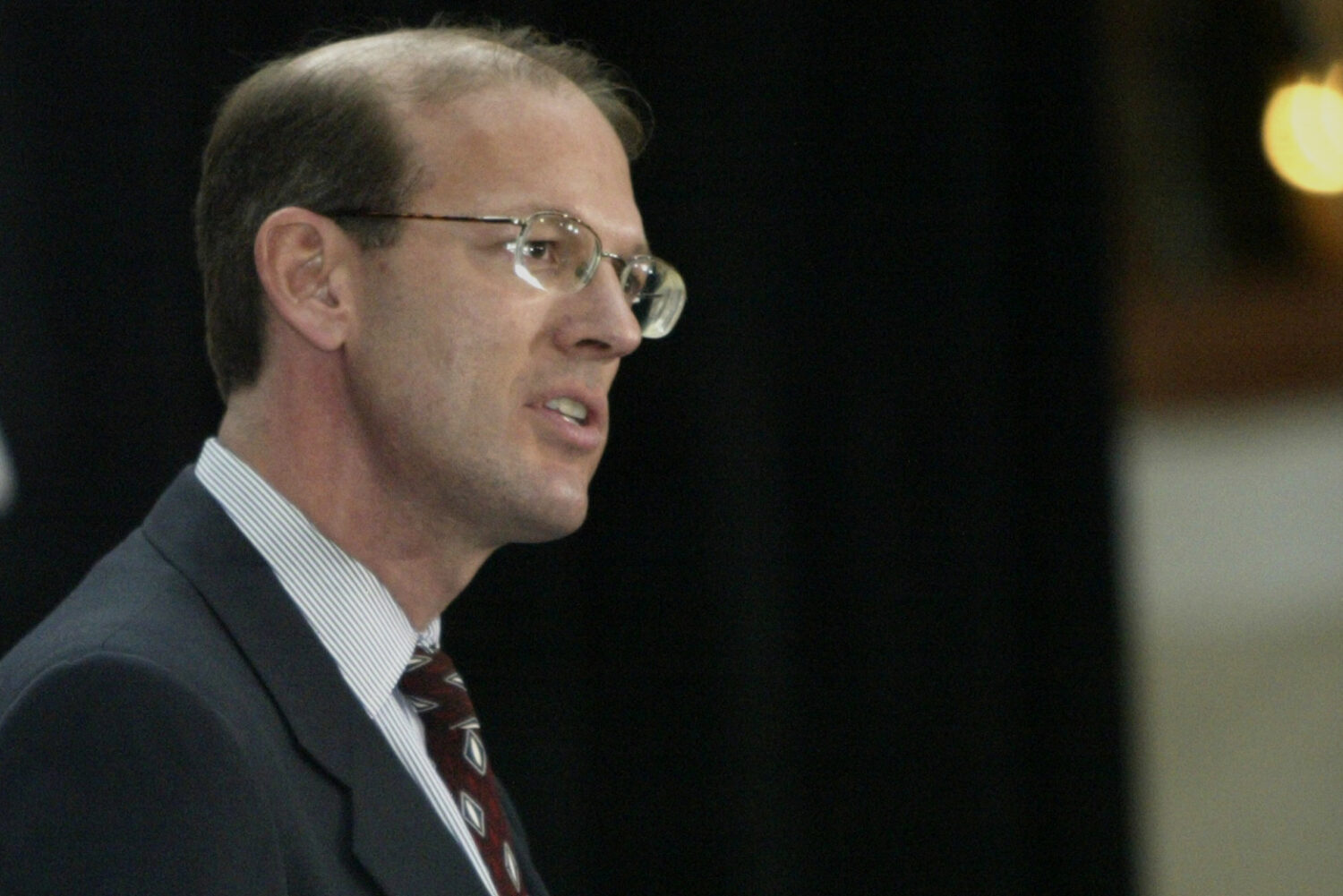
FILE - Habitat for Humanity International CEO Jonathan Reckford discusses the $6 million donation to Habitat for Humanity International by the Bank of America Charitable Foundation in Charlotte, N.C. Wednesday, April 11, 2007. (AP Photo/Nell Redmond, File)
Credit: ASSOCIATED PRESS
(AP Photo/Nell Redmond, File)

Jonathan Reckford jokes that before he became CEO of Habitat for Humanity International he couldn’t really keep a job.
In the two decades after he graduated from the University of North Carolina-Chapel Hill, Reckford had been a financial analyst at Goldman Sachs, coach of the Korean rowing team for the 1988 Olympics, and held executive and managerial positions at Marriott, Disney and Best Buy. He was executive pastor at Christ Presbyterian Church near Minneapolis, when he was recruited to lead Habitat in 2005.
What Reckford did not expect was how the twin disasters of the Indian Ocean tsunami and Hurricane Katrina would make the global housing nonprofit expand its work so quickly. Or that they would make building affordable housing such a major priority.
“It was an inflection point,” Reckford, 63, told The Associated Press in an interview. “Those two giant disasters forced Habitat to change in some ways that I think had long-term benefits. We were designed as a grassroots movement to build a few houses in thousands of locations. Suddenly, we needed to work at scale in a few countries in Asia and then across the Gulf Coast. I’m really proud of these enormous efforts.”
Reckford talked about other lessons learned in his 20 years leading Habitat, as he prepared for the annual in December – which will build 25 sustainable homes in Austin, Texas, starting on Oct. 26. The interview was edited for clarity and length.
Exactly. One thing we certainly see everywhere in the world — global North or global South — is it’s 5 to 7 times cheaper to invest in mitigation than it is to fix stuff after the disaster. Another thing for the public to know is about 80% of the funds after a big disaster go to the relief effort. You certainly need all of that relief effort. But then there’s very little left for long-term recovery. And the practical reality after these big disasters is that it’s a 10-year cycle, a 15-year cycle to really come back.
It does because we’re seeing more extreme weather. It’s not about politics. We’re having more flooding events and we have an insurance crisis from an affordability perspective. We’re investing in fortified housing. We always want to build relative to the risks in the area and we’ve had a really good record. We’re trying to do it to convince the insurance industry that families should get lower insurance payments because we’ve created safer housing. It’s just cost effective. It makes more sense to invest in lowering risk because it’s incredibly expensive to do the rescuing afterwards.
The day after I was announced, we drove and built the 200,000th Habitat home in Knoxville, Tennessee, and that meant Habitat had helped about a million people worldwide. As of last year, we’ve helped another 61 million people. A big piece of that I would say was changing our framing question from “How many houses can we build?” which was a really good question, to “What would it take to actually address the housing need?”
What we found, especially in middle- and low-income countries, is that only about 5-10% of the population have access to a bank loan for housing. We started lending money to microfinance banks and training them on how to do home improvement lending.
Those experiments went well enough that 12 years ago, we launched the MicroBuild Fund. We raised $100 million — borrowed $90 million of that, which was the first time we’d ever taken on debt — and now, 12 years later, we’re winding that fund down and getting ready to launch an even bigger fund.
The fund has loaned out $230 million to 56 microfinance banks in 36 countries. Those banks found their home loan repayment rates have been as good or better than their small business loans, so it’s created a new business channel for them. It’s directly helped a million people make home improvements.
And those banks have now put in $1.1 billion of their own capital, so we’ve actually started to show proof that there is a market opportunity for giving small unsecured home improvement loans to very low-income families to do home upgrades. This is scalable on a level that we can’t match. It’s a much greater number than we could ever build.
Yeah, I’m sad to say you’re right. I’ll give you an oversimplified, quick version of how I’ve seen this happen. We’ve always had an affordability challenge. But what’s really shocking in the last six years is how much worse it’s gotten.
If you go back to the housing crisis, lots has been written about what went wrong and how that sort of corrupted the whole housing value chain. But what really happened, in my view, is if you look at the small builders or the big builders after the housing crisis, the big builders got recapitalized and came back. The small builders didn’t. And they represented, depending on the market, 50-60% of the housing supply.
As we started under-building, initially, there was a ton of housing. But we had ten, 12 years of under-building by hundreds of thousands of units a year. The cumulative impact of that starts to add up. We need an “all of the above” approach to address that.
______
Associated Press coverage of philanthropy and nonprofits receives support through the AP’s collaboration with The Conversation US, with funding from Lilly Endowment Inc. The AP is solely responsible for this content. For all of AP’s philanthropy coverage, visit https://apnews.com/hub/philanthropy.