In Chicago, an immense show of force signals a sharp escalation in White House immigration crackdown
Oct 21, 2025, 7:01 AM
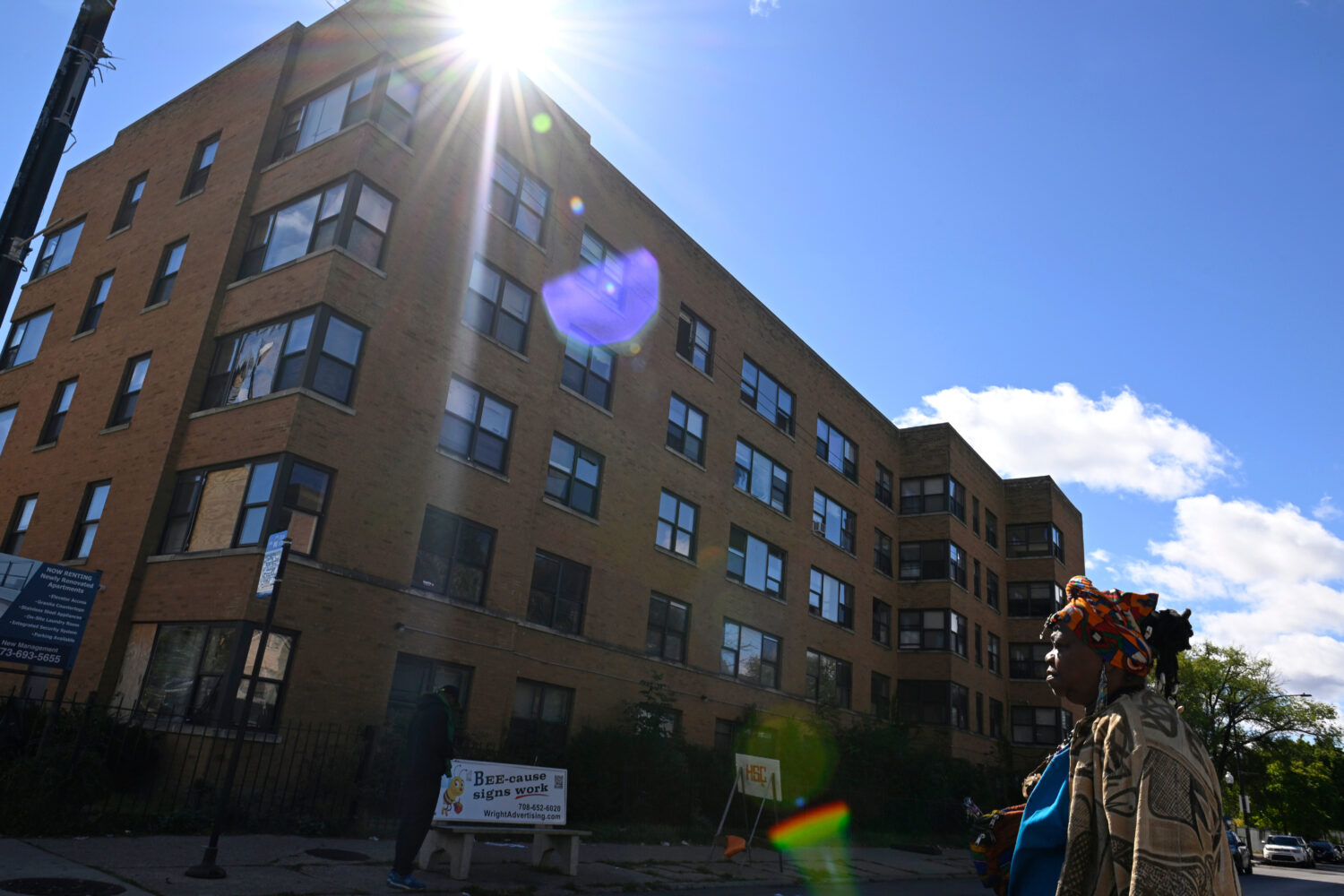
The apartment building at 7500 South Shore Drive in Chicago, which was raided by ICE agents is seen on Oct. 8, 2025. (AP Photo/Paul Beaty)
Credit: ASSOCIATED PRESS
(AP Photo/Paul Beaty)

CHICAGO (AP) — The music begins low and ominous, with the video showing searchlights skimming along a Chicago apartment building and heavily armed immigration agents storming inside. Guns are drawn. Unmarked cars fill the streets. Agents rappel from a Black Hawk helicopter.
But quickly the soundtrack grows more stirring and the video — edited into a series of dramatic shots and released by the Department of Homeland Security days after the Sept. 30 raid — shows agents leading away shirtless men, their hands zip-tied behind their backs.
Authorities said they were targeting the Venezuelan gang Tren de Aragua, though they also said only two of the 27 immigrants arrested were gang members. They gave few details on the arrests.
But the apartments of dozens of U.S. citizens were targeted, residents said, and at least a half-dozen Americans were held for hours.
The immense show of force signaled a sharp escalation in the White House’s immigration crackdown and amplified tensions in a city already on edge.
“To every criminal illegal alien: Darkness is no longer your ally,” Homeland Security said in a social media post accompanying the video, which racked up more than 6.4 million views. “We will find you.”
But Tony Wilson, a third-floor resident born and raised on Chicago’s South Side, sees only horror in what happened.
“It was like we were under attack,” Wilson said days after the raid, speaking through the hole where his door knob used to be. Agents had used a grinder to cut out the deadbolt, and he still couldn’t close the door properly, let alone lock it. So he had barricaded himself inside, blocking the door with furniture.
“I didn’t even hear them knock or nothing,” said Wilson, a 58-year-old U.S. citizen on disability.
The raid was executed in the heart of South Shore, an overwhelmingly Black neighborhood on Lake Michigan that has long been a tangle of middle-class dreams, urban decay and gentrification.
It’s a place where teams of drug dealers troll for customers outside ornate lakeside apartment buildings. It has some of the city’s best vegan restaurants but also takeout places where the catfish fillets are ordered through bullet-proof glass.
It has well-paid professors from the University of Chicago but is also where one-third of households scrape by on less than $25,000 a year.
The apartment building where the raid occurred has long been troubled. Five stories tall and built in the 1950s, residents said it was often strewn with garbage, the elevators rarely worked and crime was a constant worry. Things had grown more chaotic after dozens of Venezuelan migrants arrived in the past few years, residents said. While no residents said they felt threatened by the migrants, many described a rise in noise and hallway trash.
Owned by out-of-state investors, the building hasn’t passed an inspection in three years, with problems ranging from missing smoke detectors to the stench of urine to filthy stairways. Repeated calls to a lead investor in the limited liability company that owns the building, a Wisconsin resident named Trinity Flood, were not returned. Attempts to reach representatives through realtors and lawyers were also unsuccessful.
Crime fears spiked in June when a Venezuelan man was shot in the head “execution-style,” the Department of Homeland Security said in a statement. Another Venezuelan was charged in the death.
Days after the raid, the doors to dozens of the building’s 130 apartments hung open. Nearly all those apartments had been ransacked. Windows were broken, doors smashed, and clothes and diapers littered the floors. In one apartment, a white tuxedo jacket hung in the closet next to a room knee-deep in broken furniture, piles of clothing and plastic bags. In another, water dripping from the ceiling puddled next to a refrigerator lying on its side. Some kitchens swarmed with insects.
Wilson said a trio of men in body armor had zip-tied his hands and forced him outside with dozens of other people, most Latino. After being held for two hours he was told he could leave.
“It was terrible, man,” he said. He’d barely left the apartment in days.
Chicago, the White House says, is under siege.
Gang members and immigrants in the U.S. illegally swarm the city and crime is rampant, President Donald Trump insists. National Guard soldiers are needed to protect government facilities from raging left-wing protesters.
“Chicago is the worst and most dangerous city in the World,” he posted on Truth Social.
The reality is far less dramatic. Violence is rare at protests, though angry confrontations are increasingly common, particularly outside a federal immigration center in suburban Broadview. And while crime is a serious problem, the city’s murder rate has dropped by roughly half since the 1990s.
Those realities have not stopped the Trump administration.
What started in early September with some arrests in Latino neighborhoods, part of a crackdown dubbed “Operation Midway Blitz,” has surged across Chicago. There are increasing patrols by masked, armed agents; detentions of U.S. citizens and immigrants with legal status; a fatal shooting; a protesting pastor shot in the head with a pepper ball outside the Broadview facility, his arms raised in supplication.
By early October, authorities said more than 1,000 immigrants had been arrested across the area.
The raids have shaken Chicago.
“We have a rogue, reckless group of heavily armed, masked individuals roaming throughout our city,” Mayor Brandon Johnson said after the Sept. 30 raid. “The Trump administration is seeking to destabilize our city and promote chaos.”
To Trump’s critics, the crackdown is a calculated effort to stir anger in a city and state run by some of his most outspoken Democratic opponents. Out-of-control protests would reinforce Trump’s tough-on-crime image, they say, while embarrassing Johnson and Illinois Gov. JB Pritzker, seen as a possible Democratic presidential contender.
So the South Shore raid, ready-made for social media with its displays of military hardware and agents armed for combat, was seen as wildly out of proportion.
“This was a crazy-looking military response they put together for their reality show,” said LaVonte Stewart, who runs a South Shore sports program to steer young people away from violence. “It’s not like there are roving bands of Venezuelan teenagers out there.”
Officials insist it was no reality show.
The operation, led by U.S. Customs and Border Protection, was based on months of intelligence gathering, according to a U.S. official who was not authorized to discuss the matter publicly. The building’s landlord told authorities that Venezuelans in about 30 units were squatters and had threatened other tenants, the official said, adding that the building’s size necessitated the show of force. Immigration agencies declined further comment.
Even before the “Midway Blitz,” Trump’s election had whipsawed through Chicago’s Latino communities.
Stewart said Venezuelan children began disappearing from his programs months ago, though it’s often unclear if they moved, returned to Venezuela or are just staying home.
“I had 35 kids in my program from Venezuela,” he said. “Now there’s none.”
The raid echoed through South Shore, pinballing through memories of the surge in violence during the 1990s drug wars as well as economic divides and the sometimes uncomfortable relations between Black residents and the wave of more than 50,000 immigrants, most Latino, who began arriving in 2022, often bused from southern border states.
Chicago spent more than $300 million on housing and other services for the immigrants, fueling widespread resentment in South Shore and other Black neighborhoods where the newcomers were settled.
“They felt like these new arrivals received better treatment than people who were already part of the community,” said Kenneth Phelps, pastor at the Concord Missionary Baptist Church in Woodlawn, a largely Black neighborhood.
It didn’t matter that many migrants were crowded into small apartments, and most simply wanted to work. The message to residents, he said, was that the newcomers mattered more than they did.
Phelps tried to fight that perception, creating programs to help new arrivals and inviting them to his church. But that stirred more anger, including in his own congregation.
“I even had people leave the church,” he said.
In South Shore it’s easy to hear the bitterness, even though the neighborhood’s remaining migrants are a nearly invisible presence.
“They took everyone’s jobs!” said Rita Lopez, who manages neighborhood apartment buildings and recently stopped by the scene of the raid.
“The government gave all the money to them — and not to the Chicagoans,” she said.
Over more than a century, South Shore has drawn waves of Irish, Jewish and then Black arrivals for its lakeside location, affordable bungalows and early 20th-century apartment buildings.
Each wave viewed the next with suspicion, in many ways mirroring how Black South Shore residents saw the migrant influx.
Former first lady Michelle Obama’s parents moved to South Shore when it was still mostly white, and she watched it change. A neighborhood that was 96% white in 1950 was 96% Black by 1980.
“We were doing everything we were supposed to do — and better,” she said in 2019. “But when we moved in, white families moved out.”
But suspicion also came from South Shore’s Black middle-class, which watched nervously as many housing projects began closing in the 1990s, creating an influx of poorer residents.
“This has always been a complex community,” Stewart said of those years.
“You can live on a block here that’s super-clean, with really nice houses, then go one block away and there’s broken glass, trash everywhere and shootings,” he said. “It’s the weirdest thing and it’s been this way for 30 years.”
___
Associated Press reporters Aisha I. Jefferson in Chicago, Elliot Spagat in San Diego and Claudia Lauer in Philadelphia contributed to this report.