Many US Jewish adults have experienced assault or harassment over the past year, AP-NORC poll finds
Jul 10, 2026, 2:01 AM
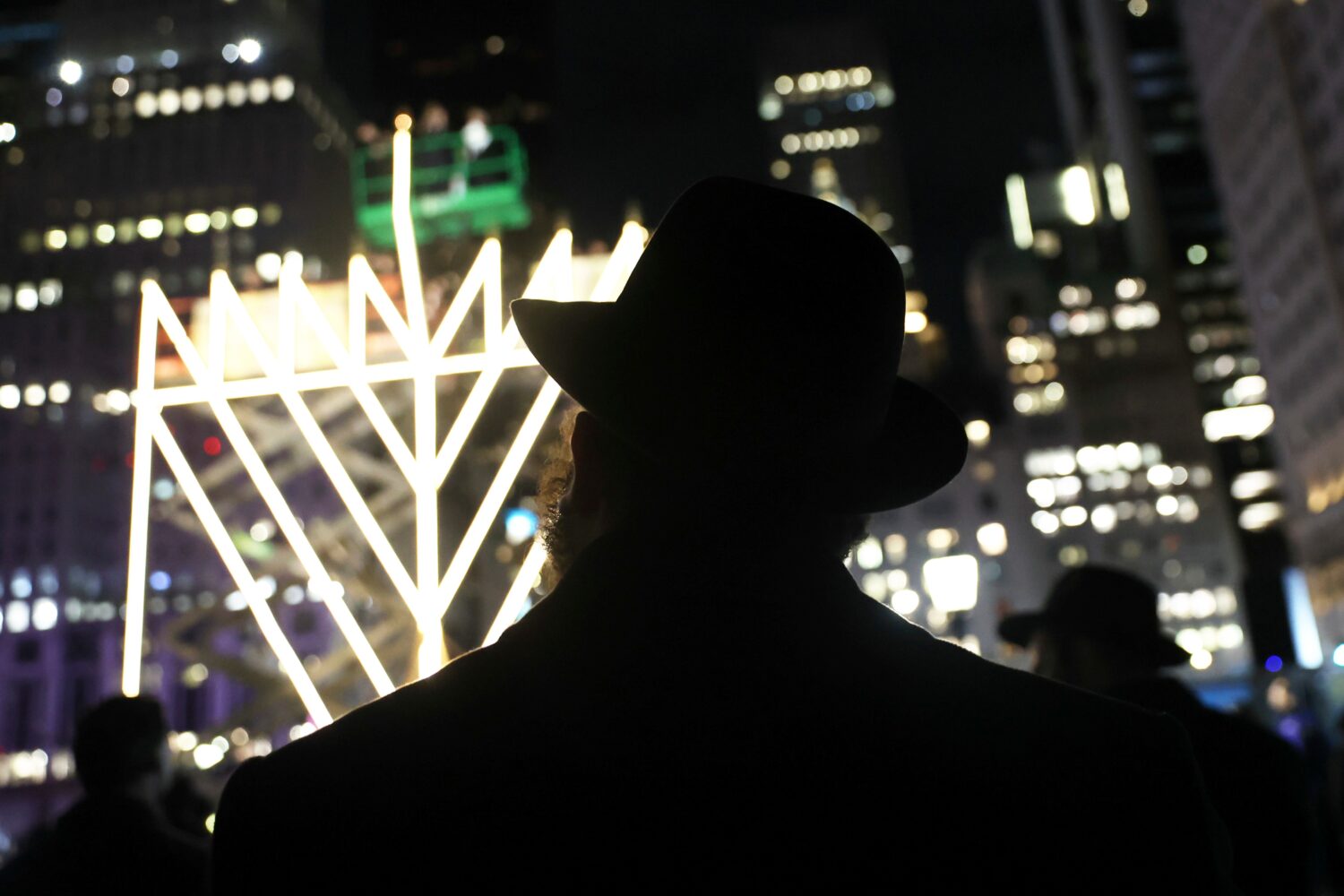
FILE - People watch the lighting of the world's largest menorah on Fifth Avenue by Central Park for the seventh night of Hanukkah, Dec. 31, 2024, in New York. (AP Photo/Heather Khalifa, File)
Credit: AP Photo/Heather Khalifa
(AP Photo/Heather Khalifa, File)

WASHINGTON (AP) — Many Jewish adults feel unsafe in the United States, a new AP-NORC poll finds, with a majority saying they feel less safe than they did before Hamas’ Oct. 7, 2023 attack on Israel.
The survey from The Associated Press-NORC Center for Public Affairs Research points to how Jewish adults’ attitudes toward their own personal safety have changed over a relatively short period as more Americans became critical of the United States’ close alliance with Israel. The war in Gaza sparked U.S. protests over Israel’s military actions against the Palestinians in Gaza, and coincided with an increase in violent attacks against U.S. Jewish communities.
The findings highlight the vulnerability that many Jewish adults in the U.S. feel as bipartisan support for Israel erodes and significant divides emerge within the Jewish community about what constitutes antisemitism — particularly when it comes to protesting Israel.
A significant share of Jewish adults, about 3 in 10, say they or someone in their household has experienced physical assault, verbal abuse, online harassment or damaged property because of their Jewish background over the last year, according to the survey.
Hal Guberman, a 30-year-old in New Jersey, wears a kippah with some trepidation ever since a stranger in a passing car yelled a slur at him when he was walking down the street last year.
“That person, they don’t know anything about me. They don’t know my politics. They don’t know my beliefs. They don’t know my viewpoints,” Guberman said. “But they saw me being visibly Jewish, and they made an opinion about me.”
About 6 in 10 Jewish adults say that prejudice against Jewish people is an “extremely” or “very” serious problem in the United States today, a view that is heightened among Jewish adults who say they are “extremely” or “very” emotionally attached to Israel.
About one-third of Jewish adults say they feel “very” or “somewhat” safe as a Jewish person in the U.S. today, while about one-third feel “very” or “somewhat” unsafe. The remaining roughly 3 in 10 say they feel neither safe nor unsafe. Those with a close connection to Israel or who identify as Jewish by religion — instead of saying they are religiously unaffiliated with a cultural, ethnic or family connection to Judaism — are more likely to feel threatened in the current environment.
About 6 in 10 Jewish adults say they feel “less safe” as a Jewish person in the U.S. than they did before Hamas’ 2023 attack, including about 7 in 10 of those who are religiously Jewish. About one-third of Jewish adults say they feel “about as safe” and very few feel safer.
Erin Baskin, a 36-year-old in Pennsylvania, said the Oct. 7 attacks didn’t change how safe she feels because she had her own experiences with prejudice before then.
“I’ve always grown up with antisemitism,” she said. “Among the rural community I’m in, they conflate Judaism with Zionism all the time. Unfortunately, that’s kind of been my experience. It’s nothing new.”
Some Jewish adults have grown wary of outwardly identifying themselves as Jewish following the Oct. 7 attacks, the survey found.
About 4 in 10 Jewish adults say they are “less likely” to wear, carry or display things that might identify them as a Jewish person than they were before Hamas’ Oct. 7 attack. About half say they are “about as likely” and about 1 in 10 say they are “more likely.”
Caitlin Rosendorn, a 24-year-old in Illinois, said she used to wear a Star of David necklace, but she worries now that wearing it could give people the incorrect impression that she supports Israel’s attacks against the Palestinian people.
“I don’t want to wear a Star of David to work if that’s going to alienate somebody who sees the Star of David as a symbol of Israel as opposed to a symbol of Judaism,” she said. “I don’t want people to get the wrong idea about my views.”
About 1 in 10 Jewish adults say that in the past year, they or someone in their household has been physically assaulted. A similar share had property damaged or destroyed specifically because of their Jewish background.
About 2 in 10 Jewish adults say they or someone in their household has been called a slur, threatened, verbally harassed or verbally abused. Similarly, about 2 in 10 say they experienced online harassment or cyberbullying. Overall, about 3 in 10 of Jewish adults say that they or someone in their household has experienced at least one of these incidents because of their Jewish background.
Jewish adults who attend religious services at least once a month are much likelier than Jewish adults overall to say they or someone in their household has experienced attacks or harassment over their Jewish background — a finding that comes as there have been several targeted attacks on Jewish religious spaces in recent years.
Slightly less than half of Jewish adults who frequently attend religious services say they or someone in their household has faced verbal harassment. A similar share experienced online harassment, and about one-quarter have dealt with physical attacks or property damage.
Jon Kessler, 38, of California, who grew up in the Conservative tradition of Judaism, believes non-Jews might be surprised at the extent to which Jewish adults have to consider security at community events.
“Most people when they go to church don’t have armed security, but every synagogue has an armed security guard,” Kessler said. “My son’s Jewish daycare has an armed security guard.”
Protests surrounding speakers tied to Israel — whether Israeli Prime Minister Benjamin Netanahyu’s address to Congress or college speakers seen as either too supportive or too critical of the country — became more common following the backlash over Israel’s war in Gaza.
Jewish adults, in particular, are divided over whether protesting an event related to Israel is an act of prejudice against Jewish people generally. About half of Jewish adults say anti-Israel protests are not a form of antisemitism, but roughly 4 in 10 say they are.
Many anti-Israel protests have been tied to criticism of Israel’s military action in Gaza. More than 73,000 Palestinians have died in Gaza since Israel retaliated against Hamas’ attack in 2023, according to the Hamas-run Gaza Health Ministry, which doesn’t distinguish between civilian and militant deaths.
About two-thirds of Jewish adults say criticizing Israel for its military actions is not a form of antisemitism, but Jewish adults with a close emotional connection to Israel are more likely to say that criticism of Israel’s military actions is antisemitic. That said, relatively few Jewish adults say it’s antisemitic just to criticize Israel for “any reason.”
Americans overall are less likely to say it’s antisemitic to protest an event that is supportive of Israel, or to criticize Israel’s military actions — but they are also much less likely to have an opinion.
Jewish adults are more unified in deeming some actions as definitively antisemitic. The overwhelming majority say vandalizing synagogues or Jewish-owned businesses because of Israel’s actions is antisemitism. The same goes for denying the reality or scope of the Holocaust, putting responsibility for Israel’s actions on Jewish people in the United States, saying Israel shouldn’t exist as a Jewish state or claiming American Jews are more loyal to Israel than to the U.S.
There is less consensus among non-Jewish U.S. adults on whether some of these actions constitute antisemitism, with many saying they’re not sure.
Amanda Goldsmith, 53, who lives in Chicago, believes people have become too comfortable expressing antisemitic views online — something that she previously thought only existed in extremist spaces.
“Now, it seems like there was an undercurrent, and it’s a free-for-all, and everyone is free to say what they want,” she said. “The freedom with which people say horrible things about Jewish people is appalling.”
___
Associated Press writer Giovanna Dell’Orto contributed from Minneapolis. Associated Press writer Peter Smith contributed from Pittsburgh.
___
Associated Press religion coverage receives support through the AP’s collaboration with The Conversation US, with funding from Lilly Endowment Inc. The AP is solely responsible for this content.
___
The AP-NORC poll of 3,040 adults was conducted June 11-17 using a sample drawn from NORC’s probability-based AmeriSpeak Panel, which is designed to be representative of the U.S. population. The poll included interviews with 1,022 Jewish adults. The margin of sampling error for adults overall is plus or minus 2.8 percentage points and the margin of sampling error for Jewish adults is plus or minus 5.0 percentage points.