Native American radio stations at risk as Congress looks to cut $1B in public broadcasting funding
Jul 15, 2025, 9:06 PM
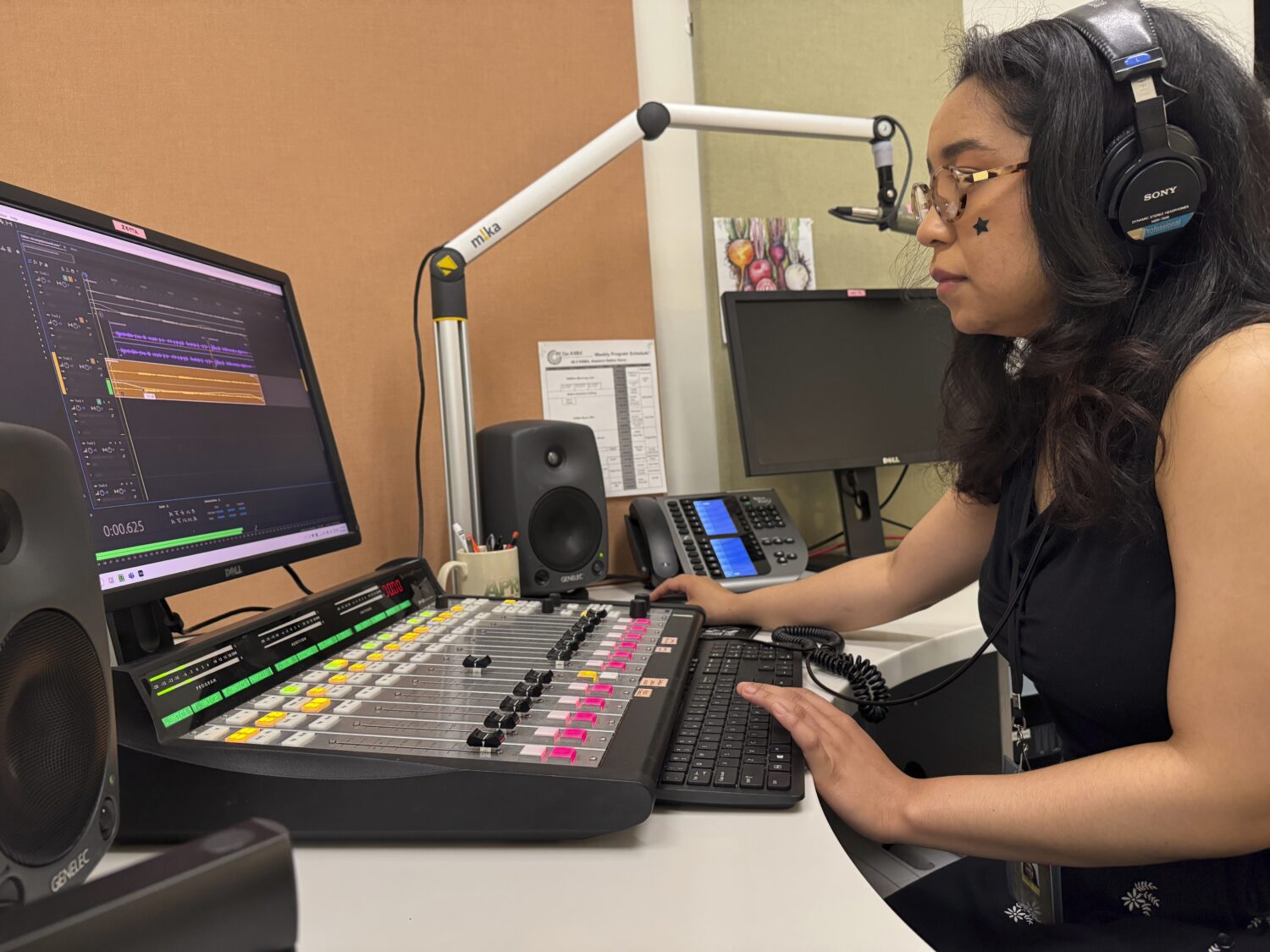
Elayna Cunningham, a college student interning at Koahnic Broadcast Corp., records a program on July 10, 2025, at the Anchorage, Alaska, studios of KNBA, the flagship station for National Native News. (AP Photo/Mark Thiessen)
Credit: ASSOCIATED PRESS
(AP Photo/Mark Thiessen)

OMAHA, Neb. (AP) — Dozens of Native American radio stations across the country vital to tribal communities will be at risk of going off the air if Congress cuts more than $1 billion from the Corporation for Public Broadcasting, according to industry leaders.
The U.S. Senate is set to vote this week on whether to approve the Department of Government Efficiency’s plan to rescind previously approved public broadcasting funding for 2026 and 2027. Fear is growing that most of the 59 tribal radio stations that receive the funding will go dark, depriving isolated populations of news, local events and critical weather alerts. The House already approved the cuts last month.
“For Indian Country in general, 80% of the communities are rural, and their only access to national news, native story sharing, community news, whatever it is, is through PBS stations or public radio,” said Francene Blythe-Lewis, CEO of the Lincoln, Nebraska-based Native American video programming producer Vision Maker Media. “If the claw back happens, I would say a good 90% of those stations will cease to exist.”
Local radio plays an outsized role in the lives of many who live in Indigenous communities, where cable television and broadband internet access are spotty, at best, and nonexistent for many. That leaves over-the-air TV stations — usually a PBS station — and more often local radio to provide local news, community event details and music by Indigenous artists. Sometimes the news is delivered in Indigenous languages.
“It means we’re not going to hear our language on the radio,” Blythe-Lewis said.
Flagstaff, Arizona-based Native Public Media, which supports the network of 59 radio stations and three television stations serving tribal nations across the country, said about three dozen of those radio stations that rely heavily on Corporation for Public Broadcasting funding will be the first to go dark if funding is cut for the coming fiscal year that starts Oct. 1.
Loris Taylor, CEO of Native Public Media, said in an op-ed that the tribal stations reach more than 1.5 million people and “may be the only source of locally relevant news, emergency alerts, public safety announcements, language preservation, health information and election coverage.”
GOP senators are under pressure from President Donald Trump, who promised last week on his Truth Social platform that any Republican who votes against the cuts “will not have my support or Endorsement.”
Many Republicans say the public media system is politically biased and an unnecessary expense. Sen. Eric Schmitt, a Republican from Missouri, recently defended the cuts as necessary to hack away at the nearly $37 trillion national debt, adding, “It is critical in restoring trust in government.”
But some Republicans have pushed back, such as Maine Sen. Susan Collins, who questioned the proposed cuts last month during a Senate committee hearing. She said that while some of the federal money is assigned to National Public Radio and the Public Broadcasting System, most of it goes to locally owned public radio and television stations.
Jaclyn Sallee is president and CEO of Koahnic Broadcast Corporation and KNBA, its radio station in Anchorage, Alaska. Koahnic produces National Native News, a five-minute daily newscast that features headline news from across Indian Country, and Native America Calling, a daily hourlong call-in program, for about 190 stations across the nation. It also produces Indigefi, a music program in Indigenous languages.
KNBA is on Native Public Media’s list of those stations that would be most affected by the federal funding cuts — a concern Sallee confirmed, as 40% of the station’s funding comes from CPB.
“What we’re really worried about are the rural stations in Alaska where they may be the only station in the community,” she said. “The people that live there depend on the station for vital weather alerts, emergency alerts; it’s the local hub of the community where people share information. So that is very troublesome because people’s lives are at risk without this service.”
It’s currently fishing season in Alaska, she said, “which means getting out in the ocean or in rivers and going long distances to subsist, and so they really rely on weather reports.”
Having the news reported in a tribe’s language isn’t just about preserving that language, she said. Sallee spent summers in Nome with her mother’s family. Her grandmother, she said, spoke only Inupiaq.
New Mexico PBS’s signal reaches all but one of the more than 20 tribes and pueblos in the state. It also has signed an agreement with the Navajo Nation, which has the largest reservation of any tribe in the U.S., that allows the tribe to carry the PBS signal and programming on the Navajo Nation Television network, New Mexico PBS general manger Franz Joachim said.
“It’s no question in my mind that, you know, immediately some stations will pretty much go dark,” Joachim said.
When those first stations fail, it won’t take long for others to follow, Joachim said. And as they do, it will mean fewer and fewer stations left to pay membership dues that also help fund all of the stations.
“So now the whole system starts to fracture,” he said. “So for me, the federal funding is really about the system as a whole that keeps us in place.”
That funding also helps produce national content that groups like Vision Maker Media produce. Those include Native American documentaries shown on PBS like “Mankiller,” the story of Wilma Mankiller who became the first woman elected principal chief of the Cherokee Nation.
Blythe-Lewis compared the potential loss of tribal stations to the country’s past attempts to erase Native American cultures, such as through federal boarding schools where Indigenous children were sent for generations to assimilate them into white society and where systemic abuse of Indigenous children was carried out.
“We’re erased from public media and therefore invisible and therefore become unknown and unheard of,” she said.