Presidents vs. Congress: Trump is only the latest to test the War Powers Act
Jun 24, 2025, 7:01 AM
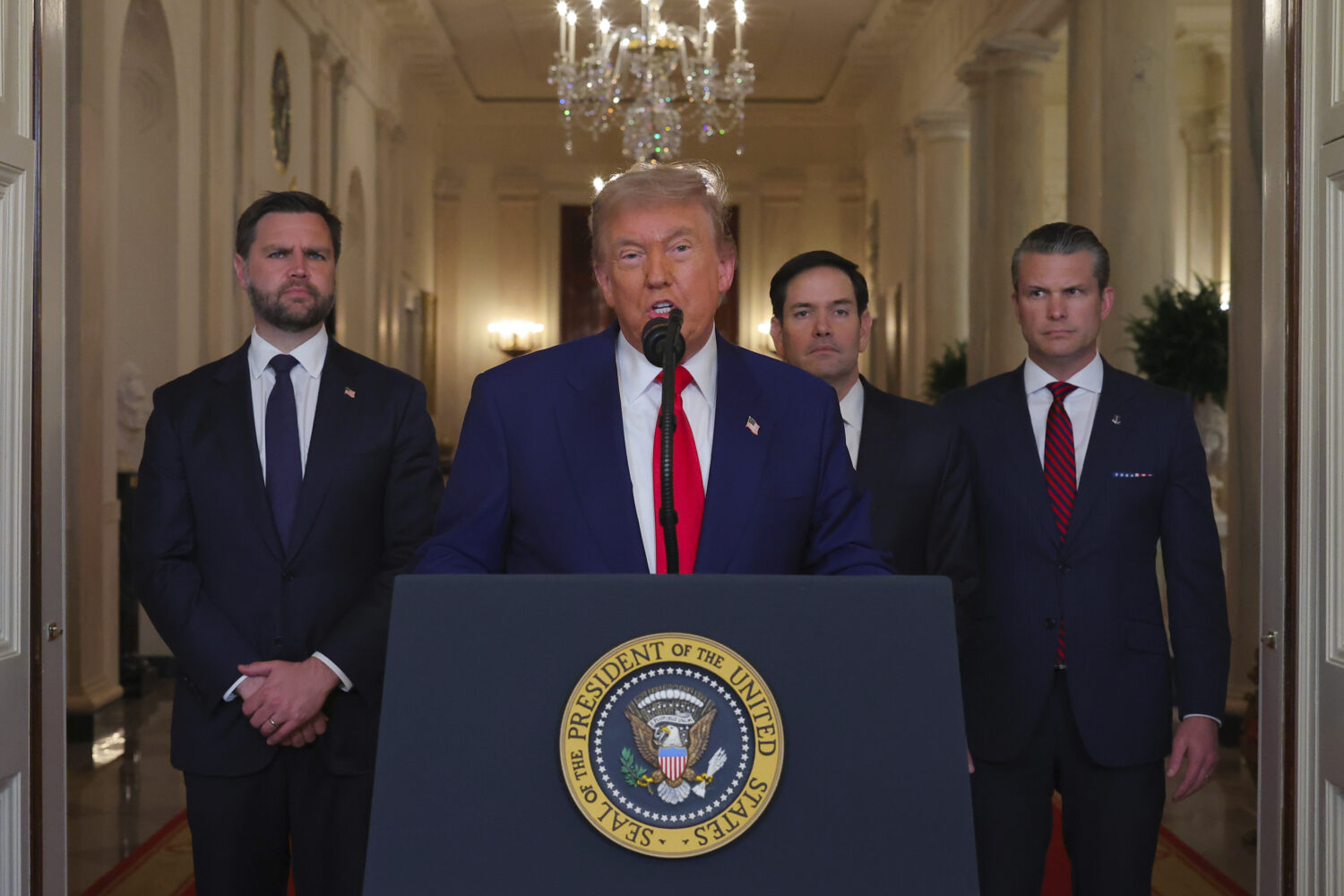
President Donald Trump speaks from the East Room of the White House in Washington, Saturday, June 21, 2025, after the U.S. military struck three Iranian nuclear and military sites, directly joining Israel's effort to decapitate the country's nuclear program, as Vice President JD Vance, Secretary of State Marco Rubio and Defense Secretary Pete Hegseth listen. (Carlos Barria/Pool via AP)
Credit: ASSOCIATED PRESS
(Carlos Barria/Pool via AP)

WASHINGTON (AP) — FOR TUESDAY MORNING – file around 10am ET or so
Donald Trump isn’t the first president to order military strikes without congressional approval. But his decision to bomb Iran comes at a uniquely volatile moment — both at home and abroad.
Overseas, the U.S. risks deeper entanglement in the Middle East if fighting erupts again between Israel and Iran. At home, Trump continues to sidestep oversight, showing little regard for checks and balances.
His move has reignited a decades-old debate over the War Powers Act, a law passed in the early 1970s meant to divide authority over military action between Congress and the president. Critics say Trump violated the act by striking with little input from Congress, while supporters argue he responded to an imminent threat and is looking to avoid prolonged conflict.
Even after Trump announced late Monday that a “complete and total ceasefire” between Israel and Iran would take effect over the next 24 hours, tensions remained high in Congress over Trump’s action. A vote is expected in the Senate later this week on a Democratic Iran war powers resolution that is meant to place a check on Trump when it comes to further entanglement with Iran.
Here’s a closer look at what the act does and doesn’t do, how past presidents have tested it and how Congress plans to respond:
Passed in the wake of American involvement in Vietnam, the War Powers Resolution prescribes how the president should work with lawmakers to deploy troops if Congress hasn’t already issued a declaration of war.
It states that the framers of the Constitution intended for Congress and the President to use its “collective judgement” to send troops into “hostilities.” The War Powers Resolution calls for the president “in every possible instance” to “consult with Congress before introducing United States Armed Forces.”
But when Congress enacted the law, “it didn’t install any hard requirements, and it provided a lot of outs,” said Scott Anderson, a fellow at the Brookings Institution.
“Habitual practice for presidents in the last few decades has been to minimally — almost not at all — consult with Congress on a lot of military action,” Anderson said. And “the language of the statute is so vague and open-ended that it’s hard to say it’s in clear contradiction” to the War Powers Resolution.
Unless a Declaration of War has already been passed or Congress has authorized deploying forces, the president has 48 hours after deploying troops to send a written report to congressional leadership explaining the decision. Trump did so on Monday, sending Congress a letter that said strikes on Iran over the weekend were “limited in scope and purpose” and “designed to minimize casualties, deter future attacks and limit the risk of escalation.”
In March, when Trump ordered airstrikes in Houthi-held areas in Yemen, he wrote a letter to congressional leadership explaining his rationale and reviewing his orders to the Department of Defense. President Joe Biden wrote nearly 20 letters citing the War Powers Resolution during his term.
If Congress doesn’t authorize further action within 60 to 90 days, the resolution requires that the president “terminate any use” of the armed forces. “That’s the hard requirement of the War Powers Resolution,” Anderson said.
Congress hasn’t declared war on another country since World War II, but U.S. presidents have filed scores of reports pursuant to the War Powers Resolution since it was enacted in 1973, over President Richard Nixon’s veto.
Presidents have seized upon some of the vague wording in the War Powers Resolution to justify their actions abroad. In 1980, for example, Jimmy Carter argued that attempting to rescue hostages from Iran didn’t require a consultation with Congress, since it wasn’t an act of war, according to the Congressional Research Service.
President George W. Bush invoked war powers in the weeks after the Sept. 11, 2001, attacks and persuaded Congress to approve an authorization for the use of military force against Iraq in 2002.
Throughout his presidency, President Barack Obama faced pressure to cease operations in Libya after 90 days. But his administration argued that the U.S. use of airpower in Libya didn’t rise to the level of “hostilities” set forth in the War Powers Resolution.
Trump’s actions in Iran have drawn the loudest praise from the right and the sharpest rebukes from the left. But the response hasn’t broken cleanly along party lines.
Daily developments have also complicated matters. Trump on Sunday raised the possibility of a change in leadership in Iran, before on Monday announcing that Israel and Iran had agreed to a “complete and total” ceasefire to be phased in over the next 24 hours.
Nevertheless, the Senate could vote as soon as this week on a resolution directing the removal of U.S. forces from hostilities against Iran that have not been authorized by Congress.
Sen. Tim Kaine, D-Va., the bill’s sponsor, told reporters Monday — prior to the ceasefire announcement — that the vote could come “as early as Wednesday, as late as Friday.” He expects bipartisan backing, though support is still coming together ahead of a classified briefing for senators on Tuesday.
“There will be Republicans who will support it,” Kaine said. “Exactly how many, I don’t know.”
He added that, “this is as fluid a vote as I’ve been involved with during my time here, because the facts are changing every day.”
Passing the resolution could prove difficult, especially with Republicans praising Trump after news of the ceasefire broke. Even prior to that, Senate Majority Leader John Thune, R-S.D., defended Trump’s actions on Monday and said he’s operating within his authority.
“There’s always a tension between Congress’ power to declare war and the president’s power as commander in chief,” said Sen. John Kennedy, R-La. “But I think the White House contacted its people, as many people as they could.”
A similar bipartisan resolution in the House — led by Democratic Rep. Ro Khanna and Republican Rep. Thomas Massie — could follow soon, although Massie signaled Monday that he may no longer pursue it if peace has been reached.
Khanna was undeterred.
“In case of a conflict in the future, we need to be on record saying no offensive war in Iran without prior authorization,” Khanna said. “We still need a vote.”
___
Associated Press writers Mary Clare Jalonick and Matt Brown contributed to this report.