NATIONAL NEWS

Supreme Court rules constitutional privacy protections apply to cellphone users location history

Jun 29, 2026, 10:37 AM
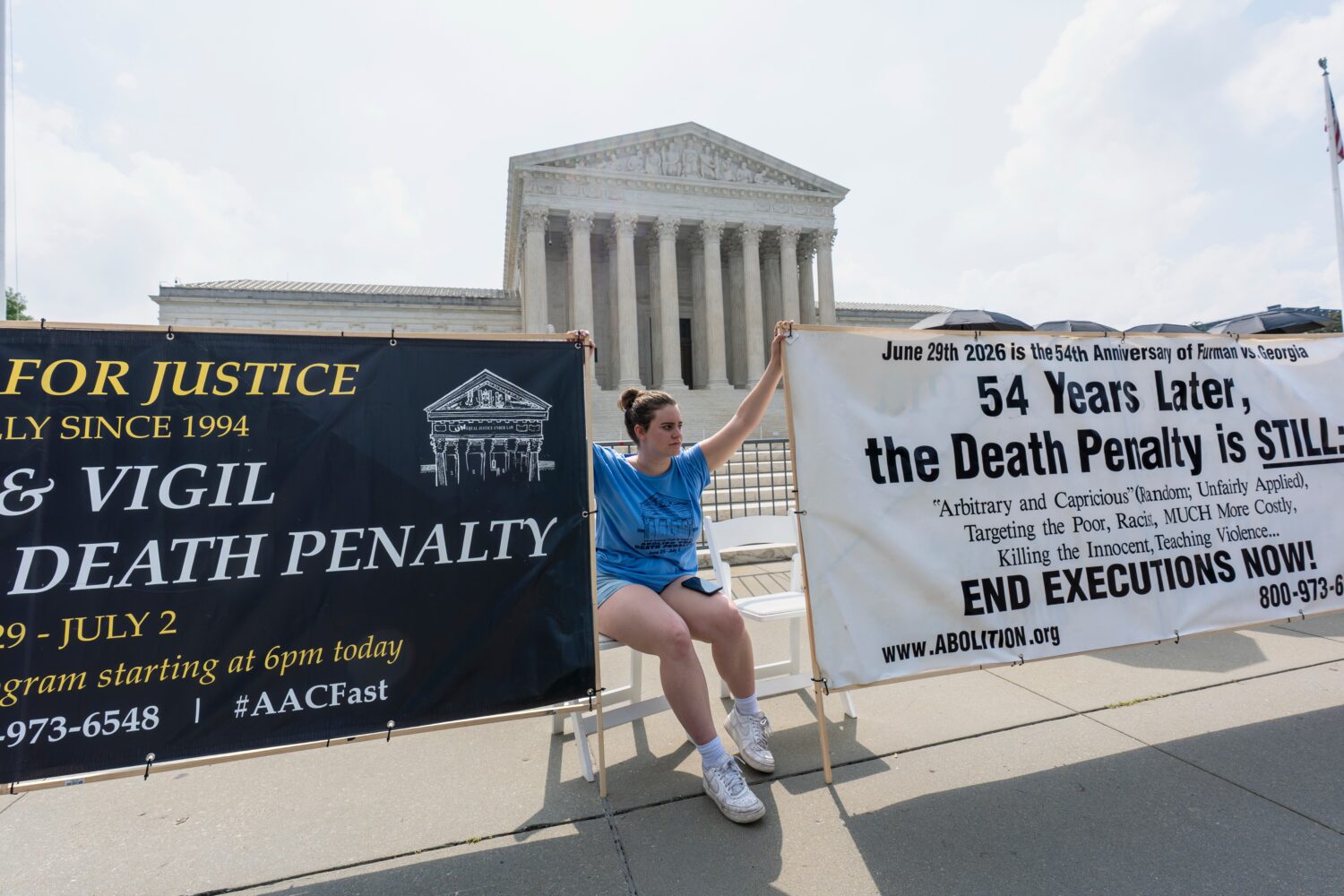
Activists and demonstrators wait outside the Supreme Court for the Justices to release opinions, in...

Activists and demonstrators wait outside the Supreme Court for the Justices to release opinions, in Washington, Monday, June 29, 2026. (AP Photo/J. Scott Applewhite)
Credit: AP Photo/J. Scott Applewhite

(AP Photo/J. Scott Applewhite)

WASHINGTON (AP) — The Supreme Court held Monday that constitutional privacy protections extend to cellphone location information, ruling in the case of a bank robber whose identity was discovered through a geofence warrant.

Justice Elena Kagan wrote for the 6-3 court that people don’t forfeit expectations of privacy even when they opt into Google’s location history.

“A cellphone user is not to be viewed as sharing private information with third parties—which then can be freely passed on to the government—just by doing the ordinary things cellphone users do,” Kagan wrote.

Justice Samuel Alito wrote in dissent that Okello Chatrie had no expectation of privacy in information he voluntarily turned over to Google.

The decision is the court’s latest effort to apply a constitutional provision ratified in 1791 to technology the nation’s founders could not have envisioned.

Police obtained a geofence warrant after a bank robbery in a suburb of Richmond, Virginia, and used it to locate cellphones that were near the bank around the time it was robbed in May 2019.

One of those phones belonged to Chatrie, who had eluded the police until they turned to the powerful technological tool.

The warrant kick-started the investigation. After determining that Chatrie was among those near the Call Federal Credit Union in Midlothian at the time, police obtained a search warrant for his home. They found nearly $100,000 in cash, including bills wrapped in bands signed by the bank teller.

Chatrie pleaded guilty to robbing the bank and was sentenced to nearly 12 years in prison. His lawyers argued on appeal that none of the evidence should have been used against him.

They challenged the warrant as a violation of his privacy because it allowed authorities to gather the location history of people near the bank without having any evidence they had anything to do with the robbery. Prosecutors argued that Chatrie had no expectation of privacy because he voluntarily opted into Google’s location history.

The Supreme Court did not decide Monday whether the search complied with the Fourth Amendment, which bans unreasonable searches and seizures. It sent the case back to a lower court for more work.

A federal judge had ruled that the search violated Chatrie’s rights, but allowed the evidence to be used because the officer who applied for the warrant reasonably believed he was acting properly.

The federal appeals court in Richmond upheld the conviction in a fractured ruling. In a separate case, the federal appeals court in New Orleans ruled that geofence warrants “are general warrants categorically prohibited by the Fourth Amendment.”

National News

A Sikorsky Skycrane maneuvers into position to refill during efforts to fight the Widemouth 2 Fire ...

Associated Press

Dangerous wildfire keeps crews from reaching helicopter crash in Utah

A large Utah wildfire kept emergency responders from safely reaching the remote site of a helicopter crash on Saturday as other fires burned across several Western states, including one that closed part of Mount Rainier National Park. The Friday morning crash of a Sikorsky Skycrane helicopter in Utah’s Fishlake National Forest ignited a new fire […]

5 hours ago

FILE - A federal agent wears an Immigration and Customs Enforcement badge in New York, June 10, 202...

Associated Press

ICE takes issue with AP reporting on policy to release body-worn camera footage

WASHINGTON (AP) — The acting director of U.S. Immigration and Customs Enforcement took issue Saturday with reporting by The Associated Press on a policy to publicly release body-worn camera footage only when the agency determines it is in its “best interests.” David J. Venturella said ICE policy “clarifies that it’s not appropriate to release footage […]

7 hours ago

Sen. Darline Graham, R-S.C., from left, seated alongside daughter Nicole Nordone and husband Larry ...

Associated Press

Darline Graham tests value of a famous name vs. lack of experience in South Carolina primary

FLORENCE, S.C. (AP) — Few people have anything bad to say about Darline Graham, who was catapulted from obscurity last month when she was appointed to replace her late brother Lindsey Graham in the U.S. Senate. “I think Darline’s wonderful,” said Kathy Bustos of Mount Pleasant, after attending a Republican forum last week. But that […]

10 hours ago

Associated Press

Lake Mead hits historic low water level as Colorado River struggles

BOULDER CITY, Nev. (AP) — Lake Mead, the largest reservoir in the United States, has plummeted to its lowest water level since it was filled some 90 years ago, another sign of the crisis plaguing the Colorado River system. Water levels at the reservoir, which straddles the Arizona-Nevada border outside Las Vegas, hit 1,040.4 feet […]

12 hours ago

FILE - Bethsaida Sigaran, left, of Baltimore, her brother Jaime Sigaran, with American Rivers, and ...

Associated Press

A pillar of environmental enforcement is targeted by Trump and Musk’s AI company

WASHINGTON (AP) — Right-leaning legal activists along with Elon Musk ’s artificial intelligence company have brought sweeping challenges against a cornerstone of legal enforcement in the United States: the right of private groups, people and local governments to sue over violations of many major laws. Their argument, supported by the Trump administration, is that the […]

13 hours ago

FILE - Maine loggers Stacey Kelly, second from left, Troy Jackson, and Hilton Hafford are threatene...

Associated Press

How Troy Jackson went from Maine logger to the Democratic nominee for Senate against Susan Collins

ALLAGASH, Maine (AP) — Troy Jackson stood alongside a small group of loggers deep in the northern Maine woods and stared down State Police troopers who threatened to arrest them. The lumberjacks had used their trucks to block access to the Quebec border in protest of Canadian loggers who were stealing their jobs by working […]

13 hours ago

Supreme Court rules constitutional privacy protections apply to cellphone users location history