Takeaways as Congress sends tax and spending cuts bill to Trump’s desk
Jul 3, 2025, 12:11 PM
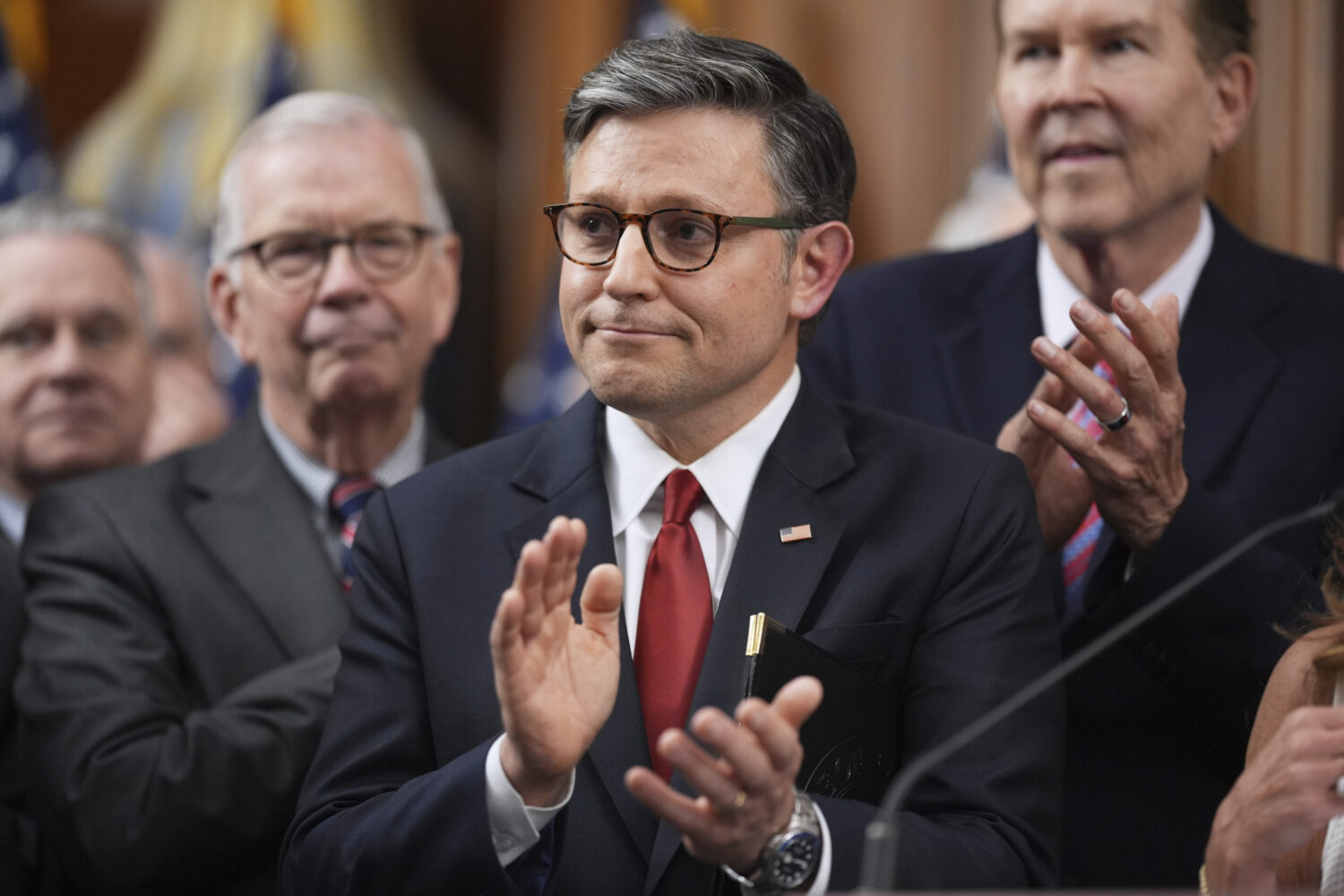
Speaker of the House Mike Johnson, R-La., is seen with other Republican House members after the passage of President Donald Trump's signature bill of tax breaks and spending cuts, at the Capitol in Washington, Thursday, July 3, 2025. (AP Photo/J. Scott Applewhite)
Credit: ASSOCIATED PRESS
(AP Photo/J. Scott Applewhite)

WASHINGTON (AP) — The House has passed the massive tax and spending cuts package that President Donald Trump calls “beautiful,” getting it to his desk a day before the July 4 deadline that he had set.
The 887-page bill includes spending cuts, tax breaks, military spending, money for deportations and other longtime GOP priorities like cuts to Medicaid and renewable energy programs. The Congressional Budget Office estimates that under the bill 11.8 million more Americans would become uninsured by 2034 and 3 million more would not qualify for food stamps, also known as SNAP benefits.
Some takeaways from Trump’s “big beautiful bill” and the path Republicans took to pass it:
By Congress time standards, the bill moved at lightning speed — reaching Trump’s desk less than six months into his term. That was only possible because Trump set a firm deadline, July 4 and pressured Republican lawmakers to get it done.
Few were left to resist, as most of Trump’s Republican critics over the years have either retired or lost reelection. Unfailingly loyal House and Senate Republicans were quick to make his priority their priority.
Plus, GOP lawmakers know they would suffer political consequences for dissent. One senator who did, Thom Tillis of North Carolina, abruptly announced on Sunday that he would retire next year — a day after saying he would oppose the legislation because of its reductions to health care programs.
“Tillis is a talker and complainer, NOT A DOER,” Trump had posted on X of Tillis.
Tillis joined Republican Sens. Susan Collins of Maine and Rand Paul of Kentucky in voting against the bill in the Senate. In the House, Reps. Brian Fitzpatrick of Pennsylvania and Thomas Massie of Kentucky were the only Republicans to vote against it.
Massie has also faced Trump’s wrath. “Massie is weak, ineffective, and votes “NO” on virtually everything put before him,” Trump posted last month.
The legislation’s passage was a direct outgrowth of the GOP election sweep that gave them the White House and majorities in both the House and the Senate. The so-called “trifecta” of power only comes around every so often, and Republicans were determined that it not go to waste.
Crucially, holding power in both chambers of Congress gave Republicans the option of using a budget procedure that overrides the Senate filibuster and allows the majority to pass legislation with only 51 votes. That meant no Democratic support was needed and they never had to involve them in the process.
Both parties have used the budget procedure to pass priorities over the years when they have found themselves with a similar trifecta — Democrats to pass the Affordable Care Act under President Barack Obama in 2010, Republicans to pass tax cuts in 2017 during Trump’s first term and Democrats again to pass President Joe Biden’s climate, health care and tax package in 2022.
The bill was a major test for both House Speaker Mike Johnson, R-La., and Senate Majority Leader John Thune, R-S.D., both of whom had very narrow majorities to navigate and wanted to show Trump that they could get his legislation passed.
The two initially disagreed on how to move forward — Johnson wanted one bill, Thune wanted two — but they eventually agreed and worked together with Trump to push the bill through each difficult step and win enough votes.
As Trump pressured the GOP leaders for a big July 4 win, he appeared to be mostly flexible when it came to what was actually in the bill. So Johnson and Thune worked to get the votes by listening to members across the ideological spectrum and adjusting the legislation as needed to ensure that they kept nearly every single Republican on board.
To get that much support, the leaders packed the bill with personal priorities for some of their most skeptical members. House Republicans from New York won a higher cap on state and local tax deductions. Missouri Sen. Josh Hawley won long-sought money for those impacted by nuclear development and testing. Alaska Sen. Lisa Murkowski won several provisions to help her sprawling state, including carve-outs for Medicaid and food stamps.
Murkowski was the last holdout in the Senate, and Thune set votes in motion within hours of her commitment to support it.
“Failure is not an option,” he said a month ago. “We’ve got to get to 51.”
Senate Democratic Leader Chuck Schumer, D-N.Y., and House Democratic Leader Hakeem Jeffries, D-N.Y., have kept up a steady opposition to the legislation and believe that its Medicaid and food stamp cuts could win them new seats, and perhaps a majority, in next year’s midterm elections.
“This vote will haunt our Republican colleagues for years to come,” Schumer said after the Senate passed the bill. “Because of this bill, tens of millions will lose health insurance. Millions of jobs will disappear. People will get sick and die.”
Hawaii Sen. Brian Schatz posted on X Wednesday evening that “it is entirely possible that we win the Senate” if the bill passes.
“I hope this bill dies, but if it passes they will pay a steep political price,” Schatz wrote.
With no power to stop the bill, Democrats embraced the powers they did have and forced long delays as Republicans neared passage.
Jeffries tied up the House floor for almost nine hours just as Republicans secured the votes, delaying their big win — and members’ flights out of town for the July 4 holiday — with a speech criticizing the bill and sharing stories of people who would be affected by cuts to Medicaid and other programs. “This is not who we are,” Jeffries said.
Schumer delayed Senate passage as well, forcing Senate clerks to read the entire 887-page bill, a step in the process that leaders usually agree to skip. It took almost 16 hours.
One huge win for Republicans is that the bill increases the nation’s debt limit by $5 trillion to allow continued borrowing to pay already accrued bills. By adding that provision, Republicans avoided risking a U.S. default and also having to pass the debt limit increase separately, a move that would have required 60 votes in the Senate and Democratic support for passage.
The last time Congress raised the debt limit was 2023, after weeks of high-wire negotiations between the Republican House, the Democratic Senate and President Biden.
Many Republicans had deep concerns about the bill. Almost every one of them voted for it anyway.
Hawley and Murkowski strongly criticized the Medicaid cuts, but voted for the legislation when some of their state priorities were added. Wisconsin Sen. Ron Johnson had once called the legislation “immoral” and “grotesque,” arguing that it would raise deficits. But he also voted for it.
New York lawmakers fought for quadrupling the cap on the state and local tax deduction to $40,000 in the House-passed bill and were unhappy when the Senate went along with that for just five years instead of 10 years. But, in the end, they accepted the change.
“I can’t be a yes on that,” Rep. Nick LaLota, R-N.Y., said. But when the roll was called, he was.
The late Sen. John McCain, R-Ariz., famously killed Trump’s attempt to repeal Obamacare when he became the deciding vote with a thumbs down in 2017. With narrow margins in both chambers, any Republican could have similarly killed this effort.
Murkowski, who, like McCain, voted against the Republican health care effort in 2017, was the only undecided senator left in the final hours before the Senate vote. But she ultimately supported it, a decision she called “agonizing.”
___
Associated Press writer Kevin Freking contributed to this report.