Ted Turner’s vision of news as global and continuous changed both the industry and society itself
May 6, 2026, 3:05 PM
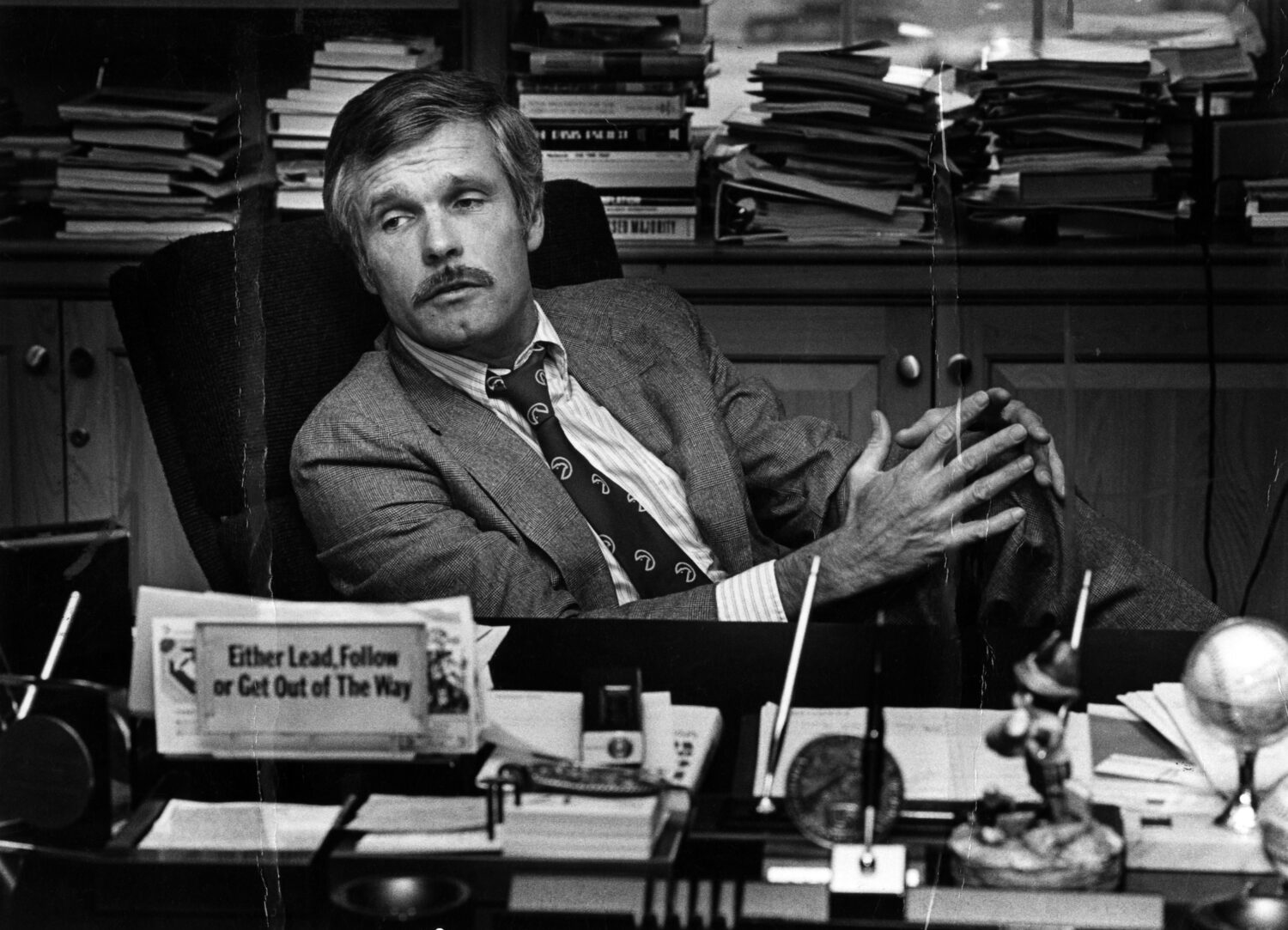
FILE - Ted Turner is seen at his desk inside the CNN Center in 1982. (Nancy Mangiafico/Atlanta Journal-Constitution via AP, File)
Credit: ASSOCIATED PRESS
(Nancy Mangiafico/Atlanta Journal-Constitution via AP, File)

NEW YORK (AP) — When the Space Shuttle Challenger exploded in 1986, Beth Knobel, a future TV news correspondent, was in graduate school. Emerging from class, she saw TV sets had been set up in the lobby. They were tuned to CNN, the 24/7 news channel that Ted Turner had launched about five years earlier, which was carrying the launch live.
“Shuttle launches were just kind of routine and the broadcast networks weren’t even covering them anymore,” says Knobel, who worked for CBS News in the 1990s and now teaches journalism at Fordham University. “CNN did. So when things went so tragically wrong, there they were on top of the story like no one else.”
That, says Knobel, who now teaches a class on TV’s biggest innovators, is just one example of why Turner was the biggest of them all — huge steps ahead of anyone else in his understanding of how news needed to be delivered.
Turner’s death comes at a fraught time for cable news, which has struggled to retain viewership in an era of countless media choices and abundant streaming video. CNN has not been immune; changes in the media ecosystem, the company’s financial picture and multiple editorial resets over the years have left it a markedly different entity than the one Turner built.
But that misses an important point: He built it.
“We use the word giant sometimes to describe people that really aren’t giant,” Knobel says. “Ted Turner truly is a giant. He invented around-the-clock news.”
Many in and around the news industry struggled Wednesday for big enough words to describe Turner’s impact on how we consume news. Longtime TV analyst Robert Thompson said the issue was hyperbole-proof.
“Death and hyperbole often go together,” said Thompson, director of Syracuse University’s Bleier Center for Television and Popular Culture. ”But there is no hyperbole here. I can think of very few other things in the 20th century that so dramatically changed American politics, journalism and civic engagement than the invention of 24-hour cable news.”
He does add a caveat: The real impact would not be truly felt until others started doing it. Which, of course, they did. But for a long time, and certainly well into the 90s, “CNN became almost generic for breaking news,” Thompson says,” like Kleenex for facial tissues and Xerox for photocopying.”
But it isn’t just the 24-hour cycle that defines Turner’s legacy in news. A number of analysts cited, too, how he conceived of news as a global commodity.
Knobel recalls that when she was Moscow bureau chief for CBS beginning in the early 1990s, she would walk into the Kremlin and see CNN on televisions.
“That was the way in which they came to understand what the world was thinking about Russia,” Knobel says. The same was true in other seats of power across the world. “Global programming didn’t exist before Ted Turner came along and said, ‘Not only am I going to build a new channel for America, but there are a lot of people around the world that will probably want to watch this news channel.’”
All of this has become so ingrained by now that it’s hard to convey to younger people that it once didn’t exist. Back in the ’70s when Turner — an insomniac — was first dreaming of 24/7 news, in many places you’d turn on your TV late at night and would see only static, a test pattern or an American flag until about 6 am.
Former CNN White House bureau chief Frank Sesno, now a media and public affairs professor at George Washington University, tells his students about the “Walter Cronkite era” — when news was delivered at an appointed time, by a voice from on high, in a 30-minute broadcast (which actually doubled the 15-minute broadcasts there once were.)
“I teach these young people and they have no idea who Ted Turner is,“ Sesno said. “I remind them this was, in fact, the world of Walter Cronkite. Ted Turner came in and and CNN was seen as an upstart, as something that wasn’t going to succeed.” Thus the derisive moniker “Chicken Noodle News,” which was echoing across the industry when Sesno joined the network in 1984 .
“When they hired me, I had zero television experience,” he says.
But CNN wasn’t looking for star anchors at the time. The news was supposed to be the star. The stable of stars came later.
For CNN, a moment of particular success came in October 1987, the year after the Challenger explosion, when 18-month-old Jessica McClure was rescued from a well in Texas after a two-day ordeal. CNN covered not only the outcome but the incremental developments — standard fare today but certainly not so then for TV.
Brooke Erin Duffy, an associate professor of communication at Cornell University, points to public appetite for that story as a key moment for CNN, which covered the “hours and hours of waiting” and allowed audiences to regularly tune in for updates.
But it was during the first Gulf War with Iraq when the entire foundation of news shifted. When other journalists left Baghdad, CNN stayed. With correspondents Bernard Shaw, John Holliman and Peter Arnett doing reports under siege from Baghdad’s al-Rashid Hotel, the network changed war journalism forever.
A key factor was technology. CNN’s news managers “went to Turner and said you know, there’s a war coming. We need some money to cover it, and Ted Turner said to them well what do you need?” Knobel said. ”What they did with that money is to bring in satellite phone technology that no one else had.” It enabled CNN to continue to broadcast news when communications were knocked out.
“I’m someone who competed against CNN for many years working for CBS (and) I can say CNN always had a technological advantage over everybody else,” she said, crediting Turner for giving his network the edge.
The 24/7 schedule of broadcasting continuous developments also vastly reshaped what it was like to actually work in the TV news industry. Journalist were increasingly expected to “be available 24/7 to satiate the public’s appetite for news,” Duffy said.
After CNN found success, more and more outlets followed suit. The uptick in competition for around-the-clock content made time even more of a currency when it came to breaking news.
“I think one of the consequences is the race for eyeballs within the saturated media landscape,” Duffy said. “Time is the currency in news media.”