The US and Iran have an enmity for the ages. After the bombs, a new chapter begins
Jun 25, 2025, 12:56 PM
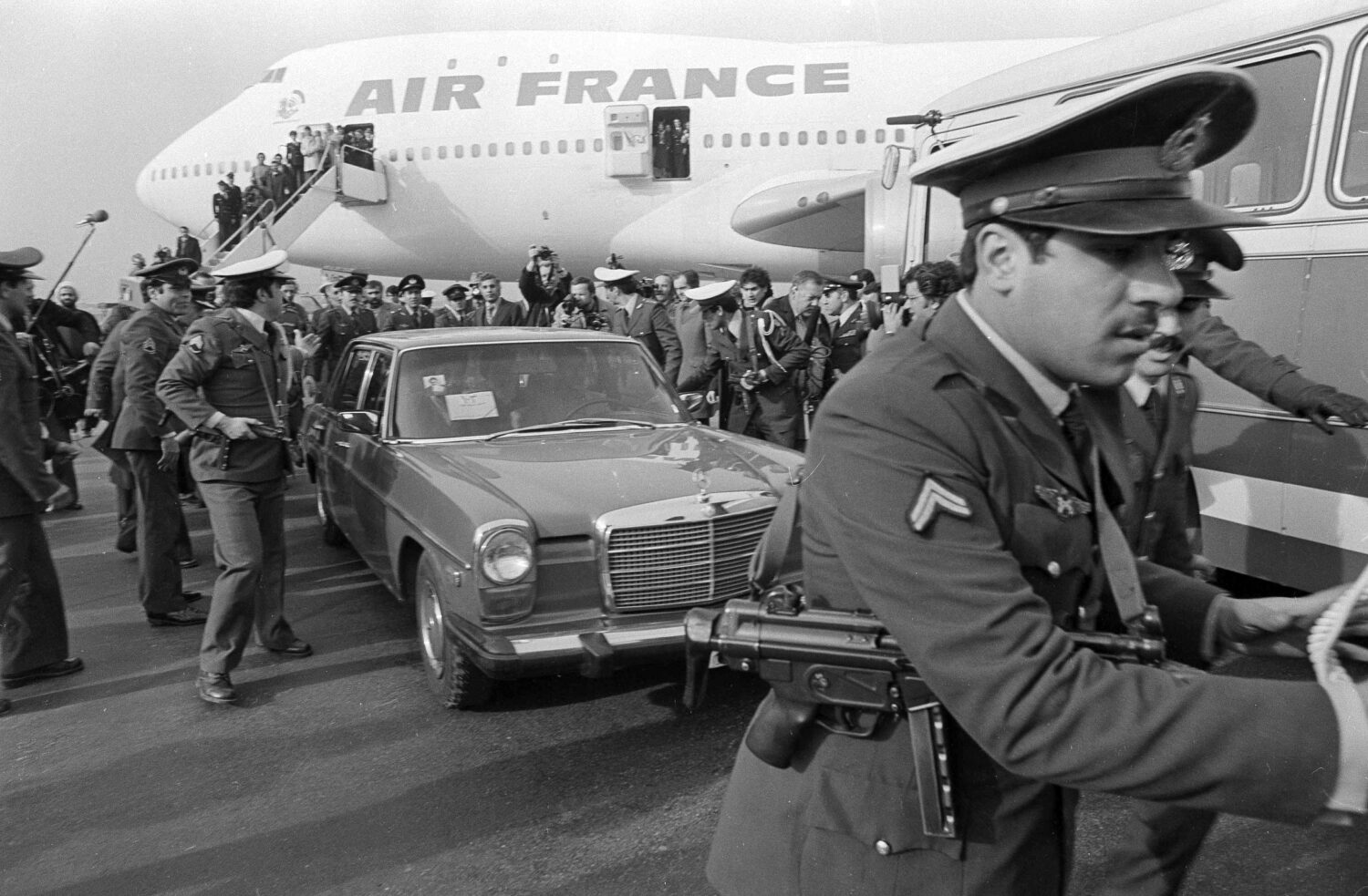
FILE - Ayatollah Ruhollah Khomeini has a heavy escort as he enters car to leave the airport in Tehran, Iran, Feb. 1, 1979, after arriving back in the country on a chartered Air France Boing 747. (AP Photo/FY, File)
Credit: ASSOCIATED PRESS
(AP Photo/FY, File)

WASHINGTON (AP) — Now comes a new chapter in U.S.-Iran relations, whether for the better or the even worse.
For nearly a half century, the world has witnessed an enmity for the ages — the threats, the plotting, the poisonous rhetoric between the “Great Satan” of Iranian lore and the “Axis of Evil” troublemaker of the Middle East, in America’s eyes.
Now we have a U.S. president saying, of all things, “God bless Iran.”
This change of tone, however fleeting, came after the intense U.S. bombing of Iranian nuclear-development sites this week, Iran’s retaliatory yet restrained attack on a U.S. military base in Qatar and the tentative ceasefire brokered by President Donald Trump in the Israel-Iran war.
The U.S. attack on three targets inflicted serious damage but did not destroy them, a U.S. intelligence report found, contradicting Trump’s assertion that the attack “obliterated” Iran’s nuclear program.
Here are some questions and answers about the long history of bad blood between the two countries:
In the first blush of a ceasefire agreement, even before Israel and Iran appeared to be fully on board, Trump exulted in the achievement. “God bless Israel,” he posted on social media. “God bless Iran.” He wished blessings on the Middle East, America and the world, too.
When it became clear that all hostilities had not immediately ceased after all, he took to swearing instead.
“We basically have two countries that have been fighting so long and so hard that they don’t know what the f— they’re doing,” he said on camera.
In that moment, Trump was especially critical of Israel, the steadfast U.S. ally, for seeming less attached to the pause in fighting than the country that has been shouting “Death to America” for generations and is accused of trying to assassinate him.
In two words, Operation Ajax.
That was the 1953 coup orchestrated by the CIA, with British support, that overthrew Iran’s democratically elected government and handed power to the shah, Mohammad Reza Pahlavi. The Western powers had feared the rise of Soviet influence and the nationalization of Iran’s oil industry.
The shah was a strategic U.S. ally who repaired official relations with Washington. But grievances simmered among Iranians over his autocratic rule and his bowing to America’s interests.
All of that boiled over in 1979 when the shah fled the country and the theocratic revolutionaries took control, imposing their own hard line.
Profoundly.
On Nov. 4, 1979, with anti-American sentiment at a fever pitch, Iranian students took 66 American diplomats and citizens hostage and held more than 50 of them in captivity for 444 days.
It was a humiliating spectacle for the United States and President Jimmy Carter, who ordered a secret rescue mission months into the Iran hostage crisis. In Operation Eagle Claw, eight Navy helicopters and six Air Force transport planes were sent to rendezvous in the Iranian desert. A sand storm aborted the mission and eight service members died when a helicopter crashed into a C-120 refueling plane.
Diplomatic ties were severed in 1980 and remain broken.
Iran released the hostages minutes after Ronald Reagan’s presidential inauguration on Jan. 20, 1981. That was just long enough to ensure that Carter, bogged in the crisis for over a year, would not see them freed in his term.
No. But the last big one was at sea.
On April 18, 1988, the U.S. Navy sank two Iranian ships, damaged another and destroyed two surveillance platforms in its largest surface engagement since World War II. Operation Praying Mantis was in retaliation against the mining of the USS Samuel B. Roberts in the Persian Gulf four days earlier. Ten sailors were injured and the explosion left a gaping hole in the hull.
Not officially, but essentially.
The U.S. provided economic aid, intelligence sharing and military-adjacent technology to Iraq, concerned that an Iranian victory would spread instability through the region and strain oil supplies. Iran and Iraq emerged from the 1980-1988 war with no clear victor and the loss of hundreds of thousands of lives, while U.S.-Iraq relations fractured spectacularly in the years after.
An example of U.S.-Iran cooperation of sorts — an illegal, and secret, one until it wasn’t.
Not long after the U.S. designated Iran a state sponsor of terrorism in 1984 — a status that remains — it emerged that America was illicitly selling arms to Iran. One purpose was to win the release of hostages in Lebanon under the control of Iran-backed Hezbollah. The other was to raise secret money for the Contra rebels in Nicaragua in defiance of a U.S. ban on supporting them.
President Ronald Reagan fumbled his way through the scandal but emerged unscathed — legally if not reputationally.
Only four: Iran, North Korea, Cuba and Syria.
The designation makes those countries the target of broad sanctions. Syria’s designation is being reviewed in light of the fall of Bashar Assad’s government.
From President George W. Bush in his 2002 State of the Union address. He spoke five months after the Sept. 11, 2001, terrorist attacks and the year before he launched the invasion of Iraq on the wrong premise that Saddam Hussein possessed weapons of mass destruction.
He singled out Iran, North Korea and Saddam’s Iraq and said: “States like these, and their terrorist allies, constitute an axis of evil, arming to threaten the peace of the world.”
In response, Iran and some of its anti-American proxies and allies in the region took to calling their informal coalition an Axis of Resistance at times.
Some, like Hezbollah and Hamas, are degraded due to Israel’s fierce and sustained assault on them. In Syria, Assad fled to safety in Moscow after losing power to rebels once tied to Islamic State terrorism but now cautiously welcomed by Trump.
In Yemen, Houthi rebels who have attacked commercial ships in the Red Sea and pledge common cause with Palestinians have been bombed by the U.S. and Britain. In Iraq, armed Shia factions controlled or supported by Iran still operate and attract periodic attacks from the United States.
In 2015, President Barack Obama and other powers struck a deal with Iran to limit its nuclear development in return for the easing of sanctions. Iran agreed to get rid of an enriched uranium stockpile, dismantle most centrifuges and give international inspectors more access to see what it was doing.
Trump assailed the deal in his 2016 campaign and scrapped it two years later as president, imposing a “maximum pressure” campaign of sanctions. He argued the deal only delayed the development of nuclear weapons and did nothing to restrain Iran’s aggression in the region. Iran’s nuclear program resumed over time and, according to inspectors, accelerated in recent months.
Trump’s exit from the nuclear deal brought a warning from Hassan Rouhani, then Iran’s president, in 2018: “America must understand well that peace with Iran is the mother of all peace. And war with Iran is the mother of all wars.”
In January 2020, Trump ordered the drone strike that killed Qasem Soleimani, Iran’s top commander, when he was in Iraq.
Then Iran came after him, according to President Joe Biden’s attorney general, Merrick Garland. Days after Trump won last year’s election, the Justice Department filed charges against an Iranian man believed to still be in his country and two alleged associates in New York.
“The Justice Department has charged an asset of the Iranian regime who was tasked by the regime to direct a network of criminal associates to further Iran’s assassination plots against its targets, including President-elect Donald Trump,” Garland said.
Now, Trump is seeking peace at the table after ordering bombs dropped on Iran, and offering blessings.
It is potentially the mother of all turnarounds.
___