Tribal college leaders are uneasy about US financial commitments despite a funding increase
Nov 17, 2025, 6:13 AM
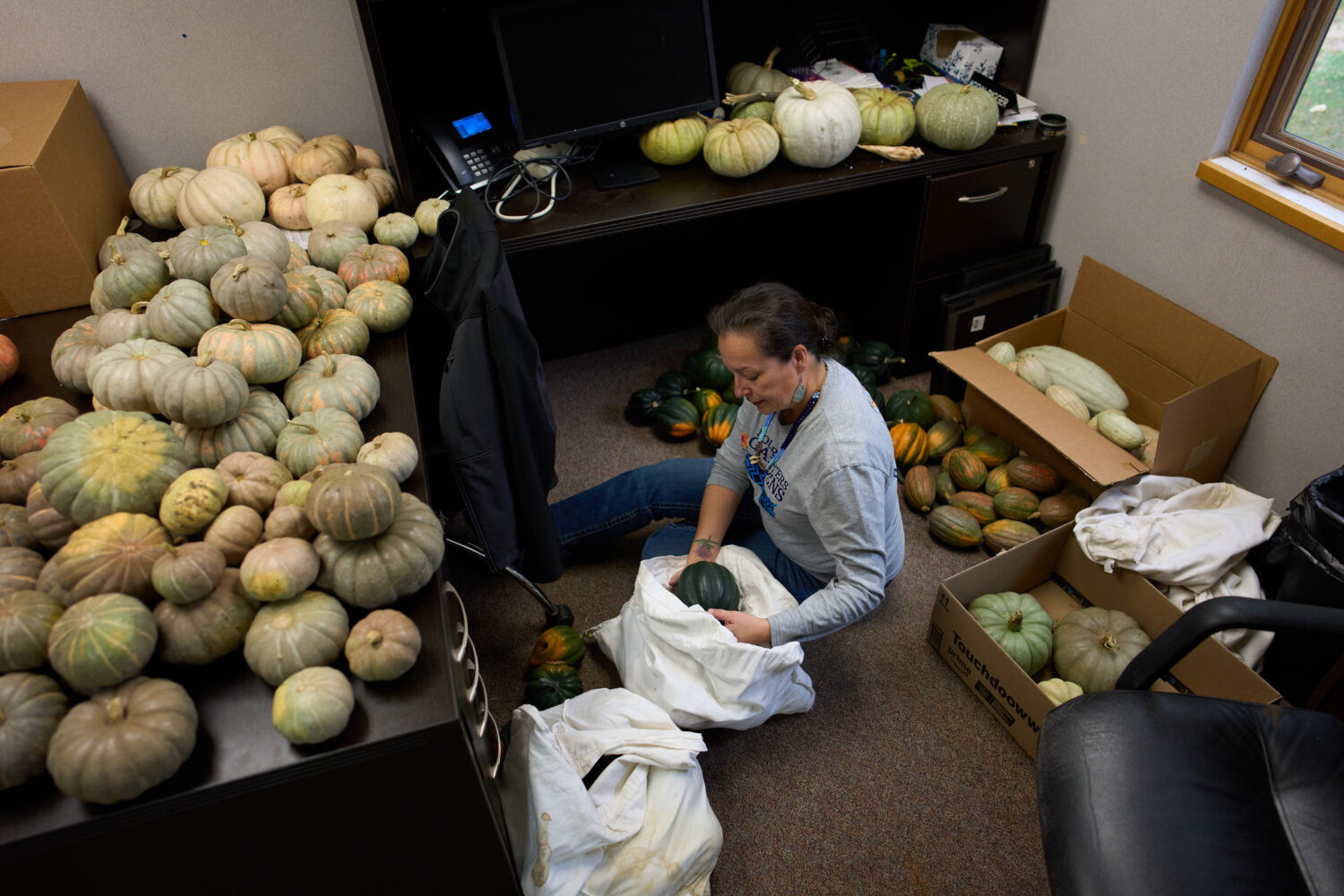
Ruth De La Cruz, food sovereignty director at Nueta Hidatsa Sahnish College, sorts through squash in an office at the school Thursday, Oct. 30, 2025, in New Town, N.D. (AP Photo/John Locher)
Credit: ASSOCIATED PRESS
(AP Photo/John Locher)

NEW TOWN, N.D. (AP) — On a recent chilly fall morning, Ruth De La Cruz walked through the Four Sisters Garden, looking for Hidatsa squash. To college students in her food sovereignty program, the crop might be an assignment. But to her, it is the literal fruit of her ancestors’ labor.
“There’s some of the squash, yay,” De La Cruz exclaimed as she finds the small, pumpkinlike gourds catching the morning sun.
The garden is named for the Hidatsa practice of growing squash, corn, sunflower and beans — the four sisters — together, De La Cruz said. The program is part of the Nueta Hidatsa Sahnish College, operated by the Mandan Hidatsa Arikara Nation.
It is one of more than three dozen tribal colleges and universities across the country that the Trump administration proposed cutting funding to earlier this year. Tribal citizens are among communities navigating the impacts of massive cuts in federal spending and the effects of the longest government shutdown in U.S. history.
A funding increase for tribal colleges and universities announced before the shutdown was welcome news, but college leaders remain uneasy about the government’s financial commitments. Those federal dollars are part of some of the country’s oldest legal obligations, and tribal college and university (TCU) presidents and Native education advocates worry they could be further eroded, threatening the passage of Indigenous knowledge to new generations.
“This is not just a haven for access to higher education, but also a place where you get that level of culturally, tribally specific education,” De La Cruz said.
When the U.S. took the land and resources of tribal nations to build the country, it promised through treaties, laws and other acts of Congress that it would uphold the health, education, and security of Indigenous peoples. Those fiduciary commitments are known today as trust responsibilities.
“We prepaid for all of this,” said Twyla Baker, the college’s president.
The U.S. may have intentionally and violently disrupted the passage of Indigenous knowledge and lifeways, Baker said, but their ancestors forced the government to promise to protect them for future generations. Those legal and moral obligations must be honored, she said.
“They carried our languages under their tongues. They carried them close to their heart. They carried these knowledge systems with them and protected them to bring them forward to us. So I feel as if I have a responsibility to do the same,” Baker said.
Today, the education pillar of the trust responsibilities takes many forms, like the hundreds of elementary schools on reservations funded by the U.S. Bureau of Indian Education and the funding that pays for Native history and language classes taught at TCUs.
That funding was set to be reduced by as much as 90% in President Donald Trump’s federal budget proposal. But in September the U.S. Department of Education announced TCUs would receive an increase of over 100%. While the decision was welcomed by many, those new federal dollars came at the cost of other institutions where many Native students attend, like Hispanic-serving institutions.
The education of Native students outside of TCUs are also part of those trust and treaty rights, said Ahniwake Rose, president of the American Indian Higher Education Consortium, which advocates for TCUs.
Rose said that the increase in Department of Education funding coincides with decreases in several areas of the federal government that provide vital grants to TCUs, like the National Science Foundation and the U.S. Department of Agriculture.
In 1994, Congress passed a bill designating tribal colleges as land grant institutions, which opened them up to new sources of federal funding through the U.S. Department of Agriculture. But unlike other land grant universities like Cornell, Purdue and Clemson that are still sustained by the profits of unceded tribal lands, TCUs don’t share in those billions of dollars. Instead they rely on grants from the federal agencies that support land grant universities.
However, that too has become more difficult, Rose said. Tribal liaisons at some of those federal departments who ensure they are complying with their trust responsibilities have been laid off or furloughed, she said, and many of those positions remain unfilled.
“We’re still under a great deal of stress,” Rose said. “I don’t want people to think because we got this increase in funds that all is OK, because it’s still precarious.”
That kind of uncertainty makes it hard to budget, said Leander McDonald, president of the United Tribes Technical College in Bismarck, North Dakota. That, mixed with the current push to cut the federal workforce, leaves him and other TCU presidents second-guessing decisions to create education programs and hire staff.
“How long is the storm going to last?” McDonald said. “That’s the part that I think is unknown for us.”
Presidents like McDonald and Baker spend a lot of their time on the road, traveling to Washington, D.C., to make the case for both the value that TCUs add and the government’s responsibility to uphold them. An American Indian Higher Education Consortium report released in September found that in 2023 TCUs generated $3.8 billion in added income to the national economy in the forms of increased student and business revenue and social savings related to health, justice and income assistance.
On top of the opportunities higher education provides, for TCU students there is an added incentive. The U.S. government systematically tried to erase their cultures, and many students and faculty believe part of the government’s fiduciary responsibility to tribal nations today includes providing opportunities to sustain the traditions that it threatened.
Learning directly from elders who pass down that knowledge is a key part of the Native American Studies program at Nueta Hidatsa Sahnish College. Students like Zaysha Grinnell, a citizen of the MHA Nation enrolled in the program, learn their languages and take classes on tribal sovereignty and traditional burial rites.
“You can’t get that anywhere else,” she said. “That experience, that knowledge, all of the knowledge that the ones teaching here carry.”
Many of the communities where those traditions were taught were broken up, the languages spoken in them were intentionally targeted, and the lands where they thrived were taken, said Mike Barthelemy, head of the college’s Native American Studies program.
“You can look around us in any direction for hundreds of miles, and those are ceded territories,” he said. “There’s not a single Indigenous nation that got really, truly compensated for what they gave. And so I think that trust responsibility, it lingers.”