Trump administration’s $46 billion ‘smart wall’ races ahead on the US-Mexico border
Jul 2, 2026, 4:48 AM
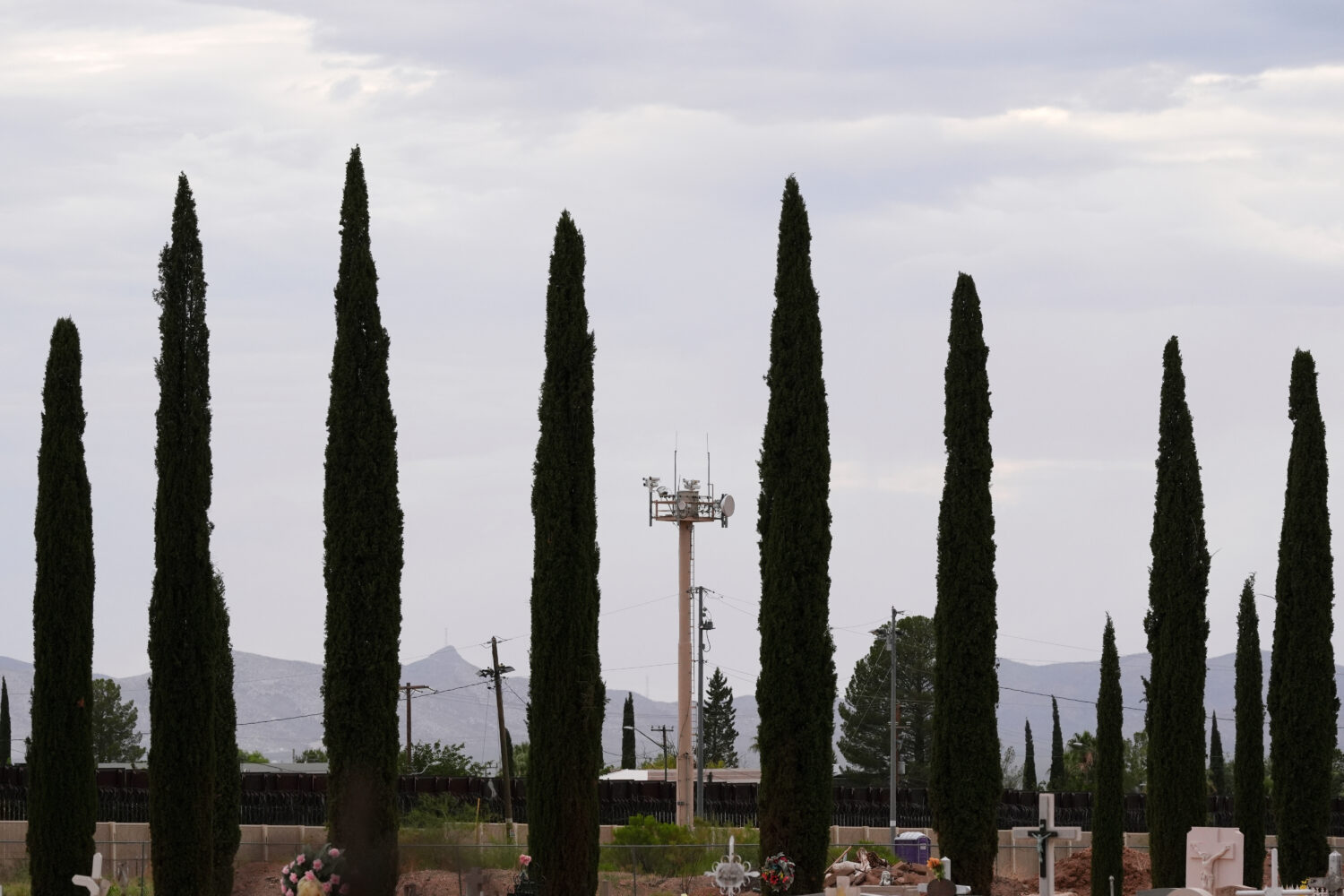
FILE - Surveillance technology used by various law enforcement sit on a tower at the border wall, July 28, 2025, in Douglas, Ariz. (AP Photo/Ross D. Franklin, File)
Credit: AP Photo/Ross D. Franklin
(AP Photo/Ross D. Franklin, File)

PHOENIX (AP) — For decades, all that separated the U.S. from Mexico was barbed wire.
Now, after a massive infusion of cash from Congress, President Donald Trump’s administration is swiftly building what it has dubbed a “smart wall,” a combination of 30-foot-tall (9-meter-tall) steel fencing and an array of sophisticated technology like sensors, cameras and towers allowing Border Patrol to surveil the territory.
The wall is under heavy scrutiny for the billions of dollars being dedicated to it when border crossings are at their lowest in decades. Critics say the U.S. is militarizing the border as it increasingly deploys sophisticated surveillance technology to the area, impacting local communities.
“We are seeing a massive expansion of surveillance and surveillance technology across the borderlands,” said Ricky Garza, border policy counsel at the Southern Border Communities Coalition, an advocacy group. “The wall in all its forms is harmful to communities.”
Officials say the technology is complementary to the physical wall and frees up agents for other tasks.
“It’s a smart wall. It’s not just a barrier,” Customs and Border Protection Commissioner Rodney Scott said during recent congressional testimony. “It maximizes the use of our most valuable resource, which is our agents.”
The wall has been a top priority for Trump, a Republican, since he first ran for president.
During the administration of President Joe Biden, a Democrat, the border emerged as a flashpoint, with thousands of people seeking to cross into the country each day. Those numbers started to taper off shortly before Trump returned to office last year and then slowed to a trickle, with his broader immigration crackdown serving as a deterrent for would-be migrants.
Flush with $46 billion to finish the wall after an infusion by Congress for immigration enforcement, CBP is inking tens of billions of dollars in contracts to build the wall and push along the president’s signature project.
Homeland Security Secretary Markwayne Mullin said recently that a preliminary part of the wall will be finished by “this time next year.” Scott said his agency is putting up 6 miles (10 kilometers) of wall a week.
Hundreds of miles had already been built before Trump returned to office. As of mid-June 2026, CBP has erected another 74 miles (119 kilometers) and aims to build hundreds more. There is no wall planned for roughly 535 miles (861 kilometers) of the roughly 2,000-mile-long (3,200-kilometer-long) border, because rugged terrain already serves as a barrier. Ground sensors and towers will be used instead.
CBP is also going back to hundreds of miles of already built wall and adding more technology, lights and roads. Along the long stretches of river in Texas that mark the border with Mexico, they’re deploying 12- to 15-foot-long (3.7- to 4.5-meter-long) cylinder-shaped buoys meant to keep migrants or smugglers from crossing the border.
Technology is playing a greater role in the Trump administration’s effort to make illegal crossings along the border more difficult, part of a broader transformation of CBP in the years since Sept. 11, 2001, into an intelligence operation with a mass surveillance network whose reach extends far beyond the nation’s frontiers, according to reporting by The Associated Press.
And critics say the border technology poses a threat.
The Southern Border Communities Coalition says surveillance technologies can push migrants into more dangerous routes to avoid being detected.
Garza, the group’s policy counsel, warned that surveillance technology infringes on the privacy rights of border residents and that locals have found ground sensors used to detect smuggler or migrant traffic placed on their property without their consent.
Nayda Alvarez and her relatives own land along the Rio Grande roughly 125 miles (200 kilometers) inland from the Gulf of Mexico. She has found cameras placed on her family’s land, and just last week she spotted a surveillance tower about a quarter of a mile (almost half a kilometer) down the river from her house.
“Are we expecting a war or something?” she said. “It doesn’t make me feel safer.”
Dave Maass, director of investigations for the Electronic Frontier Foundation, a nonprofit that focuses on civil liberties related to digital technology, said the technology has made the border area “a hostile environment” for locals and would-be migrants.
The foundation has published a guide on the various types of surveillance towers in use along the southern border designed to help local residents.
These can range from fixed towers with video, infrared and radar technologies that have a range of roughly 8 miles (13 kilometers) to remote video surveillance systems that have cameras and a spotlight fixed on top. Some are mounted on the backs of trucks so agents can drive them to different parts of the border.
Increasingly, these towers are autonomous. They can scan an area, analyze what they’re seeing using artificial intelligence and alert Border Patrol agents to something suspicious. Proponents say this helps keep Border Patrol agents out in the field instead of sitting in front of computer screens watching for activity. But it also increases AI decision-making along the border when experts have warned about the technology’s potential for bias or other problems.
The big GOP tax cuts and spending bill passed by Congress last summer requires that CBP buys only the autonomous towers, and the department is deploying an additional 95.
Underground, buried fiberoptic cables can sense movement, capturing data that is also then analyzed by AI.
“We follow the contour of the land. We go through trees. We go down into the river banks. We can go absolutely everywhere,” said Magnus McEwen-King, CEO of Sintela, which has a contract with CBP to install the cables. He spoke at a recent border security expo in Phoenix, where some of the technology was on display.
CBP also uses ground sensors and trail cameras to detect smuggling routes.
The nonpartisan watchdog group Taxpayers for Common Sense has questioned both the huge amounts of money for the wall-building and whether taxpayers are getting their money’s worth.
In 2011, under Democratic President Barack Obama, Homeland Security Secretary Janet Napolitano pulled the plug on a project to build a “virtual wall” of integrated technology like radars, sensors and cameras across the entire border after it ran over budget, faced technological glitches and was behind schedule.
Josh Sewell, director of research and policy at Taxpayers for Common Sense, said the organization would like to see more “robust evaluation” of the technologies being used to avoid similar scenarios. And he criticized the Trump administration for lack of oversight on how the money is being spent, a charge CBP has denied, citing “oversight mechanism.”
In the Big Bend area of southern Texas, opposition to the department’s wall-building plans gathered strong bipartisan support especially in the most sensitive areas that run through a state and national park and a wildlife area.
CBP now says it is not planning to build a 30-foot-high (9-meter-high) bollard wall in those areas. Its recently announced plans include installing patrol roads and some barriers designed to stop cars and using detection technologies.
Clara Benson, who is one of the founders of the No Big Bend Wall coalition, says bright lights in the area designed to illuminate the border could pollute the skies in an area renowned for having some of the best views of the stars. Even without a 30-foot-tall (9-meter-tall) steel wall running through the land, there is concern about CBP’s plans.
“There’s still a lot of fear and dread that the plan is still going to be quite damaging,” she said.