Trump is taking longer to approve disaster aid and denying Democratic states more frequently
Jul 15, 2026, 9:05 PM
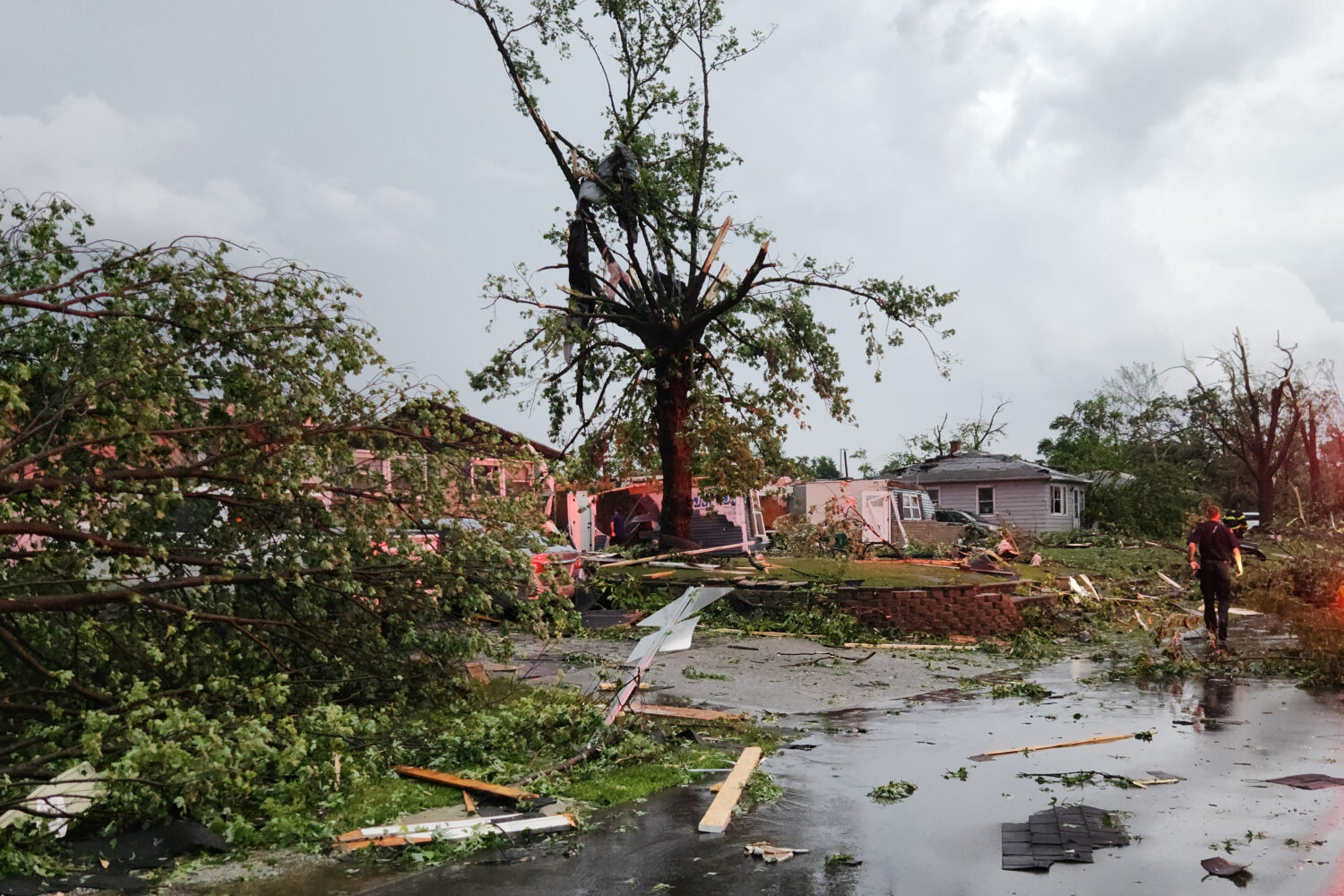
First responders walk through debris on Thursday, June 11, 2026 after a tornado passed through Merrillville, Ind. (Michael Sneiderwine via AP)
Credit: ASSOCIATED PRESS
(Michael Sneiderwine via AP)

When major disasters strike, Americans are routinely waiting weeks — or even months — to receive presidential approval for aid. And if they live in a state that didn’t support President Donald Trump, chances are greater that aid will denied.
Since taking office last year, Trump has approved about 65 requests for major disaster declarations and denied more than two dozen others from states, tribes or territories seeking federal financial assistance following hurricanes, tornadoes, storms, floods and fires.
Trump has taken longer on average to approve disaster requests than any other president, according to an Associated Press analysis of data dating back to 1989, when a federal law setting new parameters for disaster determinations was implemented. And no other president has such a disparity in denials between states that supported him politically and those that did not.
The delays and denials come as Trump’s administration contemplates a makeover of the Federal Emergency Management Agency, which administers disaster aid. Major disaster declarations are intended for events that are beyond the resources of state and local governments.
During his second term, Trump has denied a greater percentage of disaster requests than any president dating to 1989. Those denials have not been evenly distributed among states.
Trump has approved 80% of the disaster requests from Republican governors but only about 60% from Democratic governors, according to the AP’s analysis of FEMA data.
The discrepancy is even more apparent when analyzing major disaster declarations based on presidential elections. Trump has approved more than three-fourths of the requests from states that voted for him in the 2024 election but less than half the requests from states that did not. Although there are federal criteria for disaster aid, decisions ultimately are at the president’s discretion.
A batch of denials earlier this month included four Democratic states — Massachusetts, New Jersey, New York and Rhode Island — seeking federal aid for a February snowstorm.
“The President’s denial is part of a pattern of extreme partisanship as he tries to shift a heavier economic burden onto blue states. Disaster aid should be merit-based, not politicized,” Rhode Island’s Democratic U.S. Senate and House members said in a joint statement.
White House spokesperson Abigail Jackson said in a statement that “there is no politicization to the President’s decisions on disaster relief.”
During his first term, Trump actually approved a greater share of requests from states that had opposed him than those that supported him.
Yet no other president had such a wide partisan divide in disaster declarations as currently exists under Trump. Obama approved 87% of the disaster requests from Democratic governors during his second term and 79% from Republican governors, but Obama’s approval rate was identical for states that voted for and against him.
When requests are denied, individuals, insurers and local governments are left to shoulder the costs themselves.
Since Trump assumed office last year, it’s taken him an average of a month and a half to approve major disaster declarations after receiving a request from the governor or chief executive of a state, territory or tribe, the AP found. Because it can take several weeks after a disaster for officials to inspect the damage and submit a request, the total wait time often has exceeded two months.
By comparison, Trump approved major disaster requests in an average of about three weeks during his first term, a pace similar to President Joe Biden. Their predecessors — Presidents Barack Obama, George W. Bush, Bill Clinton and George H.W. Bush — all had average disaster approval times of less than two weeks.
All presidents have taken longer to approve some requests. But that’s become the norm in Trump’s second term. Of Trump’s approvals, 70% have taken at least month — up from about one-quarter of requests during Trump’s first term and Biden’s administration, and fewer than 10% under their predecessors.
Jackson said that Trump conducts a more thorough review than any administration before him, “ensuring American tax dollars are used appropriately and efficiently by the states to supplement — not substitute — their obligation to respond to and recover from disasters.”
The longer the approval process takes, the longer people must wait to receive federal aid for daily living expenses, temporary lodging and home repairs. Delays in major disaster declarations also can hamper recovery efforts by local officials uncertain whether they will receive federal reimbursement for cleaning up debris and rebuilding infrastructure.
FEMA has had four different temporary leaders since Trump took office in January 2025. One of those, Cameron Hamilton, is awaiting Senate confirmation as the agency’s permanent director.
During a Senate committee hearing last month, Hamilton said he would try to speed up disaster declaration decisions and reimbursements. He also pledged to ensure that FEMA is objective, fair and reasonable in reviewing disaster declaration requests and making recommendations to the president.
Hamilton, a former Navy SEAL, had been fired as FEMA’s acting director in May 2025 after publicly disagreeing with Trump’s idea of dismantling the agency. His reemergence signals that Trump now may support changes to FEMA instead of an outright elimination of the agency.
A council appointed by Trump has recommended a series of changes to FEMA that would shift greater responsibility to states, potentially reducing the number of major disaster declarations and the amount of federal money paid out.
The council suggested revised criteria to qualify for presidential declarations, including a prerequisite of annual minimum expenditures by states, territories and tribes.
Another recommendation, which would require congressional approval, would reduce the federal government’s share of the disaster aid from a minimum of 75% to 50% of the costs, leaving state and local governments more to cover. For governments approved for assistance, federal funding could get there quicker — within 30 days of a federal disaster declaration, instead of waiting months or years for reimbursements that are based on proof of expenditures.
For individuals, the council recommended consolidating several different types of aid into one payment targeted for those whose homes are uninhabitable.