Trump wants to stop states from regulating AI. This Utah Republican isn’t listening
Apr 19, 2026, 4:47 AM
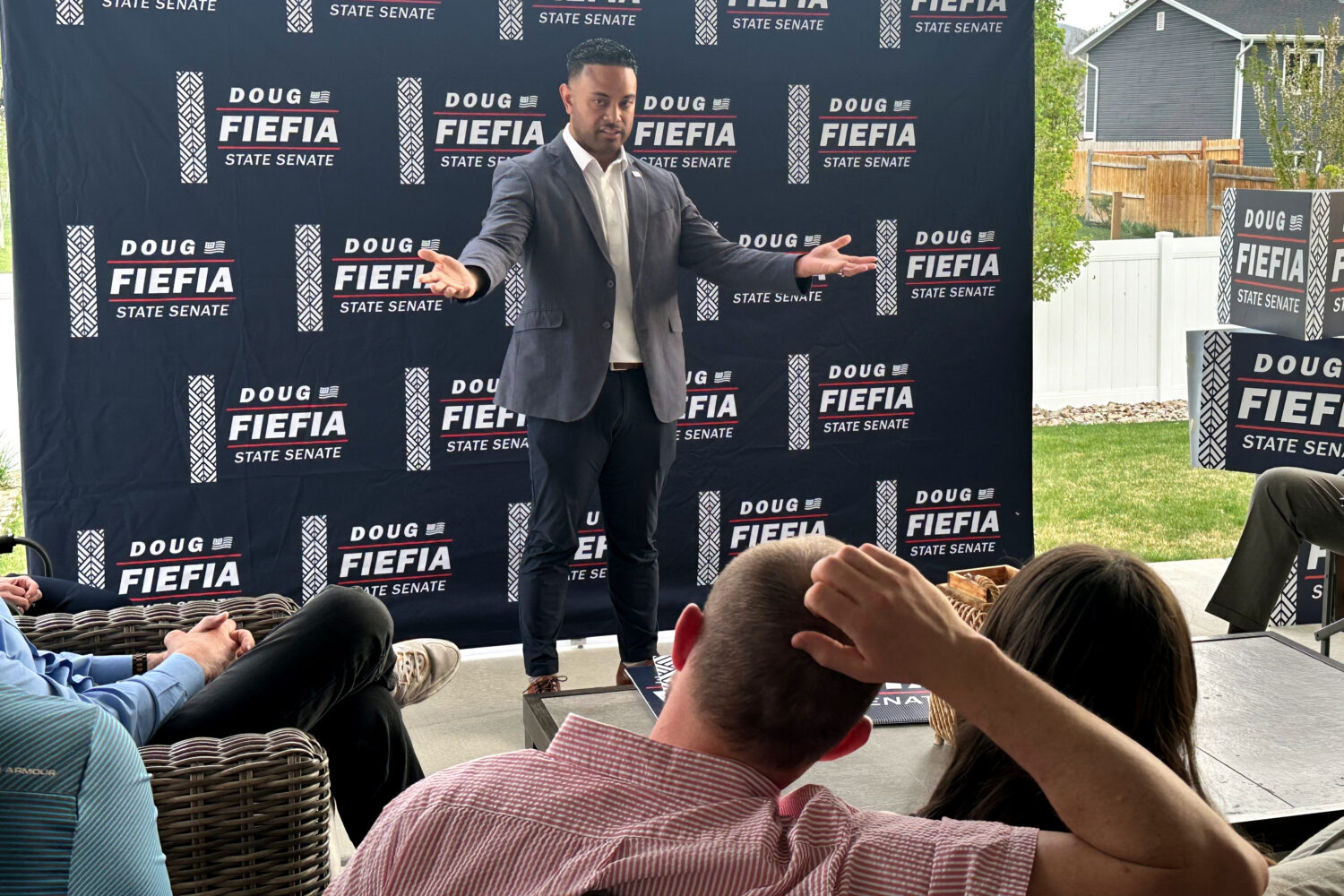
Utah State Rep. Doug Fiefia talks to Utah voters on the back deck of a house, Thursday, April 9, 2026, in Riverton, Utah. Fiefia, a Republican, has a background in technology and is running for the state senate with a pledge to tackle AI. (AP Photo/Nicholas Riccardi)
Credit: ASSOCIATED PRESS
(AP Photo/Nicholas Riccardi)

RIVERTON, Utah (AP) — When a dozen Republican activists gathered on a back deck in the Salt Lake City suburbs to talk about this year’s elections, the conversation cycled through all the staples of conservative chatter in Utah such as dwindling water supplies, illegal immigrant fraud and chemtrail conspiracy theories.
But Doug Fiefia, a state representative running to be a state senator, wanted to start with something else — artificial intelligence. Fiefia used to work at Google and, like several other tech employees who have gone into politics, he has made regulating the industry a centerpiece of his campaign.
“I know it sounds like ‘Doug, this is all you talk about,”’ Fiefia said. “That’s because it’s coming, it’s here and it’s going to be our biggest fight.”
Fiefia’s focus has put him on a collision course with President Donald Trump’s administration, which this year helped block his state proposal requiring companies to include child safety protocols. The White House wants a single national standard for artificial intelligence, arguing that a patchwork of excessive regulation could handicap American innovation in a global competition with China.
But with no progress in Congress, it has been state lawmakers struggling to address concerns about a technology that is poised to reshape the economy. In Florida, Republican Gov. Ron DeSantis added the issue to a special legislative session that he is convening later this month. Democratic-controlled New York last year required major AI developers to report dangerous incidents to the state.
All told, there are more than 1,000 state legislative proposals addressing AI, a reflection of the uneasiness that has seeped through the country.
“None of us are really sure,” said Brett Young, a structural engineer who attended the backyard event with Fiefia. “Is this something we should be scared about, or is it no so big a deal and it’ll enhance our lives?”
Trump has routinely tried to stamp out state-level AI policies, and he issued an executive order that included legal threats and funding penalties to deter new regulations.
The White House recently released a framework for potential congressional legislation that calls for preempting state laws considered “too burdensome” but would allow some rules to protect children and copyright material.
None of these steps has eased the number of proposals in state capitals. Popular ideas include forcing chatbots to remind users they are not human and barring the use of AI to make nonconsensual pornography, which includes replacing or removing clothing from photos that are posted online.
“There’s a lot of state lawmakers looking at what the federal government is doing and saying, ‘We want to take action because we’re not satisfied,'” said Craig Albright, senior vice president for government relations for the Business Software Alliance, which represents software companies.
About 8 in 10 people in the United States said they were “concerned” or “very concerned” about AI in a Quinnipiac poll last month, with about three-quarters saying government is not doing enough to regulate the technology. Roughly 9 in 10 Democrats and 6 in 10 Republicans wanted more government involvement.
The most significant regulations have passed in California and New York, solidly Democratic states. The provisions focus on disclosure of catastrophic risk, such as the AI-controlled meltdown of nuclear plants or AI models refusing to heed human direction.
But there is pressure in Republican-led states, too.
DeSantis pushed a bill to implement parental controls for minors using AI and to prohibit systems from using anyone’s likeness without permission. It fell short in the state House after overwhelmingly passing the state Senate. AI bills in Republican-controlled Louisiana and Missouri have stalled out because of Trump administration resistance.
Fiefia is part of a loose network of former tech employees turned state lawmakers trying to meet the demand for stronger regulations. He co-chairs the AI task force of the Future Caucus, a network of younger state lawmakers, with Monique Priestley, a Vermont Democrat who also has worked in tech.
Priestley said the group uses video conferences and group chats to share ideas for new proposals and deal with lobbyists who oppose their bills. She said that 166 of her state’s 482 registered lobbyists weighed in on her data privacy bill last year, which was ultimately vetoed by the governor.
“It’s like you’re running around against an army of full-time lobbyists,” said Priestley. Like many state lawmakers, she works a separate, full-time job.
Alex Bores, a former data scientist at the tech firm Palantir who quit after it signed a deal to help the first Trump administration with immigration enforcement, is also a member of the AI task force. A Democrat, Bores wrote the New York bill that was signed into law last year.
Now Bores is competing in the crowded Democratic primary to replace retiring U.S. Rep. Jerrold Nadler representing the east side of Manhattan and parts of Queen and Brooklyn in Congress, and he is facing payback from the industry. A pro-AI campaign committee has spent $2.3 million against his candidacy.
Bores said tech companies are trying to make an example of him to scare off more regulation at the state and federal level.
“It’s one reasons it’s so important for me to win this race is because, if I don’t, that intimidation they’re trying on Congress will be successful,” he said. Bores’ competitors in the June 23 primary include Jack Schlossberg, the grandson of former President John F. Kennedy, and George Conway, a former Republican who has become one of Trump’s chief antagonists on social media.
Fiefia has not attracted the sort of attention as Bores as he tries to move to the state Senate after a single session in the House. The subdivisions and shopping centers of his district are sandwiched between Utah’s jagged mountain ranges and the cul de sacs are crammed with children on bikes and scooters.
The son of Tongan immigrants, Fiefia grew up in Utah but moved to Silicon Valley, where he worked as a salesperson for Google.
Fiefia rose to manage a team working with companies on the implementation of Google’s early AI model and was disturbed by what he saw.
“What I realized is Big Tech cares about their bottom line, and they were worried about making money, not doing right for the human race,” said Fiefia, who now works at a Utah-based cloud computing and AI company.
Fiefia’s legislation was unanimously passed by a House committee this year, but the Trump administration sent a letter to the Senate saying that the measure was “unfixable.” The measure quickly died.
Daniel McCay, the state senator who Fiefia is challenging in the primary, said he thinks that was a good thing.
“I’ve been around long enough to recognize the invention of fire, the wheel, cars and the internet did not ruin society and I’m very skeptical of anyone trying to scare society into regulations,” McCay said in an interview.
He noted that the bill went beyond child safety, including whistleblower protection for AI workers and public disclosure of risks.
“It would have driven Utah out of the AI innovation business,” McCay said.
At the cottage meeting — the Utah term for a small gathering at someone’s home to discuss important issues — Fiefia faced several tech-related questions from the crowd.
Asked about defying the Trump administration, Fiefia said it was especially important to stand up for states’ rights when a fellow Republican was in power to demonstrate the principles involved.
“The Trump administration is, ‘We want zero regulations on AI,’” Fiefia said. “I think that’s wrong. I agree with a lot of what Trump says on taxes. I disagree with him on this.”