Trump raises hopes for war to wind down as Iran denies negotiations
Mar 24, 2026, 6:11 AM
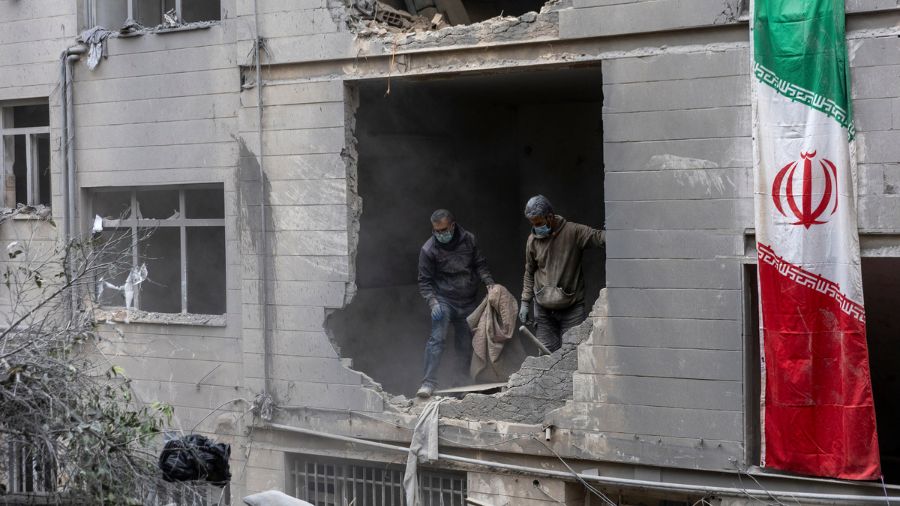
People clear rubble in a house in the Beryanak District after it was damaged by missile attacks two days before, on March 15, 2026 in Tehran, Iran. (Photo: Majid Saeedi, Getty Images)
(Photo: Majid Saeedi, Getty Images)

U.S. President Donald Trump told reporters that Iran wants “to make a deal” to end the war, claiming U.S. envoy Steve Witkoff and Trump’s son-in-law Jared Kushner had held talks Sunday with an Iranian leader. He did not say who that was, but said the U.S. has not talked to Supreme Leader Ayatollah Mojtaba Khamenei. Iran denied that such talks were taking place.
Lebanon has withdrawn the accreditation of Iran’s ambassador, ordering him to leave by Sunday and declaring him persona non grata. The removal marks a culmination in the deterioration of Lebanon’s relations with Iran since the last Israel-Hezbollah war in 2024. Some top Lebanese government officials have been critical of Tehran’s role in the country.
The death toll from the war has risen to more than 1,500 people in Iran, over 1,000 people in Lebanon, 15 in Israel and 13 U.S. military members, as well as a number of civilians on land and sea in the Gulf region. Millions of people in Lebanon and Iran have been displaced, and U.N. peacekeepers in southern Lebanon report “intense gunfire and explosions” as Israeli ground forces fight Hezbollah militants.
US Secretary of State Marco Rubio heads to France to sell the Iran war to skeptical G7 allies
He’ll attend a Group of Seven foreign ministers meeting near Versailles outside of Paris on Friday “to advance key U.S. interests” and “discuss shared security concerns and opportunities for cooperation,” the State Department said.
“Areas of focus will include the Russia-Ukraine war, the situation in the Middle East, and threats across the world to peace and stability,” it said.
Nearly all of the other G7 nations — Britain, Canada, France, Germany, Italy, and Japan — have reacted coolly at best to the U.S.-Israeli military operation against Iran and have declined to participate.
Iran will fight ‘until complete victory’
The spokesman of Iran’s top military command says that its armed forces will fight “until complete victory.”
The comments by Maj. Gen. Ali Abdollahi Aliabadi of the Khatam-al Anbiya Central Headquarters appeared related to U.S. President Donald Trump’s announcement that there were negotiations ongoing between Tehran and Washington.
Iran has denied any talks are taking place, though its foreign minister has been talking to counterparts around the region.
Iranian state television quoted Aliabadi as saying: “Iran’s powerful armed forces are proud, victorious, and steadfast in defending Iran’s integrity, and this path will continue until complete victory.”
The general didn’t say what “complete victory” would look like, but it appeared likely that Iran’s military was trying to warn against offering concessions in any possible negotiations with the U.S.
Philippine president declares a state of national energy emergency
Philippine President Ferdinand Marcos Jr. on Tuesday declared a state of national energy emergency to respond to the impact of the Middle East war, which his administration said posed “an imminent danger of a critically low energy supply.”
Under the declaration, which would initially last for a year, Marcos would lead a contingency committee that would monitor and ensure the availability and orderly distribution of fuel, food, medicines, agricultural products, and other basic goods.
Authorities were ordered to take action against the hoarding, profiteering, and manipulation of the supply of petroleum products. The Department of Migrant Workers, meanwhile, was asked to brace for the possible rescue and evacuation of Filipinos in the Middle East.
More than 2 million Filipinos live and work in the Middle East, including about 31,000 in Israel and 1,000 in Iran, but most have opted to stay in the region.
Israel’s military said it identified additional missiles from Iran for the ninth time within hours
The missiles are aimed at southern Israel, across a region near Israel’s main nuclear research center where two missiles struck Saturday.
Official says two Indian‑flagged gas tankers have passed through Strait of Hormuz without incident
And the Indian officials said they’re expected to reach Indian shores later this week.
The Pine Gas and the Jag Vasant LPG carriers crossed the war-hit strait late Monday, Rajesh Kumar Sinha, special secretary at the Ministry of Ports, Shipping and Waterways, said Tuesday.
Indian media reported that the two tankers, carrying roughly a day’s supply of the country’s cooking gas, sailed close to each other and followed a route approved by Iran that cuts closely to the country’s coastline.
Officials did not explain how the ships got permission to travel through the strait.
Iran continues to keep a stranglehold on the Strait of Hormuz, which leads from the Persian Gulf toward the open ocean and through which a fifth of the world’s oil and other important commodities are shipped.
A trickle of ships has been getting through the strait and Iran insists it remains open — just not to the U.S., Israel or their allies.
Amazon says Bahrain data center operations disrupted by drone activity
Amazon says data center operations in Bahrain have been disrupted by drone activity, the second time that its cloud computing service in the Middle East has been affected since the Iran war erupted.
The company said Amazon Web Service in the Bahrain region “has been disrupted as a result of the ongoing conflict” early Tuesday, without providing further details.
“We continue to support affected customers, helping them to migrate to alternate AWS Regions, with a large number already successfully operating their applications from other parts of the world,” the company said.
Three AWS Middle East data centers, including two in the United Arab Emirates and one in Bahrain, were damaged by Iranian drone strikes days after the war began.
The company has been advising customers using servers in the Middle East to migrate shift their cloud computing workloads to other regions and to direct online traffic away from the UAE and Bahrain.
Palestinians in the West Bank inspect trunk of a massive missile that hit near village homes
The missile, which dwarfed its many onlookers, cratered the ground in the Palestinian village of Haris. It wasn’t clear whether it was an Iranian missile or an Israeli interceptor missile fired by Israeli air defense.
“We are caught between two fires, between Israeli missiles and Iranian missiles, so we do not know,” Haris resident Hatem Dawood said. “We have no shelters to protect our children, nothing at all.”
Dawood, who’s also a former member of the village’s governing council, said the missile had fallen Tuesday morning.
Palestinian paramedics haven’t reported any injuries or deaths from the impact. Israel’s military did not respond to requests for details from The Associated Press.
Blasts heard in Tehran
An Associated Press journalist has heard a huge blast in the northern part of Iran’s capital, Tehran, that shook his home.
Another blast struck near central Tehran, another AP journalist said.
It wasn’t immediately clear what was being targeted, but Israel had said that it was embarking on airstrikes targeting locations in Iran.
Egypt and Jordan condemn Israeli practices in the West Bank
Egypt and Jordan say the Iran war shouldn’t distract the international community from the Israeli practices in the occupied West Bank.
Israel’s “illegitimate measures” in the West Bank “undermine all chances to achieve just peace,” the Egyptian and Jordanian foreign ministers said.
The ministers also condemned settler attacks in the West Bank as a “flagrant violation of international law.”
Lebanon orders Iran’s ambassador to leave
The Foreign Ministry said Tehran’s diplomatic representative in Lebanon has to leave by Sunday, declaring him persona non grata.
Foreign Ministry spokesperson Denise Rahme told The Associated Press that the Iranian Embassy will still have a charge d’affaires to head its diplomatic mission.
The removal of the ambassador marks a culmination in the deterioration of Lebanon’s relations with Iran since the last Israel-Hezbollah war in 2024.
Iran names new Supreme National Security Council secretary
Iran has named a former Iranian Revolutionary Guard commander as the new secretary of the country’s Supreme National Security Council, replacing Ali Larijani, who was killed in an airstrike.
Iranian state television identified the new secretary as Mohammad Bagher Zolghadr.
Zolghadr reached the rank of brigadier general in the Guard. He had been serving as the secretary of Iran’s Expediency Council.