What boycotting looks like 70 years after the Montgomery Bus Boycott
Dec 5, 2025, 4:49 AM | Updated: 9:54 pm
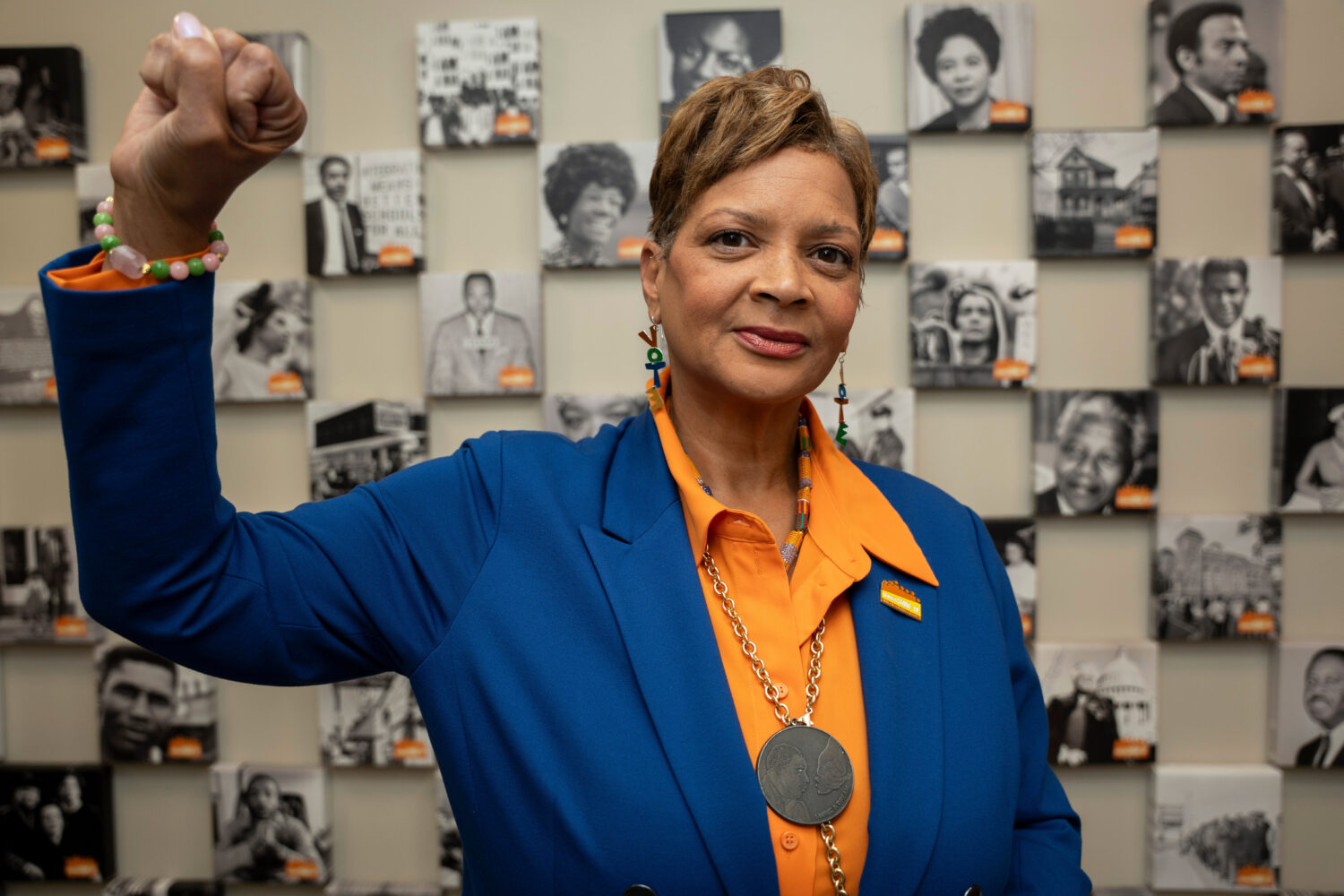
Deborah Scott, CEO of Georgia Stand-Up, raises her fist while standing in front of a wall honoring unsung heroes of the civil rights movement at The Movement Center, in Atlanta, Sunday, Nov. 30, 2025. (AP Photo/Olivia Bowdoin)
Credit: ASSOCIATED PRESS
(AP Photo/Olivia Bowdoin)

MONTGOMERY, Ala. (AP) — Doris Crenshaw was 12 years old on Dec. 5, 1955, when she and her sister eagerly rushed door to door in their neighborhood, distributing flyers prepared by activists planning a boycott of city buses in Montgomery, Alabama.
“Don’t ride the bus to work, to town, to school or any place on Monday,” the flyers read, urging people to attend a mass meeting that evening.
There was a sense of urgency. Days earlier, Rosa Parks, the secretary of the local NAACP chapter, had been the latest Black person arrested for refusing to give up a bus seat to a white passenger on the segregated buses. For 381 days, an estimated 40,000 Black residents stayed off city buses — opting to walk, ride in car pools or take Black-owned cabs — until a legal challenge struck down bus-segregation laws.
“In this city there was a groundswell of a need to do something about what was going on in the buses, because a lot of people were arrested,” Crenshaw, now 82, recalled.
The Montgomery Bus Boycott marks its 70th anniversary Friday — many of the boycott organizers’ descendants, including those of late civil rights icons the Rev. Martin Luther Jr. and the Rev. Ralph D. Abernathy Sr., plan to reunite in the Alabama city where it all started. Widely considered the beginning of the modern Civil Rights Movement, the bus boycott demonstrated the power of sustained nonviolent protest and economic pressure that continues to provide a model for the activism today.
A group of national organizers encouraged people to avoid the temptation of Black Friday and Cyber Monday deals, aiming the action at corporations like Target and Amazon over their stance of diversity initiatives and financial backing of the Trump administration.
“Any time there can be a strategic and organized response to corporate behavior or exclusionary policy, communities should be free to identify the best approach to address the harm that’s being created,” NAACP President Derrick Johnson said in a phone interview Thursday.
“Boycotting is one tool in the toolbox. At the NAACP, we call it selective buying campaigns.”
Parks’ Dec. 1, 1955, arrest was the final catalyst for the boycott that had been quietly discussed by some activists in the city. The seats at the front of the city buses were reserved for white people. And Black passengers, who were forced to sit in the back, were expected to give up their seats if the white section became full.
Contrary to the story that is often told, Parks, who died in 2005, wrote that she was not particularly tired from work that day when she took a stand by keeping her seat.
“No, the only tired I was, was tired of giving in,” Parks wrote in her autobiography.
Parks was a beloved figure in the town, Crenshaw recalled. She led the NAACP Youth Council and Crenshaw and other members would meet at the Parks’ apartment each week.
Pulling off the boycott for more than a year took an extreme amount of dedication and discipline, Crenshaw recalled.
“We walked, and we kept walking,” said Crenshaw, who walked across town to school each day. “We never got back on those buses.”
Crenshaw went on to a lifetime of civil rights activism. She organized National Council of Negro Women chapters as a southern field representative and was a member of President Jimmy Carter’s domestic policy staff, focused on small and minority business issues. She founded The Southern Youth Leadership Development Institute, mentoring young people as Parks once did for her.
“Everywhere you go, people say they are inspired by Mrs. Parks and by what happened with the Montgomery Bus Boycott,” Crenshaw said.
While the specific methods have changed, the underlying goal of leveraging the economic power of the community to drive social and policy change remains the same, said Deborah Scott, the CEO of Georgia Stand-Up. The organization is focused on economic and social justice issues and emphasizes engaging and developing the next generation of activists and leaders.
Scott said she was a teenager when she arrived in Atlanta more than 30 years ago to begin organizing with the Southern Christian Leadership Conference around the anti-apartheid movement. She worked to free South African anti-apartheid activist Nelson Mandela and to establish a holiday honoring the Rev. Martin Luther King Jr.
She learned from the Rev. James Orange, the late prominent civil rights activist and King assistant, who taught her the value of preparing young people to work for however long it takes to enact change.
She remembers some of the important questions he posed: “What are you going to do after you tweeted, after you put the word out to show up? What are going to say when you get to the microphone? What are you going to do and how will you conduct yourself in these situations?”
Just like the original Montgomery boycott, which sought access to affordable, non-discriminatory transportation by bringing large groups of people together to drive change, the success of boycotts after it required an unshakeable sense of unity.
“Everything is about relationships, but relationship organizing is the thing that is the same,” she said.
With widespread use of social media platforms, today’s boycotts look different. Scotts said the biggest change in boycotting with the newer generation is the focus on using consumer purchasing power to pressure companies to change their policies or practices.
“We’re encouraging people to really dig deep about where they want to spend their dollars,” she said.
Madison Pugh, at 13, is about the same age that Crenshaw was when she became involved in the Montgomery Bus Boycott. The eighth grader decided with her grandmother not to shop at Target after the retailing giant announced it was phasing out its diversity, equity and inclusion initiatives.
She said the retailer’s decision felt like a betrayal and a step backward.
Living in Montgomery, Pugh is growing up surrounded by the history of the civil rights movement that transpired decades before she was born. The stories from Crenshaw and others are more than just inspiring, she said.
“It’s saddening to the heart to know that a whole group of people weren’t allowed to go somewhere and have an education or be treated as humans because they were a different skin color,” Pugh said. “It definitely lets me know that the job will never be finished and you have to keep pushing.”
Scott said one of her goals is to help people see the connection between the activism of the past and today.
“The movement and the civil rights movement didn’t just happen back then. It’s still happening now,” Scott said.
___
Green reported from New York. Race and Ethnicity news editor Aaron Morrison in New York contributed.