What to know about earthquake early warning systems
Jun 25, 2026, 12:44 PM
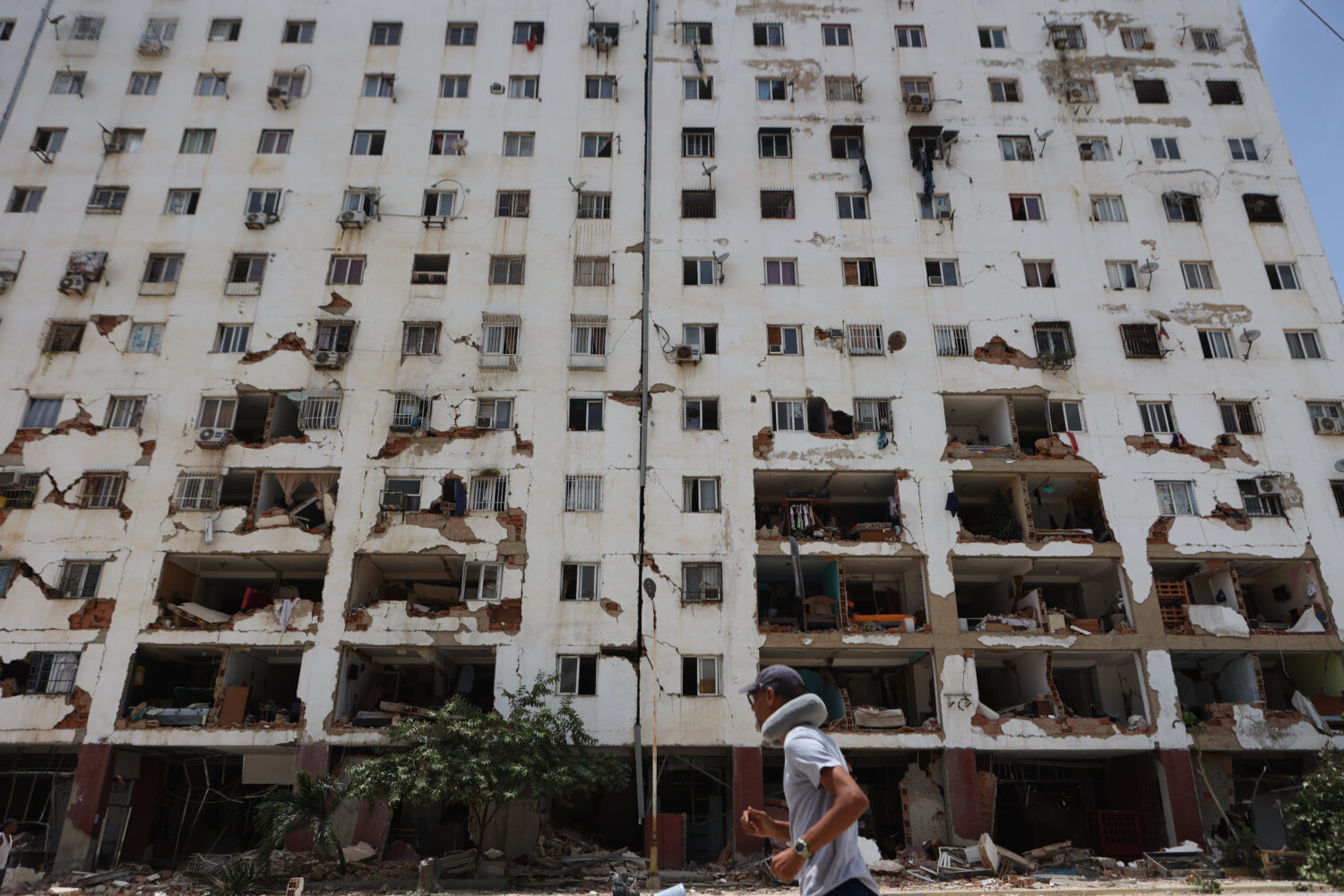
A resident walks past a damaged building a day after an earthquake and several aftershocks struck La Guaira, Venezuela, Thursday, June 25, 2026. (AP Photo/Pedro Mattey)
Credit: AP Photo/Pedro Mattey
(AP Photo/Pedro Mattey)

As earthquakes struck from California to Venezuela to Japan, millions of people received warnings on their mobile phones, providing critical seconds to seek protection.
Venezuela was struck with a pair of deadly earthquakes Wednesday evening and Thursday morning that brought significant shaking to the northern coast of Japan. Earlier in the week residents in the U.S. state of California experienced a moderate earthquake, and at the start of June, 37 people in the Philippines died in a quake near Mindanao.
Many nations have developed systems for alerting people seconds before shaking begins, and even in countries like Venezuela that do not have such systems, Google Android Earthquake Alerts can send important warnings.
Here’s what to know:
Several countries have Early Earthquake Warnings — sometimes shortened to EEW — including the United States, Mexico, Japan, Turkey, Romania, China, Italy and Taiwan, according to the U.S. Geological Survey.
Venezuela does not have a national EEW. Wednesday evening’s back-to-back 7.2- and 7.5-magnitude earthquakes were among the strongest to strike the country in more than a century.
Still, some people in Venezuela received warnings seconds or even minutes before the shaking began through Google’s Android Earthquake Alerts system. The warning system relies on crowdsourced data from the sensors in individual cellphones to detect seismic events and send warnings to other phone users in the area.
Pericles Sánchez, a 39-year-old Venezuelan writer in Caracas, received an earthquake warning on his Android phone a few minutes before the earthquake reached his home, allowing him the time to run outside. Sánchez said his family’s house was not damaged.
“It wasn’t until we were already outside that we started to feel it,” Sánchez said.
On the U.S. West Coast, the USGS operates an early warning system called ShakeAlert for California, Oregon and Washington. That system feeds alerts to people in multiple ways, including through a California-run app called MyShake. Through the various systems, over 4 million people were alerted to Wednesday’s California quake, said Robert de Groot, a USGS scientist.
The first public EEW was launched in 1991 in Mexico, and today people are warned of large quakes through broadcast stations, phone apps and public alarm systems. Mexico City also holds earthquake drills to practice how to respond to an earthquake.
After a magnitude 9.0 earthquake and tsunami ravaged parts of Japan’s northeastern coast in 2011, killing more than 22,000 people and triggering a catastrophic meltdown of the Fukushima Daiichi nuclear power plant, the country expanded its earthquake warning system to cover the ocean floor.
Japan’s Seafloor Observation Network for Earthquakes and Tsunamis, or S-Net, uses thousands of miles of underwater cables and sensors to directly monitor the offshore subduction zone where tectonic plates meet. The system is considered the most sophisticated in the world, and it has increased warning times for earthquakes by about 20 seconds, and made tsunami warnings as much as 20 minutes faster.
California’s MyShake app launched in 2019 and has since sent 6.8 million alerts for 194 earthquakes, according to the state.
Earthquakes generate a few types of movement “waves:” P-waves travel fastest and cause smaller vibrations in the earth. Larger, slower S-waves come next, creating more dangerous earth-shaking movements. L-waves come last and are the most destructive.
Most EEWs use seismometers and other sensors to detect those waves, and then transmit that information to regional networks where the data is used to determine an initial location and estimated magnitude within seconds. If the intensity of the earthquake reaches a certain threshold, alerts go out to the areas likely to be affected.
In the U.S., those alerts are sent through multiple means including the public Wireless Emergency Alert system, various phone apps or regional public warning systems.
Some people might get multiple alerts for the same event, and others — particularly those in rural areas or who don’t have phones nearby — might not get any.
De Groot of the USGS said having multiple systems provides valuable backup in case one fails.
“It’s always good to have more than one way of getting alerts. It’s the reason why you carry a spare tire in your car or carry some small bills in your wallet because the ATM may not work,” he said.
Google’s Android earthquake warning system relies on the accelerometers in individual cellphones, which are the same sensors that flip the screen when a phone is turned sideways. If a stationary Android phone detects a P-wave, it sends a signal to Google’s detection center, which then analyzes data from other phones in the region. That crowdsourced data is used to confirm the earthquake and send alerts.
The nature of earthquakes also means that people closest to the epicenter will get the shortest warning times, or may not even get the warning until heavy shaking has already begun. People farther away may have more time to prepare — though it’s typically only seconds.
The electronic signals used to detect the shaking and transmit the warnings move at the speed of light, much faster than seismic waves can travel through the ground. It’s sort of like a rainstorm — the further away someone is from a lighting strike, the longer it will take before they hear the accompanying thunder.
Wireless Emergency Alerts, or WEAs, are limited to 90 characters that can be broadcast from cell towers to any WEA‐enabled mobile device. But alerts from the MyShake app or those distributed through Google devices often contain more information, including the distance in miles between the device receiving the message and the epicenter, and the estimated magnitude.
All alerts include a message telling people to “drop, cover, hold on.”
___
Boone reported from Boise, Idaho and Rodriguez reported from San Francisco. Associated Press journalists Fabiola Sánchez in Mexico City and Julie Watson in San Diego, California contributed.