What to know about the evolution of execution methods in the US
Jun 9, 2026, 2:13 PM
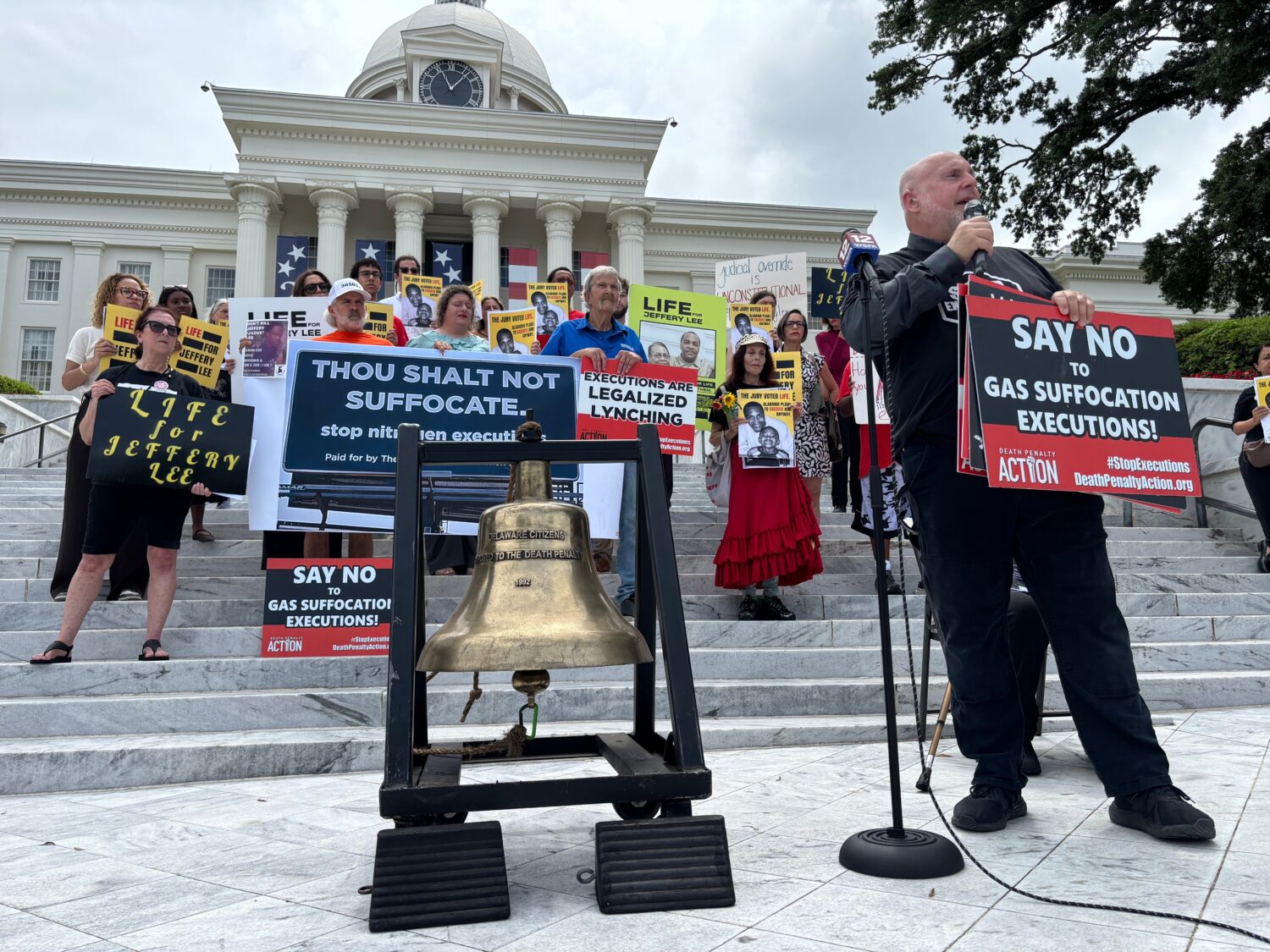
Abraham Bonowitz, of the group Death Penalty Action, leads a demonstration outside the Capitol in Montgomery, Ala., on Monday, June 8, 2026, to oppose an upcoming execution in Alabama. (AP Photo/Kim Chandler)
Credit: AP Photo/Kim Chandler
(AP Photo/Kim Chandler)

Responding to a lawsuit by an Alabama death row inmate, a federal appeals court says the state’s use of nitrogen gas to put people to death needs more study to determine whether it violates a constitutional ban on cruel and unusual punishment.
The appeals court sent the lawsuit filed by death row inmate Jeffery Lee back to the lower court judge for additional consideration.
Monday’s ruling marks the latest potential shift in the United States’ ever-evolving use of capital punishment. States with the death penalty have a variety of execution methods on the books, including lethal injection, electrocution, lethal gas and firing squad.
Here’s a look at the execution methods currently in use and the ones that have fallen out of favor:
Twenty-eight states and the federal government authorize the use of lethal injection, in which an inmate has one or more deadly drugs injected into their bodies as they are strapped to a gurney, according to the Death Penalty Information Center, a Washington, D.C.-based nonprofit center.
But lethal injection has been plagued by problems. States often struggle to obtain the necessary drugs, in part because pharmaceutical manufacturers have banned the use of the lethal injection components for executions.
Some execution teams have struggled or failed to find suitable veins, needles have become clogged or disengaged and in some cases multiple doses of the drugs have been needed to kill the condemned person.
Those problems have prompted some states to experiment with different execution methods. After a botched execution attempt in 2024, Idaho lawmakers made death by firing squad the state’s primary execution method.
Lethal injection was first proposed in New York in the late 1800s, though that state eventually opted to go with electrocution, said Fordham Law School Professor Deborah Denno. The very thing that made lethal injection appealing to death penalty proponents — its relatively sanitized appearance — appalled medical societies around the country, Denno said.
“It’s what people would expect when they walk into a hospital, what you would expect doctors to do who are really concerned that you don’t suffer,” Denno said. “So, you transplant that idea onto a method that’s designed to kill somebody, and that’s a really good marketing tool for the public.”
Six people have been executed by firing squad since 1976, according to the Death Penalty Information Center. The use of firing squads is rare, but support for the approach appears to be growing in some regions.
Five states — Idaho, Mississippi, Oklahoma, Utah and South Carolina — have authorized the use of firing squads, and Florida and North Carolina both have laws allowing any constitutional method of execution to be used if necessary. Tennessee authorizes the use of methods like firing squads if its primary methods are found unconstitutional.
The U.S. Justice Department announced in April that it is adopting firing squads as a permitted method of execution as President Donald Trump’s administration moves to expedite capital punishment cases.
“Not to get political, but there is a strand in our culture that is showing a greater acceptance of the use of violence in this particular context,” said Denno. “In this country’s history, we’ve never had that many states adopt firing squads ever.”
In firing squad executions, a condemned person is usually bound to a chair and is shot through the heart by execution staffers standing up to 25 feet (7.6 meters) away. The method is meant to quickly stop a person’s heart, but it can be botched.
Attorneys for death row inmates in South Carolina say a man put to death by firing squad last year was conscious and likely suffered in extreme pain for as long as a minute because the bullets struck Mikal Mahdi lower than expected.
Nine states authorize the use of electrocution, including Alabama, Arkansas, Florida, Kentucky, Louisiana, Mississippi, Oklahoma, South Carolina and Tennessee. Since 1976, 163 electrocutions have been carried out. But only 19 have been done since 2000.
In this method, a person is strapped to a chair and has electrodes placed on their head and leg before between 500 and 2,000 volts run through their body. The last electrocution took place in 2020 in Tennessee.
Texas killed 361 inmates by electrocution from 1924 to 1964, according to the state’s Department of Criminal Justice.
Since 1976, 163 people have been executed by electrocution, according to the Death Penalty Information Center.
Electrocution executions have been rife with problems, particularly in Florida, where in some executions the condemned person actually caught on fire or was left with deep burns, Denno said. Two states, Georgia and Nebraska, have rendered electrocution unconstitutional.
Still, at least some death row inmates have chosen electrocution or firing squad when offered the choice between those methods and lethal injection. Those choices likely reflect more about the number of botched lethal injection executions in the U.S. than any endorsement of the other methods, said Denno.
Nitrogen gas has been used in eight executions nationally. Seven of those were in Alabama and one in Louisiana.
Other states that include lethal gas as an authorized method are Arizona, Arkansas, California, Mississippi, Missouri, Oklahoma and Wyoming. In lethal gas executions, a condemned person is typically strapped to a chair or gurney in an airtight chamber before it is filled with a lethal gas. A mask is placed over the prisoner’s face and nitrogen gas is pumped in, depriving the person of oxygen and resulting in death. From 1979 to 1999, 11 inmates were executed using cyanide gas.
In 2024, Alabama revived the method, becoming the first state to use nitrogen gas to execute Kenneth Eugene Smith.
Smith shook violently for several minutes during the execution, and a lawsuit filed by another death row inmate contends the process was tortuous and “a human experiment that officials botched miserably.”
In a separate case, a federal appellate panel on Monday reversed a lower court’s finding that Alabama’s method does not violate the U.S. Constitution’s ban on cruel and unusual punishment. The panel sent the lawsuit filed by Lee, a death row inmate, back to the lower court judge for additional consideration.
Lee is still scheduled to be executed with nitrogen on Thursday, but the lower court judge is expected to weigh whether Lee’s proposed alternative of death by firing squad is feasible.
Hanging was the primary method of execution around the world for centuries, said Denno, and that didn’t change in the U.S. until lawmakers became concerned that it might be struck down in the courts.
Data collected by researchers of U.S. executions from 1608 to 2002 found 9,322 people were put to death by hanging. But in capital punishment’s modern era, only three individuals in the U.S. have been executed that way, one each in the years 1993, 1994 and 1996.
“Hangings are really gruesome, and they were also getting increasingly out of control with huge crowds,” said Denno. “That raised a lot of public concern over what this was doing societally, and there was pressure to come up with something more humane. Parallel to all of that, there was concern among some politicians that this could lead to getting rid of the death penalty entirely, so we better come up with something else.”
That same pattern continues today, said Denno.
“States typically change for one of two reasons: One, there’s a series of botches in their particular state and they think the method is going to be constitutionally challenged or it is being constitutionally challenged,” said Denno. “The other reason is that they look at what other states are doing. If you have a bunch of states adopting a new method, and one particular state fears their method may come under challenge, then they’ll switch for that reason.”
___
Former Associated Press reporter Juan A. Lozano contributed.