What to know about Trump’s deployment of National Guard troops to LA protests
Jun 7, 2025, 9:24 PM | Updated: Jun 13, 2025, 9:22 am
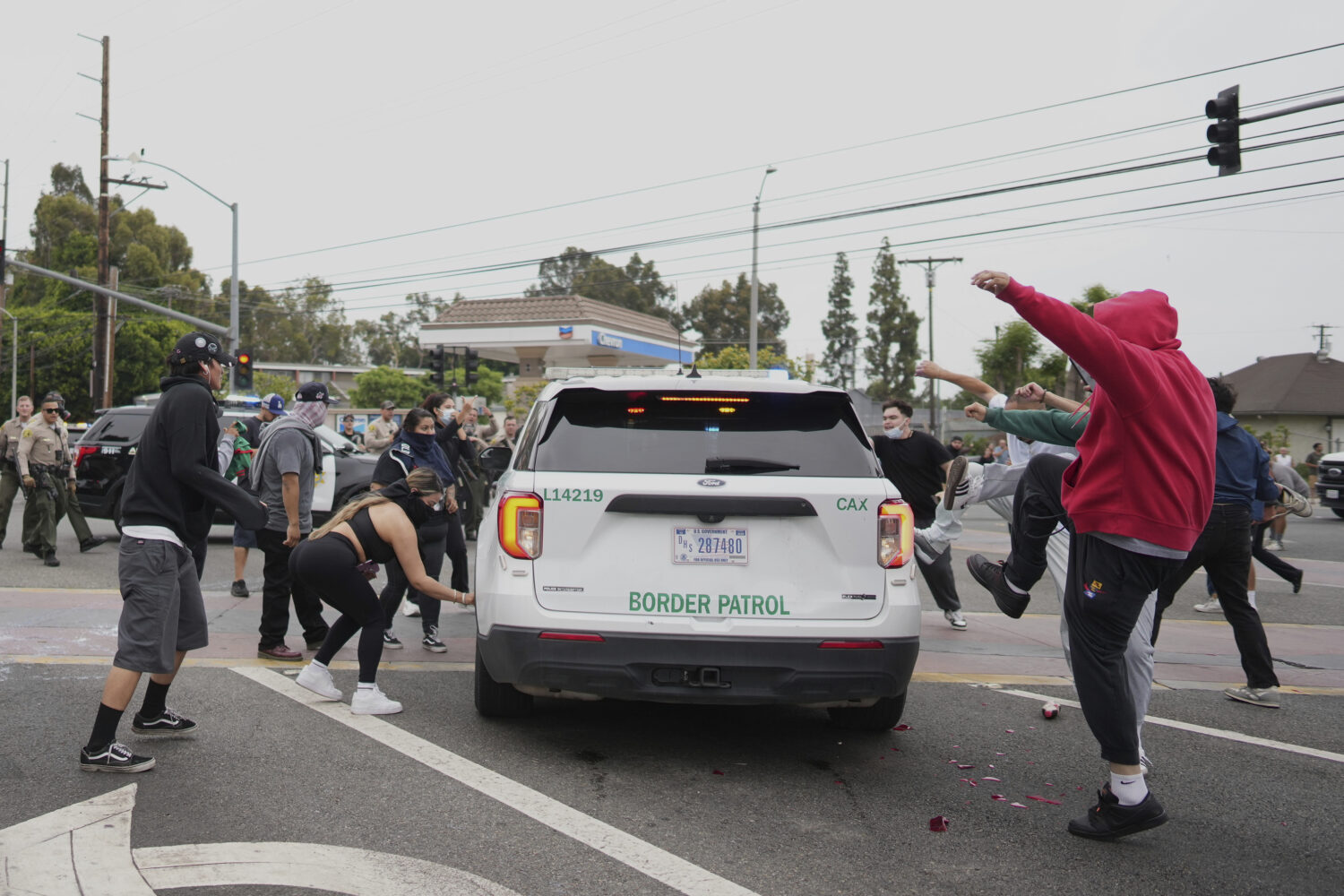
Protesters kick the side of a Border Patrol vehicle during a demonstration over the dozens detained in an operation by federal immigration authorities a day earlier, in Paramount, Calif., Saturday, June 7, 2025. (AP Photo/Eric Thayer)
Credit: ASSOCIATED PRESS
(AP Photo/Eric Thayer)

President Donald Trump says he’s deploying 2,000 California National Guard troops to Los Angeles to respond to immigration protests, over the objections of California Gov. Gavin Newsom.
It’s not the first time Trump has activated the National Guard to quell protests. In 2020, he asked governors of several states to send troops to Washington, D.C. to respond to demonstrations that arose after George Floyd was killed by Minneapolis police officers. Many of the governors he asked agreed, sending troops to the federal district. The governors that refused the request were allowed to do so, keeping their troops on home soil.
This time, however, Trump is acting in opposition to Newsom, who under normal circumstances would retain control and command of California’s National Guard. While Trump said that federalizing the troops was necessary to “address the lawlessness” in California, the Democratic governor said the move was “purposely inflammatory and will only escalate tensions.”
Here are some things to know about when and how the president can deploy troops on U.S. soil.
Generally, federal military forces are not allowed to carry out civilian law enforcement duties against U.S. citizens except in times of emergency.
An 18th-century wartime law called the Insurrection Act is the main legal mechanism that a president can use to activate the military or National Guard during times of rebellion or unrest. But Trump didn’t invoke the Insurrection Act on Saturday.
Instead, he relied on a similar federal law that allows the president to federalize National Guard troops under certain circumstances.
The National Guard is a hybrid entity that serves both state and federal interests. Often it operates under state command and control, using state funding. Sometimes National Guard troops will be assigned by their state to serve federal missions, remaining under state command but using federal funding.
The law cited by Trump’s proclamation places National Guard troops under federal command. The law says that can be done under three circumstances: When the U.S. is invaded or in danger of invasion; when there is a rebellion or danger of rebellion against the authority of the U.S. government, or when the President is unable to “execute the laws of the United States,” with regular forces.
But the law also says that orders for those purposes “shall be issued through the governors of the States.” It’s not immediately clear if the president can activate National Guard troops without the order of that state’s governor.
Notably, Trump’s proclamation says the National Guard troops will play a supporting role by protecting ICE officers as they enforce the law, rather than having the troops perform law enforcement work.
Steve Vladeck, a professor at the Georgetown University Law Center who specializes in military justice and national security law, says that’s because the National Guard troops can’t legally engage in ordinary law enforcement activities unless Trump first invokes the Insurrection Act.
Vladeck said the move raises the risk that the troops could end up using force while filling that “protection” role. The move could also be a precursor to other, more aggressive troop deployments down the road, he wrote on his website.
“There’s nothing these troops will be allowed to do that, for example, the ICE officers against whom these protests have been directed could not do themselves,” Vladeck wrote.
The Insurrection Act and related laws were used during the Civil Rights era to protect activists and students desegregating schools. President Dwight Eisenhower sent the 101st Airborne to Little Rock, Arkansas, to protect Black students integrating Central High School after that state’s governor activated the National Guard to keep the students out.
George H.W. Bush used the Insurrection Act to respond to riots in Los Angeles in 1992 after the acquittal of white police officers who were videotaped beating Black motorist Rodney King.
National Guard troops have been deployed for a variety of emergencies, including the COVID pandemic, hurricanes and other natural disasters. But generally, those deployments are carried out with the agreements of the governors of the responding states.
In 2020, Trump asked governors of several states to deploy their National Guard troops to Washington, D.C. to quell protests that arose after George Floyd was killed by Minneapolis police officers. Many of the governors agreed, sending troops to the federal district.
At the time, Trump also threatened to invoke the Insurrection Act for protests following Floyd’s death in Minneapolis – an intervention rarely seen in modern American history. But then-Defense Secretary Mark Esper pushed back, saying the law should be invoked “only in the most urgent and dire of situations.”
Trump never did invoke the Insurrection Act during his first term.
But while campaigning for his second term, he suggested that would change. Trump told an audience in Iowa in 2023 that he was prevented from using the military to suppress violence in cities and states during his first term, and said if the issue came up again in his next term, “I’m not waiting.”
Trump also promised to deploy the National Guard to help carry out his immigration enforcement goals, and his top adviser Stephen Miller explained how that would be carried out: Troops under sympathetic Republican governors would send troops to nearby states that refuse to participate, Miller said on “The Charlie Kirk Show,” in 2023.
After Trump announced he was federalizing the National Guard troops on Saturday, Defense Secretary Pete Hegseth said other measures could follow.
Hegseth wrote on the social media platform X that active duty Marines at Camp Pendleton were on high alert and would also be mobilized “if violence continues.”