What to know about Trump’s latest tariffs
Jul 24, 2026, 1:37 PM
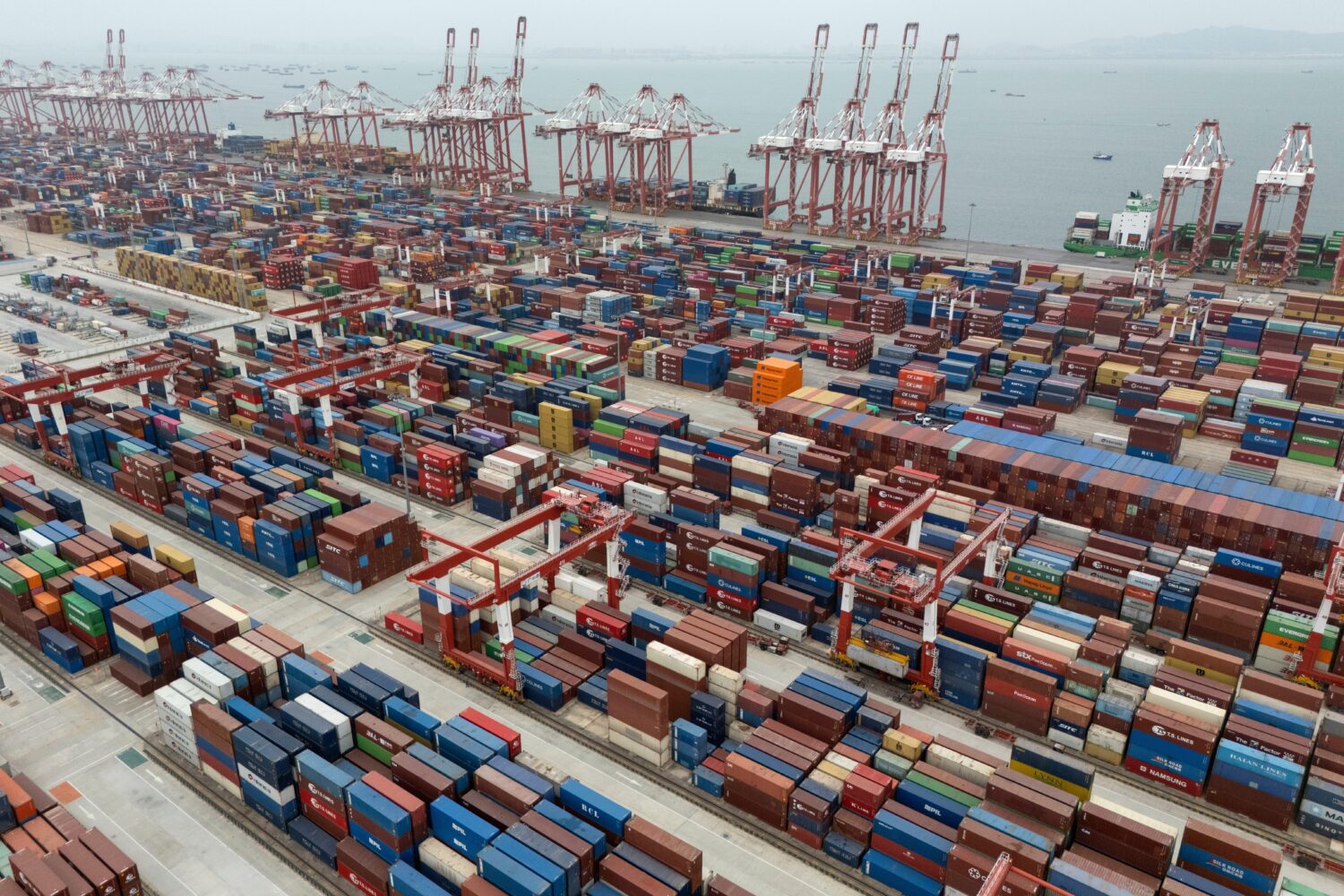
FILE - Shipping containers are seen ready for transport at the Guangzhou Port in the Nansha district in southern China's Guangdong province, April 17, 2025. (AP Photo/Ng Han Guan, File)
Credit: AP Photo/Ng Han Guan
(AP Photo/Ng Han Guan, File)

WASHINGTON (AP) — President Donald Trump keeps finding ways to maintain a wall of tariffs around the American economy.
On Friday, he rolled out new double-digit tariffs on imports from 60 U.S. trading partners, ostensibly for failing to do enough to prevent imports produced by forced labor. But the breadth of the levies — they cover 99% of U.S. imports — suggests another motivation: replacing worldwide tariffs that Trump imposed last year only to see them struck down by the Supreme Court in February.
The forced-labor import taxes also happened to take effect at 12:01 a.m. Friday — precisely when time ran out on temporary global tariffs Trump had imposed after the Supreme Court setback.
The levies were no surprise. They were virtually the same ones that U.S. Trade Representative Jamieson Greer proposed in June. Still, they drew immediate fire from America’s trading partners and from U.S. critics who point out that tariffs are taxes paid by importers — or businesses buying goods from other countries — and are usually passed along to consumers with higher prices.
“This is a blatant attempt to revive Trump’s illegal global tariffs under a different name,” said Oregon Sen. Ron Wyden, the top Democrat on the Senate Finance Committee. “These latest tariffs will continue to keep inflation and prices high for Americans, and do nothing to help workers around the world.”
The Liberty Justice Center, a libertarian advocacy group, has already filed a lawsuit against the new tariffs in a specialized trade court.
Trump’s high-tariff strategy, meant to revive U.S. manufacturing, comes with political risks for the president. Americans are already frustrated with the high cost of living as they prepare for Nov. 3 elections that will determine whether Trump’s Republicans keep full control of Congress.
Here’s what we know.
The new tariffs range from 10% to 12.5% on imports from 60 economies — including major U.S. trading partners like the European Union, India, Japan, Canada and Mexico. The 12.5% rate applies to countries that do not have laws banning imports produced by forced labor. The 10% rate applies to countries that have restrictions on forced-labor imports but are not adequately enforcing them in the Trump administration’s view.
Trump is sparing some products from the new tariffs, including oil and fertilizers, imports that receive favorable treatment under a North American trade pact and products like steel and aluminum already hit with tariffs he imposed on national security grounds.
Friday’s new taxes are being imposed under more a durable trade law: Section 301 of the Trade Act of 1974, which permits the president to place import taxes and other sanctions against countries found to have engaged in unfair trade practices. Trump used Section 301 to slap big tariffs on China in his first term, and they survived court challenges.
Businesses — and, by extension, consumers — are still paying the price of other previously imposed levies. In his second term alone, Trump has added duties on a range of products from specific sectors — using Section 232 of the 1962 Trade Expansion Act. That includes tariffs on imported cars, steel and aluminum, lumber and even kitchen cabinets that are still in effect today.
For much of last year, Trump also levied so-called “reciprocal” tariffs and other more sweeping duties on almost every country in the world by invoking the 1977 International Emergency Economic Powers Act (IEEPA). But those are the tariffs the Supreme Court struck down in February, forcing the administration to pay hefty refunds.
Meanwhile, the prior 10% levy that elapsed on Friday came with a time limit. That’s because Trump imposed it using yet another law, Section 122 of the Trade Act of 1974, which allows levies for just 150 days.
The new tariffs were widely anticipated, and many businesses prepared by front-loading shipments of their goods.
Earlier this month, the National Retail Federation and Hackett Associates forecast that import volume at major U.S. container ports would hit a new all-time record in July, “driven by retailers stocking up ahead of expected tariff increases.”
Because Friday’s duties are so close to the prior 10% levy, Oxford Economics notes that the overall effective rate for U.S. tariffs won’t change by much immediately. But all eyes are on the likelihood of the Trump administration imposing additional Section 301 levies down the road — raising uncertainty for businesses yet again.
The National Retail Federation reiterated Friday that steeper tariffs result in “higher costs for business owners” — and therefore higher prices for consumers. “We encourage the administration to focus on trade agreements with our nation’s trading partners that truly open markets by lowering tariffs, not raising them,” the trade group said in a statement.
Matt Priest, president and CEO of the Footwear Distributors and Retailers Association trade group, said Friday that its footwear manufacturers have already been increasing prices on retailers in an anticipation of the new tariffs in recent months. He noted that last year footwear brands could work with its factories to share higher costs, but shoppers are already now starting to see higher price tags.
For June, overall shoe prices went up 4.1%, while children’s shoe prices rose 4.7% compared with June 2025, he said. He expects prices will keep rising as companies absorb higher fuel costs resulting from the Iran war.
“We don’t see anything in the market right now that’s pushing prices downward, and that’s a concern,” Priest said.
Again, the Trump administration is justifying the latest tariffs on grounds that the targeted countries have failed to do enough to prevent imports produced by forced labor.
“The United States has had a forced labor import ban for nearly a century, and rigorously enforces it; it’s well past time for our trading partners to do the same,” said U.S. Trade Representative Jamieson Greer.
That reasoning was quick to draw sharp objections from major trading partners. Australian Trade Minister Don Farrell slammed the levies as “completely unjustified,” and European Union foreign policy chief Kaja Kallas questioned the Trump administration’s stance while pointing to the “very good” labor conditions on her continent.
Criticism also bubbled up in Washington, much along party lines.
“President Trump isn’t serious about combating forced labor,” Democratic Congresswoman Linda Sanchez wrote in a post on social media platform X. “If he was serious, he would not be applying the same tariff rate to China, one of the worst forced labor abusers in the world, as he does to countries like Australia.”
Both China and Australia face the new 12.5% rate under Friday’s tariffs.
Trade groups across sectors also previously stressed that tariffs of this scope would do little to address forced labor globally.
“Forced labor is a complex, multifaceted issue, and the proposed tariffs will not remedy this global problem,” the Forced Labor Working Group — which includes the National Retail Federation, U.S. Chamber of Commerce and others — wrote in a July 6 letter to Greer during the administration’s investigation. They called on the U.S. to instead pursue “more impactful” measures to address forced labor.
Trump’s doomed IEEPA tariffs delivered a windfall for the U.S. Treasury, generating revenue to help pay for the president’s massive 2025 tax cuts.
With the IEEPA import taxes in full effect, U.S. tariff revenue peaked at more than $31.4 billion last October. Then, after the Supreme Court struck down the IEEPA levies, the money started drying up. Tariff collections dipped to $22 billion in both March and April. As refund checks went out faster than revenue from the Section 122 and other tariffs came in, the number turned negative: A small ($42 million) shortfall in May was followed by a whopping $25.6 billion loss in June.
The Committee for a Responsible Budget, which advocates reduced federal budget deficits, calculates that the new forced-labor tariffs — combined with levies Trump announced this month on Canada and Brazil — will replace less than 60% of the revenue lost when the Supreme Court struck down the IEEPA tariffs.
____
Grantham-Philips reported from New York. AP Journalists Michelle Chapman and Anne D’Innocenzio contributed.