Medved: Our children deserve perspective, not propaganda
Jun 8, 2021, 5:03 PM | Updated: 5:03 pm
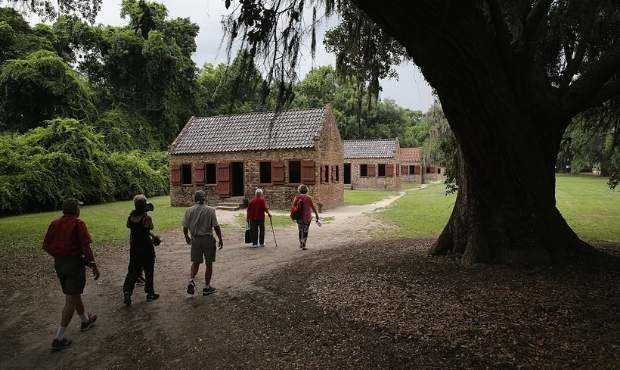
Tourists walk past the former slave quarters of the Boone Hill Plantation on July 16, 2015 in Mount Pleasant, South Carolina. (Photo by John Moore/Getty Images)
(Photo by John Moore/Getty Images)
In this era of much heralded “racial reckoning,” thoughtful citizens should prepare to answer an uncomfortable question: Of all major nations on earth, which one benefited the most from the hideously cruel institution of slavery?
Why is it difficult for us to talk about Critical Race Theory?
Conditioned by the sophistries of Critical Race Theory and the ubiquitous propaganda of The 1619 Project, millions of Americans would, no doubt, feel tempted to identify the United States as slavery’s most shameless beneficiary. After all, the case for reparations, now championed by Democrats in both houses of Congress, rests on the assumption that the nation’s rise from a string of struggling, insecure frontier settlements to a swaggering, globe-straddling colossus, depended principally on the stolen labor of millions of kidnapped Africans.
We commonly speak of slavery as the nation’s “original sin” – suggesting that our national existence has been inextricably entangled with the evil institution since long before independence. No one can question that involuntary servitude is indeed sinful, but the idea that it originated with the United States, or that slavery played an indispensable role in this nation’s origins, lacks both logic and evidence, as does the persistent claim that Americans bear unique historical guilt.
To put the relevant history in a more accurate context, consider one shocking number: 4%.
That’s the highest possible percentage of the African slaves shipped across the Atlantic who ever made their way to the British settlements in North America, or to the new American nation that grew out of them.
Professor Henry Louis Gates of Harvard explained these painstaking calculations in 2014 at TheRoot.com: “The most comprehensive analysis of shipping records over the course of the slave trade is the Trans-Atlantic Slave Trade Database. … Between 1525 and 1866, in the entire history of the slave trade to the New World, … 10.7 million survived the dreaded Middle Passage, disembarking in North America, the Caribbean and South America. And how many of these 10.7 million Africans were shipped directly to North America? 388,000. That’s right: a tiny percentage. In fact, the overwhelming percentage of the African slaves were shipped directly to the Caribbean and South America; Brazil received 4.8 million Africans alone!”
What’s more, the Portuguese Empire and its Brazilian colony, despite their domination of the hideous human traffic across the Atlantic in its first two centuries, weren’t even the worst of the long-time predators when it came to enslaving Africans. Marcus Rediker, author of the 2007 book The Slave Ship: A Human History, declares: “From the seventh century to the nineteenth, more than nine million souls were carried northward in the Trans-Saharan trade organized by Arab merchants in North Africa and their Islamic allies. These slaves were traded in highly developed commercial markets. In many areas, when European slave traders arrived on the coast, they simply entered preexisting circuits of exchange and did not immediately alter them.”
In Constantinople, capital of the vast Ottoman Empire, an estimated 20% of the population consisted of slaves – many of them sold as children to become lifelong shock troops for the Sultan, and many others, young girls doomed to brief lives of sexual servitude.
The reason to revisit this global history isn’t to excuse America’s own role in an international atrocity; to say that our record of racism and exploitation wasn’t as bad as that of the Turks or the Portuguese is to set a very low bar indeed.
But to ignore or downplay slavery’s status as an ancient and universal institution, and to blame the horrible traffic on some conception of white supremacy is to ignore the suffering of enslaved people in China, the Islamic World, The Roman Empire, Russia, and in Africa itself, long before the advent of European colonialism.
Consider the distorted perspective explicitly expressed by the introductory New York Times Magazine remarks presenting their influential 1619 Project. The editor avers that “the country’s very origin” traces to the first ship carrying enslaved people to the Jamestown settlement in Virginia and then proclaims: “Out of slavery – and the anti-black racism it required – grew nearly everything that has truly made America exceptional.”
This ridiculous comment ignores the fact that slavery, in 1619, in no sense counted as exceptional and rather represented the global norm. And contrary to the groundless assertion of the New York Times, some of the rapidly developing patterns of colonial life that did count as exceptional and, indeed unique, in no sense “grew out of” slavery. Take, for instance, the unprecedented ability of people of sharply divergent religious traditions to co-exist productively and peacefully, with a minimum of strife or deadly conflict, after centuries of faith-based bloodshed in Europe, Asia, and everywhere else on earth.
Those who object to current attempts to inspire guilt rather than gratitude in a new generation of American children are of course justified in calling out distortions about our own past, in curricula or media accounts. But we but should simultaneously recognize the devastating impact of the prevailing, national ignorance about the rest of the world, or its long history. The United States is hardly alone in harsh treatment of indigenous peoples, occasional hostility toward immigrants, gaping inequities in economic opportunity, or otherwise falling short of our highest founding ideals. But the nation does count as exceptional in addressing those and other shortcomings and, for the most part, addressing them constructively.
The declaration that America constitutes “the greatest nation on God’s green earth,” which I ritually repeat at the opening of every hour of my radio show, doesn’t amount to a proclamation of perfection. “Greatest” is a relative term, so that in order to make any assessment you need to know something about the field for comparison. In addition to refocusing on their homeland’s glories and virtues, today’s students need more background on the rest of the world to appreciate the Republic’s place in it.
If skeptics as to the nation’s supremely consequential and singular goodness knew more about the globe beyond our borders, our own homeland would look much better. Our children (and their parents) need more than propaganda; they deserve perspective.
You can hear Michael Medved every week day from 12 p.m. – 3 p.m. on KTTH. Also, listen to him join KIRO Radio’s Gee and Ursula Show every Friday.
Follow @https://twitter.com/MedvedSHOW