Tech Talk: Technology helps Seahawks survive late scare, clinch Super Bowl berth
Jan 30, 2026, 6:03 AM
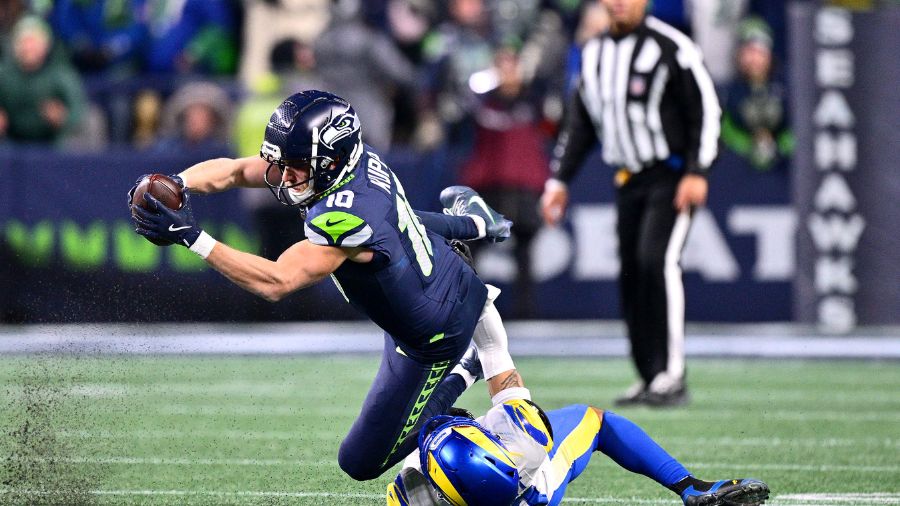
WR Cooper Kupp reaches for a first down late in the NFC Championship game against the Los Angeles Rams. (Photo courtesy of Getty Images)
(Photo courtesy of Getty Images)
One of the most pivotal moments in the Seahawks’ NFC Championship victory Sunday did not come from a touchdown or a turnover, but from a ruling guided by the referees and advanced replay technology.
Late in the fourth quarter, Seattle held a four-point lead when Cooper Kupp made a short catch on third down with just three minutes remaining. As he stretched toward the line to gain, Kupp was twisted to the ground and the ball came loose at the end of the play, briefly raising the possibility of a game-altering fumble.
The play ignited a firestorm of scrutiny among football analysts around the country — firstly, was it a catch or incomplete?
“This is a huge play,” Football Firsts’ Kevin Kennedy said. “He catches the ball, he takes two steps.”
Those two steps established that Kupp completed the process of making a completion under NFL rules.
“Therefore, when he hits the ground, the ground cannot cause a fumble, so he is down upon impact,” Kennedy explained.
That decision kept the Seahawks’ drive alive, but the bigger question still remained, and that is where technology swooped in to help.
Whether Kupp had reached the line to gain for a first down was too close to determine by eyesight alone. The margin was measured in inches, if not less.
RELATED STORIES



The NFL’s high-tech replay system

One of six dedicated 8K cameras installed in NFL stadiums for the league’s Hawk-Eye SMART replay system. (Photo courtesy of the Seattle Seahawks)
To make the call, officials were assisted by the NFL’s Hawk-Eye SMART replay system, a technology that combines every broadcast camera angle with six dedicated 8K cameras installed in NFL stadiums. The system allows replay crews at the stadium and at league headquarters in New York to rapidly analyze the precise placement of the football.
Using those measurements, officials confirmed that the ball had crossed the line to gain, awarding Seattle a crucial first down in its most significant postseason game in more than a decade.
The Seahawks went on to run down the clock and secure the win, punching their ticket to the Super Bowl.
Kupp later acknowledged that extending the ball on third down is typically discouraged because of the risk involved, even though the play ultimately worked in his favor.
“Yeah, you never, you never reach on third down,” Kupp explained in a press conference one day after the game. “You reach for it on third down, you fumble. The opportunity is gone. Now you’ve eliminated the chance for anything on fourth down, and so that’s why you don’t do it on third, but it worked out.”
In a game defined by narrow margins, the outcome came down to precision, aided by technology designed to measure it.
Follow Luke Duecy on X. Read more of his stories here. Submit news tips here.