SEATTLE NEWS ARCHIVES & FEATURES
Contested house for sexually violent predators inspires bill in Legislature
Feb 13, 2020, 4:33 PM | Updated: Feb 14, 2020, 6:00 am
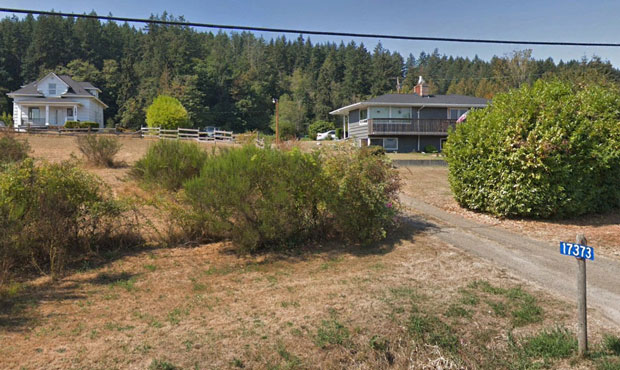
The home of the four sexually violent predators, right, as viewed from the school bus stop 150 feet from the property line on Viking Way just outside Poulsbo. (Washington State for Public Safety)
(Washington State for Public Safety)
A Kitsap County house for four Level 3 sexually violent predators that was the center of controversy last year has inspired a new piece of legislation in the Washington State Senate.
Senate Bill 6436 tightens requirements for SVPs transitioning away from court-ordered confinement at the Special Commitment Center on McNeil Island and back into the community through the state’s less restrictive alternative program.
“[It requires] better safeguards, more accountability from the state, and more notification so that the housing is placed where it is not in the vicinity of children,” said Sen. Christine Rolfes (D-Bainbridge Island), one of the bill’s sponsors.
Sexually violent predators are defined by law as “any person who has been convicted of or charged with a crime of sexual violence and who suffers from a mental abnormality or personality disorder which makes the person likely to engage in predatory acts of sexual violence if not confined in a secure facility.”
Verdict: House for sexually violent predators a violation of county code
When a less restrictive alternative house for four SVPs on conditional release from McNeil Island opened in late 2018 in a residential area outside Poulsbo, just 150 feet from a school bus stop, neighbors formed Washington State for Public Safety. The group works with state and local lawmakers to advocate for stricter laws around sexual predator placement.
“If this is happening in our neighborhood, this could happen in anyone’s neighborhood, and so we knew what needed to happen was changes to the law,” WSPS Director Tricia Benson stated.
Kitsap County found the Viking Way house to be in violation of county code last summer, but the company operating the house successfully appealed this decision and was allowed to continue operations.
Tighter regulations around release of sexually violent predators
SB 6436 requires any sexually violent predator petitioning for conditional release to have progressed far enough in sex offender treatment at the Special Commitment Center to be deemed not a risk to the community by a court.
“Right now, there’s no affirmative that the community is not at risk — there’s an assumption that the community is not at risk,” Rolfes said. “It would make that determination the responsibility of the court.”
Benson said in the past, SVPs have been granted conditional release even when it was not supported by their treatment providers, the Washington State Department of Corrections, and the Department of Social and Health Services. It’s imperative to make sure that people conditionally released are thoroughly vetted, she said, because it only takes one time for a life to be forever harmed.
“Statistics tell us that there are going to be individuals who re-offend — you can’t get away from those numbers and that data,” she said. “It will happen, it can happen — are we really going to use the measure [of waiting] until we actually have a hands-on physical assault of one of our children?”
The Senate bill also requires a greater amount of information to be provided to the public by the county sheriff’s office when a Level 3 sex offender is released into the community. While current sheriff’s notifications and online listings of sexually violent predators include the person’s name, photo, a list of convictions, address by 100 block, and physical description, the new system would additionally require the SVP’s civil commitment status and history, as well as a description of prior sex offenses, so that community members can be especially aware of what to watch out for. Additionally, a community meeting must be held.
“If the community isn’t notified ahead of time, nobody is there to say, ‘There is a school bus stop,’ or, ‘There is a daycare,'” Rolfes said.
The legislators and citizen group believe that a more thorough notification system might have prevented the four SVPs at Viking Way from being moved to a location so close to children.
“The whole siting process has been a mess in my county, in Kitsap County, in terms of mixed information from state agencies, and a real concern that the one home that has been placed is in a residential neighborhood … The community wasn’t notified ahead of time, and they’re all concerned about their public safety,” Rolfes said.
Secure community transition facility mandate
The other major change the bill implements is requiring all SVPs on conditional release to live at a secure community transition facility before moving into any other less restrictive alternative.
Right now, the state operates just two secure community transition facilities, residences that are legally required to include specific security precautions, such as resident GPS monitoring, 24/7 staff trained in sex offender treatment, and electronic security systems. Transition facilities must also be away from the “line of sight” of “potential risks,” such as schools or playgrounds.
Poulsbo neighbors fear for children after sex offenders move in
WSPS argues that the Viking Way house operates with the intention of a secure community transition facility, but without the mandated precautions.
“We need to call it what it is — we need to call it a secure community transition facility,” Benson said. “We need to make sure that they are regulated appropriately, where they have the same level of security across the board, and that they’re not placed near children and families in residential neighborhoods.”
Currently, she said, conditionally released SVPs are not all legally bound to have the same security measures — each less restrictive alternative differs.
Sen. Steve O’Ban (R-Tacoma) signed on to the bill because he has seen SVPs placed in adult family homes in his district. Adult family homes, he said, were originally meant to be for the elderly or for adults living with developmental disabilities.
“My district has a disproportionate number of adult family homes that have taken [released inmates] from the Special Commitment Center … I don’t think they’re appropriate locations for those folks,” he said.
To O’Ban’s relief, SB 6436 prohibits SVPs being placed in adult family homes. Putting the most dangerous sex offenders with society’s most vulnerable can have disastrous results, O’Ban noted — he pointed out a 2018 case where a former Western State Hospital patient with a violent history murdered a disabled senior with a coffee mug at a Lakewood adult family home.
“They’ve morphed into a facility that takes people with violent tendencies … we have to be far more careful and selective about where we put individuals with recorded violent pasts,” he said.
With legislators from both sides of the aisle sponsoring the Senate bill — the other sponsors are Sen. Emily Randall (D-Bremerton) and Sen. Claire Wilson (D-Auburn) — O’Ban is optimistic about its future.
“The best bills tend to be the ones that have the best work that’s been done to try to work out any partisan issues,” he said. “I hope that this bill, because it does have bipartisan support, will get through the Legislative session this year.”
The house that set off the debate
The Viking Way house never leaves Benson’s mind. She sees it every day on her way to work, fearing for the families living next door and thinking of the neighbors who have reported seeing men at the windows watching their children at the school bus stop. She no longer takes her children to places that have been approved for the SVPs — including stores, local parks, and cinemas.
“I don’t want the possibility of having my children in their presence,” she said. “Even if nothing does happen, I don’t even want them to be able to see them, or think about them, or use them as one of their sexual fantasies.”
If SB 6436 passes, it will not retroactively affect the SVPs living at the Viking Way house, but it will apply to any new residents moved there in the future. Benson feels relieved at the thought of tighter regulations.
“I don’t dispute that civil commitment is a treatment program, and I also don’t dispute that some of these sexually violent predators have the ability to be rehabilitated, but … I don’t understand the argument that we need to have compassion for their rehabilitation, as if residential neighborhoods are the only place to put them,” Benson said. “We have plenty of areas outside of neighborhoods with children and families.”
Sen. Rolfes agrees that there is a careful balance between the constitutional rights of SVPs and the security of their fellow community members.
“This category of offender is deemed likely to re-offend — but they do have their civil liberties, they do have their rights,” she said. “So the state has compromised by saying, ‘These people can live in the community, they don’t have to stay locked up on McNeil Island, but there are safety elements put in place.'”