SEATTLE NEWS ARCHIVES & FEATURES
UW professor explains criticized minimum wage study
Jun 26, 2017, 3:40 PM | Updated: 3:41 pm
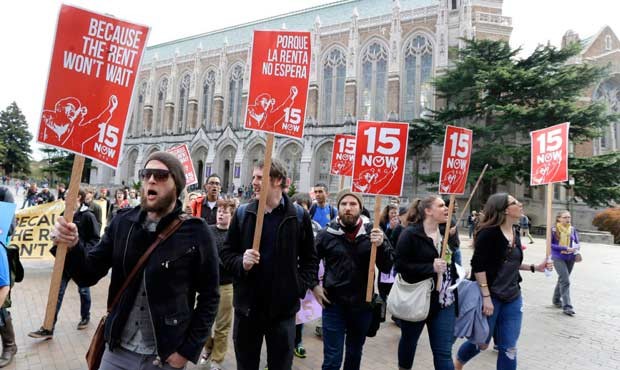
In this April 1, 2015, file photo, students and other supporters protest on the University of Washington campus in Seattle, in support of raising the minimum wage for campus workers to $15 an hour. Seattle's $15-an-hour minimum wage law has cost the city jobs, according to a study released Monday, June 26, 2017, that contradicted another new study published last week. (AP Photo/Ted S. Warren, File)
(AP Photo/Ted S. Warren, File)

One of the big questions asked even before Seattle’s minimum wage law went into effect is still being asked today: What is the net effect on jobs and workers?
A report released by the University of Washington, which was commissioned to study the law by the Seattle City Council, found that although the economy absorbed the first wage increase from $9.47 an hour to $11 an hour, things were different when wages increased again.
Mark Long, associated dean of research and professor of public policy and governance, told KIRO Radio’s Dori Monson that when the wage increased Jan. 1 to $13 an hour for some small employers and $15 an hour for some large employers, it caused a reduction in hours for low-wage workers. Long, co-author of the latest UW report, says they found an approximate 9 percent decline in the number of hours for those earning less than $19 an hour. That offsets the 3 percent increase in pay workers got, having a negative impact overall.
Based on the current data, it comes out to about $125 per month for low-wage earners, Dori pointed out. It’s a “real world impact.”
“I would agree with that conclusion,” Long said.
Currently, small employers (those with 500 or fewer employees) must pay employees $13 an hour if they are not paying $2 an hour toward medical or $2 an hour in tips, or $11 an hour if they are. Large employers (501 or more employees) must pay $15 an hour if they do not pay toward medical benefits or $13.50 if they are.
According to the study, there are about 5,000 fewer jobs now than what is projected would be in the city if there were no minimum wage law.
The report follows another by University of California Berkeley economists, who found the law didn’t hurt the number of jobs in the restaurant industry. The author of that report, Michael Reich, has criticized the UW’s study.
Reich argues that UW did not properly compare the real Seattle to a statistical model. The model, according to Reich, were based on areas of the state that do not compare to Seattle. Reich’s model compared Seattle to a model based on other areas around the country. He also argues that excluding “multisite businesses” like restaurants and retail has skewed the data.
But if the data is accurate, it could have major implications for the future, Dori points out. A downturn in the economy could mean a loss of more jobs and more hours.
“One of the things you’d expect to happen during recession is you’d expect wages to fall. But if wages can’t fall, it would be harder for employers to hire workers given the reduction in aggregate demand due to the recession,” Long said.
Listen to the entire interview here.