A familiar refrain as China and Japan, uneasy neighbors in East Asia, begin 2026 at odds again
Jan 8, 2026, 12:34 AM | Updated: 1:12 am
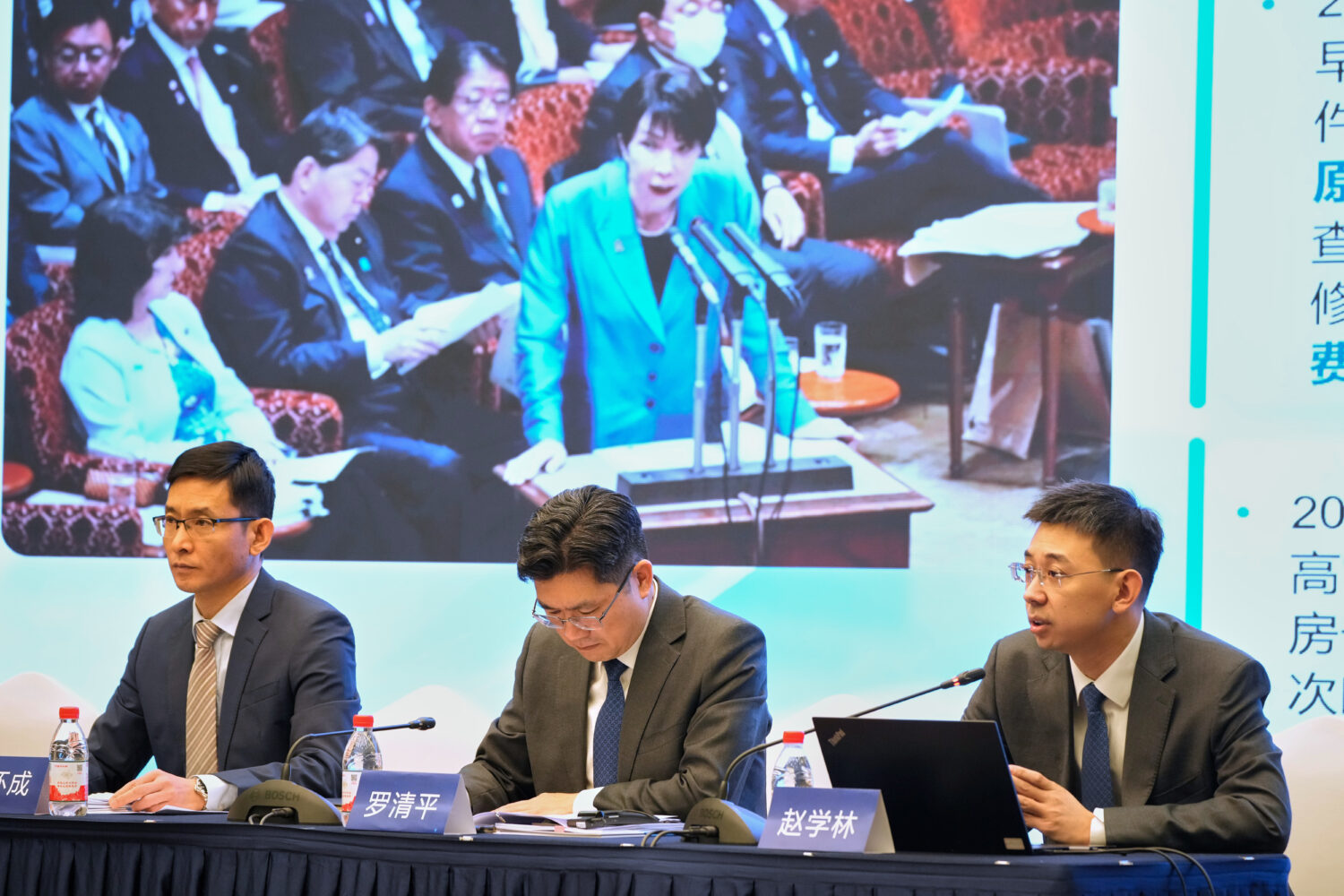
From left to right, Dan Huaicheng, secretary-general of China Arms control and Disarmament Association (CACDA), Luo Qingping, chairman of China Institute of Nuclear Industry Strategy, and Zhao Xuelin, engineer of China Institute of Nuclear Industry Strategy, attend a press conference on release the research report "Nuclear Ambitions of Japan's Right Wing Forces: A Serious Threat to World Peace" at a hotel in Beijing, China, Thursday, Jan. 8, 2026. (AP Photo/Vincent Thian)
Credit: ASSOCIATED PRESS
(AP Photo/Vincent Thian)

BEIJING (AP) — They’re at it again.
China and Japan — frenemies, trading partners and uneasy neighbors with a tortured, bloody history they still struggle to navigate — are freshly at each other’s rhetorical throats as 2026 begins. And it’s over the same sticking points that have kept them resentful and suspicious for many decades: Japan’s occupation of parts of China in the 20th century, the use of military power in East Asia, economics and politics — and, of course, pride.
From insinuations that Chinese citizens face dangers in Japan to outright accusations of resurgent Japanese imperialism, this first week of the year in China has been marked by the communist government scorning Tokyo on multiple fronts and noticeably embracing the visiting leader of another crucial strategic neighbor: South Korea.
The latest chapter in Japan-China enmity surged In November when Japan’s new leader waded into choppy bilateral waters. She said, in effect, that if China moved militarily against Taiwan, she wouldn’t rule out involving Japan’s constitutionally defense-only military. That didn’t go over well in Beijing, which has teed off on Tokyo over the years for far less.
“Prime Minister Sanae Takaichi’s erroneous remarks concerning Taiwan infringe upon China’s sovereignty and territorial integrity, blatantly interfere in China’s internal affairs, and send a military threat against China,” Foreign Ministry spokesperson Mao Ning said Wednesday, a week after military exercises around the island ended. “We urge Japan to face up to the root causes of the issue, reflect and correct its mistakes.”
That’s hardly uncommon language. China frequently demands Japan ponder the path it has taken and correct its “erroneous” course. It’s rhetoric, sure, but it goes far deeper. And sometimes it’s hard to tell what’s real umbrage and what’s ginned up for domestic political consumption.
Because when it comes to the China-Japan relationship, anger remains a powerful and enduring tool on both sides. And there’s no indication that’s going away anytime soon.
From the time Japan colonized Taiwan in 1895 after a war with Qing Dynasty China, a deep suspicion and at times outright enmity has existed between the two countries.
It worsened in the 1920s and 1930s after Japan’s brutal occupation of parts of China resulted in torture and deaths that Chinese resent to this day. At the same time, Japanese leaders have sometimes thrown incendiary political footballs like visits to the Yasukuni Shrine, a memorial to Japanese who gave their lives in the nation’s wars — including some war criminals from the Sino-Japanese wars. China, like clockwork, responds with indignation.
Japan lost World War II to the Allied powers and relinquished offensive military powers under a U.S.-drafted constitution, even as the current communist Chinese government was establishing the People’s Republic in 1949. Since then, any hint of Japanese military assertiveness has drawn great umbrage here. Disputes over territory, such as an island chain called Diaoyu by China and Senkaku by Japan, spike occasionally
The enmity, pulled out when something is perceived as aggressive or anger is required for a domestic audience, lurks barely beneath the surface, ready to pop. Even today, cartoons circulate online in China depicting Japanese as demonic, aggressive and anti-China.
This week has been an illuminating case study.
On Tuesday, China slapped restrictions on “dual-use exports” to Japan — anything, it said, that Japan could adapt for military use. Though it didn’t specify what the ban includes, anything from drones to rare earths could be considered dual-use. The lack of specificity allows China to adjust its approach as it goes — making it more or less strict depending on where the political winds are blowing.
Japan demanded the move be rescinded. “These measures, which only target Japan, deviate significantly from international practice,” its Foreign Ministry said, calling China’s actions “absolutely unacceptable and deeply regrettable.” This came days after it protested Chinese mobile drilling rigs in the East China Sea.
While the Chinese Commerce Ministry did not mention rare earths curbs, the official newspaper China Daily, seen as a government mouthpiece, quoted anonymous sources saying Beijing was considering tightening exports of certain rare earths to Japan.
On Wednesday, the focus turned to a gas called dichlorosilane, used in computer chip manufacturing. The Commerce Ministry said it had launched an investigation into why the price of dichlorosilane imported from Japan had decreased 31% between 2022 and 2024. “The dumping of imported products from Japan has damaged the production and operation of our domestic industry,” it said.
Finally, on Thursday, China’s Arms Control and Disarmament Association, a nongovernment agency (inasmuch as any agency in China is nongovernmental) released with some fanfare a report provocatively titled “Nuclear Ambitions of Japan’s Right-Wing Forces: A Serious Threat to World Peace.” It spent 29 pages outlining worries and accusations that Tokyo harbors dangerous nuclear ambitions.
But it also went broader, invoking once again its stance that the nation’s right-wing leaders — and, by extension, the whole country itself — have “failed to reflect on Japan’s history of aggression.”
“Japan has never been able to fully eliminate the scourge of militarism in the country,” the report said. “If Japan’s right-wing forces are left free to develop powerful offensive weapons, or even possess nuclear weapons, it will again bring disaster to the world.”
Also part of the equation this week: China’s visible pivot to another regional neighbor, South Korea, whose president spent four days in Beijing. Seoul has a bumpy history of its own with Japanese aggression and also sporadic — though generally less intense — friction with Beijing, a longtime supporter and ally of its rival North Korea.
Chinese media gave splashy coverage to Lee Jae Myung’s visit, touting new Beijing-Seoul agreements on trade, environmental protection and transportation — and notably technology, given the dual-export ban. Also visible: Lee at two business events watching major companies pledge increased collaboration. The sides signed 24 export contracts worth a combined $44 million, according to South Korea’s Ministry of Trade, Industry and Resources.
The burst of official affection toward South Korea didn’t stop with Lee. While he was here, Chinese media reported that South Korea overtook Japan as the leading destination for outbound flights from the mainland over New Year’s. That’s on top of Beijing’s recent efforts to discourage Chinese from traveling to Japan, citing “significant risks to the personal safety and lives of Chinese citizens” there.
For now, Japan-China tension remains a matter of rhetoric and policy. But no one is predicting a quick resolution. With Japan’s staunch ally, the United States, planning to furnish more arms to Taiwan in a single sale than ever before, there’s too much at stake for both East Asian nations at this moment — and too much contentious history — for an easy and quick solution.
“This time … de-escalation and a return to the status quo may not be as easily achieved,” Sebastian Maslow, an East Asia specialist and associate professor of international relations at the University of Tokyo, wrote in The Conversation last month. “With diplomatic channels in short supply and domestic political agendas paramount, an off-ramp for the current dispute is not in sight.”
___
Ted Anthony has written about China for The Associated Press since 1994.