DEA quietly resumes anti-drug coordination with Bolivia almost 20 years since its expulsion
Feb 13, 2026, 1:21 PM
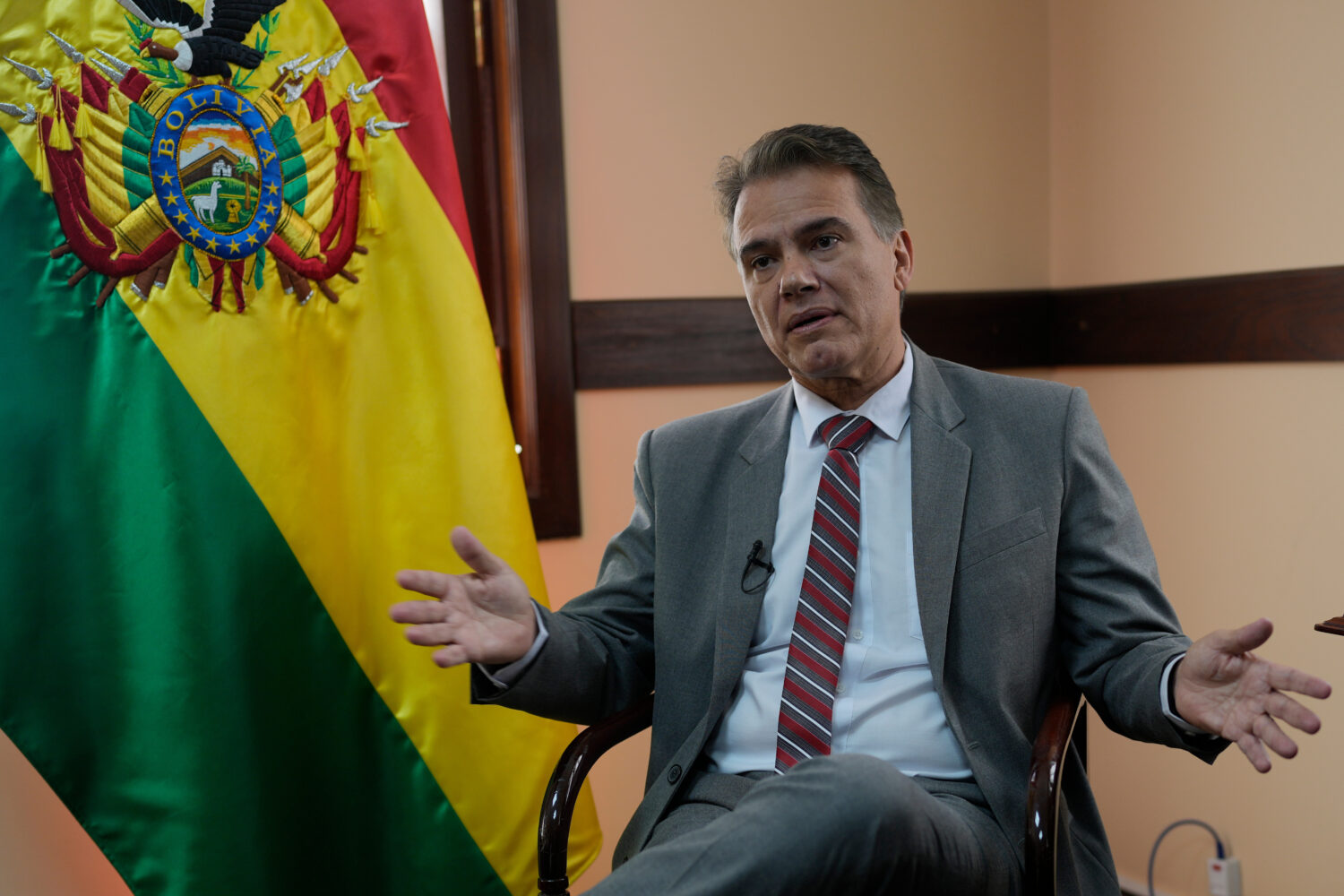
Bolivia's Vice Minister of Social Defense and Controlled Substances Ernesto Justiniano gives an interview in La Paz, Bolivia, Thursday, Feb. 12, 2026. (AP Photo/Juan Karita)
Credit: ASSOCIATED PRESS
(AP Photo/Juan Karita)

LA PAZ, Bolivia (AP) — The United States has resumed intelligence coordination on counternarcotics efforts with Bolivia under its conservative president, a high-ranking Bolivian official said, reviving a sensitive relationship nearly 20 years after left-wing former President Evo Morales expelled U.S. anti-drug agents from the world’s third-biggest producer of cocaine.
While officials finalize the details of a deal that will see the Drug Enforcement Administration return to the Andean nation, the U.S. has started sharing information on transnational criminal networks with Bolivian law enforcement and helping vet and train officers, Bolivia’s Vice Minister of Social Defense and Controlled Substances Ernesto Justiniano told The Associated Press in an interview late Thursday.
“We are already receiving support in various ways, in the training and integrity analysis of personnel,” Justiniano said. “There is a lot of intelligence, resources, they can provide us, and we need it.”
The DEA did not respond to a request for comment on Justiniano’s remarks, his first to foreign media on the U.S. counternarcotics assistance already underway in Bolivia.
The quiet resumption of coordination comes as Bolivian President Rodrigo Paz, a centrist former senator who took office last November, restores full diplomatic relations with Washington after nearly two decades in which Morales’ Movement Toward Socialism party, or MAS, shunned the West in favor of China, Russia, Cuba and Iran.
U.S. Secretary of State Marco Rubio has praised Paz’s election as a “transformative opportunity for both nations” as the Trump administration overhauls decades of U.S. policy to try to make Washington the dominant world power in the Western Hemisphere.
The exact details of the DEA’s renewed presence in Bolivia are still being hammered out, with Justiniano saying that there were “still a couple more meetings to be held, an agreement to be finalized by the foreign ministry.”
But experts say the agency’s return marks an important foreign policy achievement for the U.S. in Latin America, where President Donald Trump’s deployment of military force against cartels smuggling drugs galls traditional allies like Colombia and Mexico.
“We have little idea what’s been going on these past 20 years, so having the DEA back there can open a lot of other doors for the U.S.,” said retired U.S. diplomat Daniel Foote, who served in the Peace Corps in Bolivia during the cocaine heyday and later worked on counternarcotics policy in the country. “This is as much about helping Bolivia as it is keeping the U.S. safe.”
Justiniano was equivocal when asked if this renewed U.S. assistance would look like a return to the heavy-handed policies of the late 1990s, when DEA-backed Bolivian forces got into deadly clashes with farmers as they moved in to burn crops that had sustained Indigenous communities for centuries.
He acknowledged the sensitivities, particularly in the coca leaf-growing jungle region near Bolivia’s central city of Cochabamba where resentment lingers over Washington’s militarized approach. National backlash in 2006 vaulted Morales, a charismatic former coca growers ’ union leader, to power and helped sustain his popularity for an unprecedented three consecutive terms.
“In Bolivia, when it comes to language, you have to be very careful,” Justiniano said. “Are we going to have bases full of gringos here? No, that’s not going to happen.”
But Bolivia “would welcome” the DEA, along with other regional forces, playing a direct role in its interdiction operations on the ground, he said, adding: “We do need to conduct joint operations.”
Farmers in the tropical Chapare region are girding for harder-line policies that could impede legal production of coca, the mild stimulant chewed and revered for millennia among Indigenous communities but stigmatized abroad as the raw material for cocaine.
“We will not allow the establishment of any military base in the Cochabamba tropics,” coca growers’ leader Aquilardo Caricari said at a recent press conference, citing the arrests and killings of farmers in the 1990s.
Morales, for his part, has been hiding out in the Chapare for months evading an arrest warrant linked to allegations of statutory rape that he denies. He has not appeared publicly since the Jan. 3 U.S. seizure of his ally, former Venezuelan president Nicolás Maduro amid speculation he may have slipped out of the country.
As the first Indigenous president of majority-Indigenous Bolivia, Morales made coca leaves central to his agenda of resisting foreign meddling and promoting Andean heritage.
Decriminalizing the leaf and extolling its medicinal benefits, he allotted coca plots of 1,600 square meters (1,913 square yards) to farming families and empowered unions to stop excess production.
But the legal market for the plant’s traditional use didn’t put off the illicit one for its processing into cocaine, officials say, where the prices offered are much higher.
Justiniano claimed that over 90% of the coca grown in the Chapare is now diverted into the cocaine trade, but that obtaining data about drug trafficking in Bolivia has been almost impossible since Morales kicked out U.S. anti-narcotics agents in 2008.
At the time of its expulsion, the DEA had about 100 agents in four offices across the country — the agency’s second-biggest foreign footprint outside Colombia.
Ever since, Foote said, “Bolivia has been a blind spot.”
The once-sleepy city of Santa Cruz in eastern Bolivia is now a thriving hub for traffickers who live in modern, gated suburbs, drawn from as far afield as Albania and China.
In an echo of history, Paz is seeking to reclaim Bolivia’s place as U.S. ally in the fight against drugs nearly four decades after his father, former President Jaime Paz Zamora, did the same.
By the time Paz Zamora took office in 1989, Colombia’s Medellin and Cali cartels had been using Bolivia as an air bridge for years, purchasing semi-processed coca paste for conversion into cocaine powder to distribute globally.
Paz Zamora invited the U.S. military to train Bolivia’s security forces, extradited cocaine kingpins to face charges in the U.S. and dismissed members of his own government accused of taking drug money, remembers Robert Gelbard, the U.S. ambassador to Bolivia at the time.
While the efforts successfully drove down cocaine production, Gelbard said he hoped that this time, under the younger Paz, the DEA wouldn’t take “the sort of aggressive approach we followed in the 1990s.”
Even if Bolivia wanted the DEA to return with guns blazing, it might not get much cooperation from Washington. The agency ordered the closure of more than a dozen offices worldwide during the Biden administration.
Jaime Aparicio, the former Bolivian ambassador to Washington, expects Trump to be different.
“Drugs are his main enemy in this region,” he said.
___
DeBre reported from Buenos Aires, Argentina. Associated Press writer Joshua Goodman contributed from Miami.