Detailed findings from AP investigation into how US tech firms enabled China’s digital police state
Sep 8, 2025, 9:30 PM
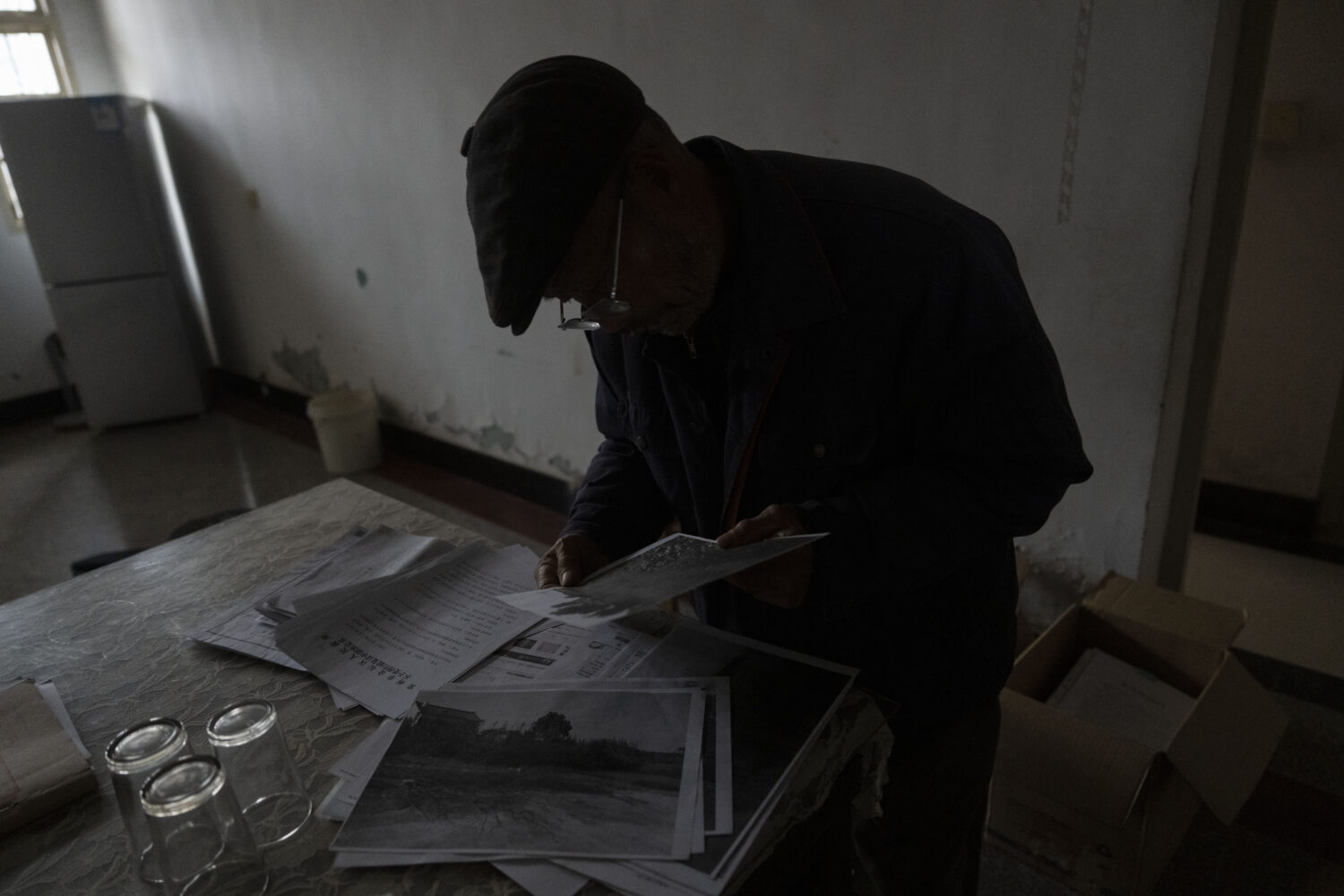
Petitioner Yang Guoliang looks through documents at his home in Changzhou in eastern China's Jiangsu Province, Friday, Dec. 13, 2024. (AP Photo/Ng Han Guan)
Credit: ASSOCIATED PRESS
(AP Photo/Ng Han Guan)

BEIJING (AP) — American tech companies to a large degree designed and built China’s surveillance state, playing a far greater role in enabling human rights abuses than previously known, an Associated Press investigation found. They sold billions of dollars of technology to the Chinese police, government and surveillance companies, despite quash dissent, persecute religious sects and target minorities.
The AP investigation was based on tens of thousands of leaked emails and databases from a Chinese surveillance company; thousands of pages of confidential corporate and government documents; public Chinese language marketing material; and thousands of procurements, many provided by ChinaFile, a digital magazine published by the non-profit Asia Society. The AP also drew from dozens of open record requests and interviews with more than 100 current and former Chinese and American engineers, executives, experts, officials, administrators, and police officers.
American tech firms were by far the biggest suppliers, but German, Japanese, and Korean firms also had a role. Here are some examples:
MILITARY ACCESS: A Chinese military contractor worked with Armonk, New York-based IBM in 2009 to design national intelligence systems, including a counterterrorism system, according to classified Chinese government documents. These systems were used by China’s secret police, the Ministry of State Security, and the Chinese military. IBM referred to any such deals as “old, stale interactions”: “ … If older systems are being abused today — and IBM has no knowledge that they are — the misuse is entirely outside of IBM’s control, was not contemplated by IBM decades ago, and in no way reflects on IBM today.”
ANTI-TERROR ANALYSIS: IBM agents in China sold IBM’s i2 policing analysis software to the Xinjiang police, China’s Ministry of State Security, and other Chinese police units throughout the 2010s, leaked emails show. i2 software was subsequently copied and deployed by one former IBM agent, Landasoft, as the basis for a predictive policing platform that tagged hundreds of thousands of people as potential terrorists during a brutal crackdown in China’s far west Xinjiang region. IBM says it ceased relations with Landasoft in 2014, prohibited sales to police in Xinjiang and Tibet since 2015, and has no record of any sales of i2 software to the Public Security Bureau in Xinjiang.
ETHNIC REPRESSION: Dell and then-subsidiary VMWare sold cloud software and storage devices to police and entities providing data to police in Tibet and Xinjiang, even as late as 2022 after ethnic repression there was widely known. Dell addressed race in its marketing: In 2019, Dell said on WeChat it had teamed up with surveillance firm Yitu to sell a “military-grade” AI-powered laptop for Chinese police with “all-race recognition.” Dell, based in Round Rock, Texas, told AP it conducts “rigorous due diligence” to ensure compliance with U.S. export controls. Chinese policing systems, including in Xinjiang, also used software from Oracle, based in Austin, Texas, and from Microsoft, based in Seattle, according to procurements and a leaked database obtained by AP.
FINGERPRINT RECOGNITION: Chinese defense contractor Huadi worked with IBM to construct China’s national fingerprint database; IBM said it never sold “fingerprinting-specific” products to the Chinese government and that any possible misuse “for fingerprinting purposes” was done without its knowledge or assistance. HP and VMWare sold technology used for fingerprint comparison by Chinese police. Intel said in 2019 marketing material that it partnered with Hisign, a Chinese fingerprinting company that sold to Xinjiang police, to make their fingerprint readers more effective, and that the new reader was “fully tested in an actual application scenario” with a municipal police bureau. Hisign was still an Intel partner as of last year, according to Chinese media reports. California-based Intel said it has not had any technical engagement with Hisign since 2024, and told AP it would “act swiftly” if it became aware of any “credible misuse.”
AI CAMERAS: IBM, Dell, Tokyo-based Hitachi, and VMWare promoted facial recognition for use by Chinese police. Japanese electronics giant Sony said on its official WeChat account that it wired a Chinese prison with “intelligent” cameras, saying it was widely trusted for “surveillance projects.” California chip giant NVIDIA and Intel partnered with China’s three biggest surveillance companies to add AI capabilities to camera systems used for video surveillance across China, including in Xinjiang and Tibet, until sanctions were imposed. Relations with other Chinese surveillance companies continued more recently: NVIDIA posted on its WeChat social media account in 2022 that Chinese surveillance firms Watrix and GEOAI used its chips to train AI patrol drones and systems to identify people by their walk. NVIDIA told AP those relationships no longer continue.
SURVEILLANCE RESEARCH: NVIDIA, IBM, and Hitachi staff collaborated with Chinese police researchers and companies on surveillance technology. NVIDIA said in a post dating to 2013 or later that a Chinese police institute used its chips for surveillance technology research. NVIDIA said it doesn’t currently work with Chinese police but did not address the past. And in 2021, an IBM and a U.S. Army researcher coauthored an AI video study with a Chinese police researcher working at a sanctioned company, according to a paper unearthed by IPVM, a surveillance research publication. The U.S. Army told AP the Chinese police researcher only worked on the paper after the Army researcher’s work had concluded.
DNA: Chinese police DNA labs bought Dell and Microsoft software and equipment to save genetic data on police databases. In 2021, Hitachi advertised DNA sequencers to Chinese police, and police labs bought pipettes from German biotech firm Eppendorf last year. And until contacted by AP in August, Massachusetts-based biotech firm Thermo Fisher Scientific‘s website stated that its kits are made for China’s national DNA database and “designed” for the Chinese population, including “ethnic minorities like Uyghurs and Tibetans,” and featured the work of a Chinese police researcher who discussed using Thermo Fisher kits to identify ethnic Uyghur and Manchu populations at a 2016 conference. Thermo Fisher stopped sales in Xinjiang in 2021 and in Tibet in 2024, but still promotes kits to police elsewhere in China, including at a police trade show earlier this year. In a statement to AP, Thermo Fisher said its kits “are designed to be effective across diverse global populations” but “do not have the capability to distinguish among specific ethnic groups.”
INTERNET POLICE: In 2014, VMWare said internet police in cities across China used its software, and in 2016, Dell said on its WeChat account that its services assisted the Chinese internet police in “cracking down on rumormongers” — essentially promoting censorship. An undated IBM marketing presentation said that internet police in Shanghai and Guangzhou used its i2 software, with metadata suggesting it was from 2018. IBM held a conference in Beijing promoting i2 in 2018, according to its official WeChat account.
ENCRYPTION TECHNOLOGY: Leaked government blueprints show Illinois-based Motorola provided encrypted radio communications technology to the Chinese police for handling “sudden and mass events in Beijing.” Motorola did not respond to requests for comment.
AI DRIVES: Californian hard disk giants Seagate and Western Digital and Tokyo-based Toshiba sell hard drives specialized for AI video systems for use by Chinese police. In 2022, Toshiba wrote about how its surveillance hard drives can help police monitor communities to “identify and control suspicious” or “blacklisted” individuals. “They’re optimized and adapted for security systems,” Toshiba sales director Feng Hao told AP. Last year, Western Digital touted its partnership with Chinese surveillance company Uniview at a policing trade expo, months before Uniview was sanctioned over complicity in rights abuses. And Seagate said on WeChat in 2022 that it sells hard drives “tailor made” for AI video systems in China for use by police to help them ”control key persons,” and promoted their drives to police at a security trade association in China this year.
MAPPING SOFTWARE: Blueprints show that in 2009, IBM, Oracle, and Esri, the creator of ArcGIS based in California, sold hundreds of thousands of dollars’ worth of software to build China’s Police Geographic Information System, and in 2013, HP said it sold “digital fencing” solutions to Chinese police. Such systems alert Chinese police even today when Uyghurs, Tibetans or dissidents stray out of provinces, counties or even villages. The U.S. curbed exports of such mapping software to China in 2020. But the restrictions are narrow in scope, and Esri maintains a research center in Beijing that marketed to police and other Chinese clients. Esri denied involvement.
POLICE GEAR: Chinese police patrol the streets equipped with foreign technology. Officers stroll the streets of Beijing with Motorola walkie-talkies, for example, while Korean electronics giant Samsung sells microSD cards for police body cameras, advertising them at Chinese police trade shows in 2023 and 2024. And in WeChat posts, Chinese state-owned company Jinghua said it cooperated with German electronics giant Philips on China’s first ”AI-powered 5G” police body camera and advertised Philips-branded recorders and cameras to Chinese police. In a statement, Philips said it had no partnership with Jinghua, did not authorize sales of Philips-branded body cameras in China, and would be contacting Jinghua over the posts.
IBM, Dell, California network seller Cisco, Seattle-based Amazon Web Services, Seagate, Intel, Thermo Fisher and Western Digital all said they adhere to relevant export controls, laws and regulations where they operate. Eppendorf, Sony, and Hitachi declined to describe their business relationships in China but said they respected human rights.
Oracle, Hewlett Packard Enterprise, and California tech conglomerate Broadcom, which acquired VMWare in 2023, did not comment on the record. HP, Motorola, Samsung, Toshiba, Huadi, and Landasoft did not respond. Microsoft said it did not knowingly provide software for updates to China’s main policing system.
The Xinjiang government said in a statement that it uses surveillance technologies to “prevent and combat terrorist and criminal activity” and does not target any particular ethnicity. The statement said Western countries also use such technology, calling the U.S. “a true surveillance state.” Other government agencies did not respond to a request for comment.
__
Yael Grauer is an independent investigative tech reporter. AP journalists Garance Burke in San Francisco, Larry Fenn in New York and Byron Tau in Washington contributed to this report, along with Myf Ma, an independent investigative journalist, researcher and programmer in New York covering China.
__
Contact AP’s global investigative team at Investigative@ap.org or https://www.ap.org/tips/