Even with a deal to reopen the Strait of Hormuz, it could take weeks or months for oil to fully flow
Jun 15, 2026, 9:44 AM
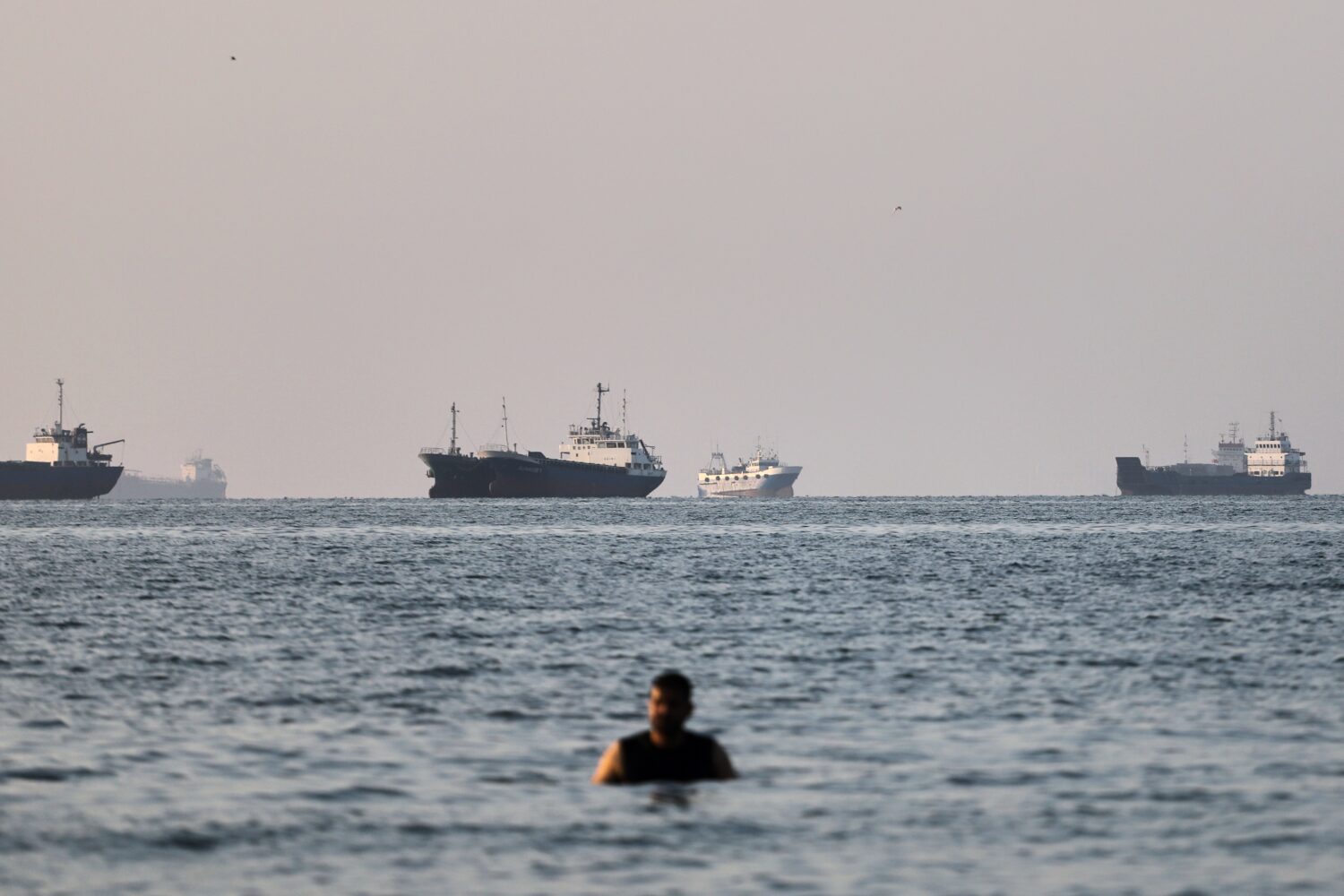
A person stands in shallow water as cargo and commercial vessels are anchored in the Strait of Hormuz off Bandar Abbas, Iran, Monday, June 8, 2026. (Amirhosein Khorgooi/ISNA via AP)
Credit: AP Photo/Amirhosein Khorgooi
(Amirhosein Khorgooi/ISNA via AP)

FRANKFURT, Germany (AP) — The tentative agreement to end the war in Iran and reopen the Strait of Hormuz would be good news for the global economy. But even as the price of oil dropped Monday, many questions remained about when and how it would start flowing again through the world’s most vital artery for energy shipments.
Before the war, the strait carried a fifth of the world’s crude oil. Now, it will take time for hundreds of ships trapped in the Persian Gulf to exit through the narrow strait. And Gulf oil producers that throttled back production will need time to get the oil moving again. Analysts also say ship captains may take their time to decide if passage is safe and that the threat of attack from Iran has truly receded.
All told, oil prices, inflation and energy flows simply won’t see an immediate return to what they were before the war — not for weeks or even months. And that’s assuming the deal, set to be signed Friday, proves durable. Details hadn’t been released.
Even if the Strait is completely open, it will take time for tankers to enter, load, and make the journey to Asian countries — the chief customers for Gulf oil from Saudi Arabia, Iraq, Bahrain, the United Arab Emirates, Kuwait and Oman. A trip to Japan and back can take 45 to 50 days.
Captains, insurers and owners may take their time in attempting passage, given the volatile situation.
“Operationally, the sector is not rushing back,” wrote Richard Meade, editor-in-chief of shipping data and analysis company Lloyd’s List, noting that many warn mine clearance and a return to use of the internationally recognized transit lanes “are prerequisites for safe navigation. ”
Ships have been trickling out through an Iranian-run vetting lane in the north of the strait, while others have slipped out with lights and location systems turned off under U.S. forces’ guidance in a southern passage along the coast of Oman. Iran had threatened to attack ships using the internationally established mid-strait transit lanes that keep inbound and outbound ships out of each other’s way.
Some 500 commercial vessels remain in the Persian Gulf, according to maritime and energy intelligence firm Kpler, and they can’t all leave through the narrow strait at once.
Amena Bakr, head of Middle East energy and OPEC+ insights at Kpler, estimated that clearing mines would take six months, vessels leaving and returning to reload two to three months, and restarting production in some countries to prewar levels another three months.
Iran has demanded the right to collect money from ships using the strait, and in some cases has already exacted payment to let ships leave. Trump said on his social media platform Truth Social that the deal involved a “toll free opening,” but there’s been no confirmation from Iran.
The period between the deal’s announcement and signing “gives both sides scope for issuing conflicting statements on the agreement, especially on the extent to which Iran will manage traffic and demand fees,” said Torbjorn Soltvedt, principal Middle East analyst at risk intelligence company Verisk Maplecroft.
Paying tolls would present a quandary for ship owners, since the U.S. and EU have designated the Islamic Revolutionary Guard Corps a terrorist organization, and the U.S. Treasury has sanctioned the entity Iran has announced to run its collections. Unless those sanctions are modified, paying exposes shippers and banks to sanctions.
Legal experts say allowing Iran to control passage would violate international law on freedom of navigation as set down in the United Nations Convention on the Law of the Sea, which requires countries to permit peaceful passage through territorial waters. The strait’s waters are shared by Iran to the north and Oman to the south.
Some producers in the Middle East paused extracting oil from the ground, known as a shut-in, when they ran out of storage space. Restarting those operations can be a slow process.
Countries such as Saudi Arabia and the United Arab Emirates, which were able to export some oil through alternate pipelines or routes besides the Strait of Hormuz, may be among the quickest to resume production, said Alan Gelder, senior vice president of refining, chemicals and oil markets at Wood Mackenzie, an analytics firm.
“Places like Iraq could be much more challenged because they’ve had a much bigger shut-in, their fields are more difficult … it may well take about a year before they get back,” he said.
Claudio Galimberti, chief economist at Rystad Energy, noted in an emailed comment that “sentiment has clearly improved. But sentiment is not the same as supply.”
“It will take time for production to ramp back up, for logistics to normalize, and for the risk premium embedded in crude prices to dissipate,” he said in an emailed comment.
Countries won’t restart until they know there is a durably open strait and that a ceasefire will last more than 30 or 60 days, said Daniel Sternoff, senior fellow at the Center on Global Energy Policy at Columbia University.
Economists at Capital Economics estimate that energy flows would reach 80% of prewar levels by September.
Even if the deal reopens the strait immediately, that will not immediately send inflation lower, economists say.
Inflation is ”set to stay above target in most major economies throughout this year and the first half of next, even as growth remains relatively weak,” said Neil Shearing, group chief economist at Capital Economics.
Inflation could even rise when government measures aimed at easing the energy shock expire, Joachim Nagel, the head of Germany’s Bundesbank central bank said in a speech Monday.
That includes Germany’s temporary lowering of fuel taxes by 17 euro cents per liter, which runs through June 30.
“It will take months for the oil supply to return to normal,” Nagel said.