Here’s why new fronts seem to be opening up across the Middle East
Jul 30, 2026, 10:01 AM | Updated: 5:26 pm
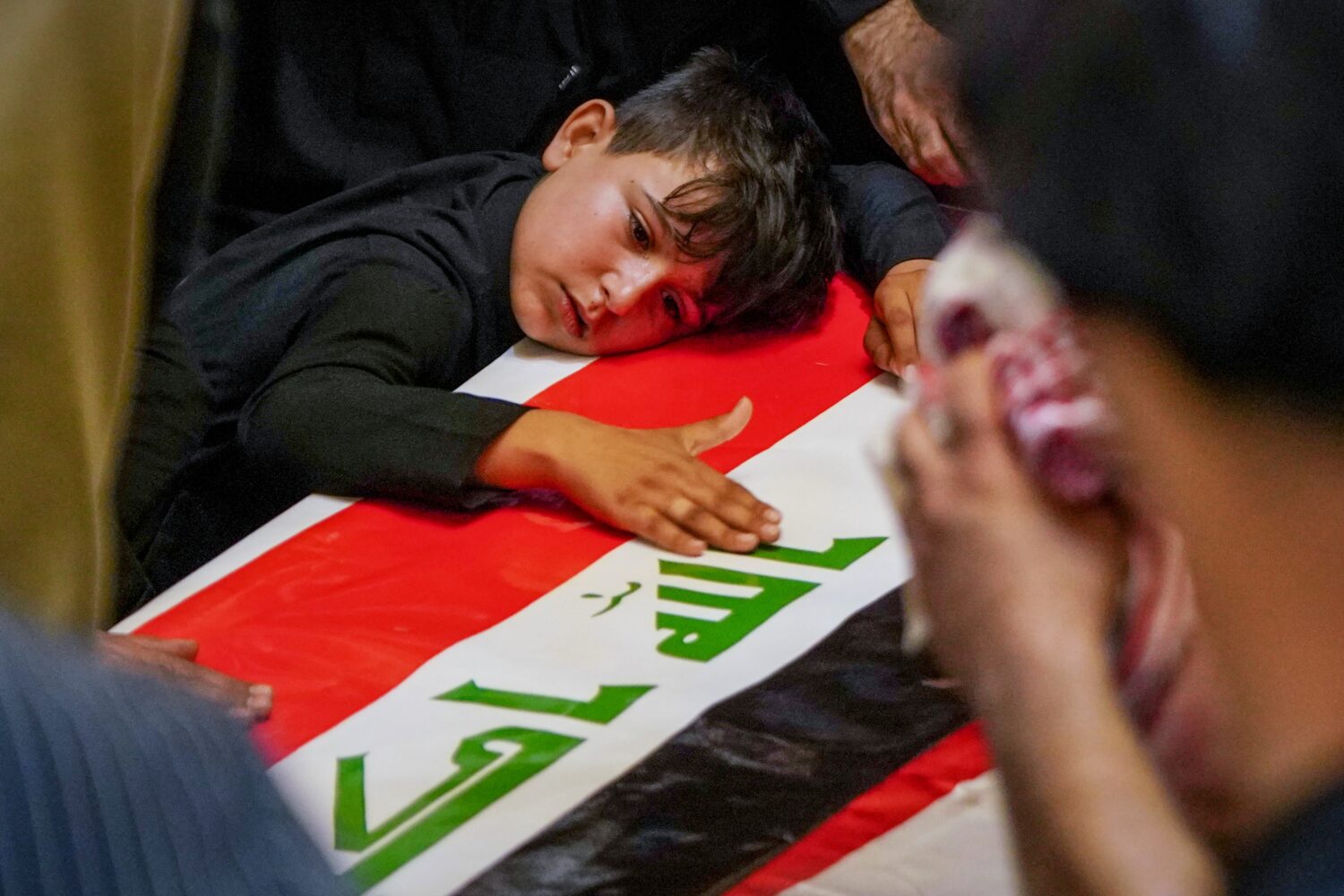
A child rests his head on the coffin of a Popular Mobilization Forces fighter draped in the Iraqi flag during a funeral for Popular Mobilization Forces fighters killed in airstrikes on PMF bases in Najaf, Iraq, Thursday, July 30, 2026. (AP Photo/Anmar Khalil)
Credit: AP Photo/Anmar Khalil
(AP Photo/Anmar Khalil)

ANKARA, Turkey (AP) — Houthi rebels in Yemen said they attacked Saudi oil facilities. The Saudis blamed militias in Iraq and joined the United States in bombing them. Iran fired missiles at Jordan. Drones set ships ablaze in Egypt.
But it’s not actually as complicated as it sounds, and it’s all related to the broader war between the United States and Iran, currently focused on the Strait of Hormuz.
Iran supports armed groups across the Middle East that allow it to project power far beyond its borders. The U.S. has thousands of troops based in allied Arab countries that have been targets of Iran’s retaliation.
Here’s a look at why so many fronts seem to be heating up at once.
The epicenter of the latest violence is the Strait of Hormuz, an elbow-shaped passage running between Iran and Oman that carried a fifth of the world’s traded oil and gas before the war.
Iran says it controls the waterway and has attacked ships attempting to use an alternative route overseen by the U.S. military along the coast of Oman.
The U.S. has struck Iran in response, saying the strait should be open to all international traffic, as it was before the U.S. and Israel attacked Iran on Feb. 28. When the U.S. strikes Iran, Iran retaliates by firing missiles and drones against Arab countries hosting U.S. forces, like Jordan and Kuwait.
The exchanges of fire in recent weeks led to the collapse of an interim agreement aimed at winding down the war. That has deepened mistrust on both sides. At this point, Iran appears to be more interested in cementing its control over the strait than in making a deal with the U.S. to lift international sanctions.
The Iran-backed Houthis in Yemen, who stayed on the sidelines during the initial phase of the war, have declared a blockade on Saudi Arabia, threatening shipping through another major trade route leading through the Bab el-Mandeb strait and the Red Sea up to Egypt’s Suez Canal.
The Houthis also claim to have attacked Saudi oil infrastructure near an East-West pipeline that the kingdom has used to ship millions of barrels of oil since the Strait of Hormuz has been effectively closed.
The Houthi-Saudi tensions are rooted in a separate but related conflict going back more than a decade that seems to be reigniting. But it also presents a new front on which Iran could pressure a key U.S. ally and potentially choke off more of the world’s energy supplies, with effects far beyond the region.
ِAmbrey, a maritime security firm, has recorded over 10 transits that U-turned in the Red Sea and Gulf of Aden since the Houthi naval blockade against Saudi Arabia was announced. Bab al-Mandeb transits have been down 30% since July 21 compared to June, according to the latest Ambrey data.
Earlier this week, Saudi Arabia accused Iran-backed militias in Iraq of launching drone attacks on its oil facilities for two straight days. In response, U.S. and Saudi fighter aircraft bombed militia sites in Iraq, killing at least 20 fighters and six Iranian advisers.
Iraq has close ties to both the U.S. and Iran and has long struggled to balance them. Since the start of the war, it has been in a literal crossfire. The government condemned the U.S.-Saudi strikes, saying they came as it was trying to investigate what had happened.
The Popular Mobilization Forces, a collection of armed groups close to Iran, are officially part of Iraq’s security forces but often act autonomously, including by attacking U.S. forces stationed in Iraq.
American forces are due to finish their withdrawal from the country at the end of September, and the Iraqi government has vowed to disarm nonstate actors or incorporate them into the military. But those efforts could stall as the wider war rages.
The remaining U.S. forces are based in Iraq’s semiautonomous Kurdish region, which is also home to armed Iranian Kurdish dissident groups. Iran has attacked both over the course of the war.
On Wednesday, a drone attack on Egypt’s Mediterranean port of Damietta set two natural gas vessels ablaze, including a U.S.-owned floating storage facility.
No one has claimed the attack, and the Houthis have denied responsibility.
Egypt, a close U.S. ally and regional mediator, is one of the only countries in the Middle East to have avoided military involvement in the war.
Israel, which took part in the initial weekslong bombardment of Iran and was repeatedly targeted by Iranian missiles earlier in the conflict, has remained on the sidelines since the interim peace deal.
The Iran-backed Hezbollah militant group fired rockets into northern Israel shortly after the outbreak of the war. Israel responded with aerial bombardment and a ground invasion. It has since occupied, depopulated and destroyed large parts of southern Lebanon, saying such measures are necessary to root out militants.
A June 20 truce has largely held. Israel and Lebanon’s government are currently implementing the initial stages of an agreement in which Israeli forces would withdraw and Lebanon’s army would move in. The deal also states that Hezbollah must be disarmed. The group has rejected the deal and could violently resist any attempt to forcibly disarm it.
Any attack by Iran, Hezbollah or Israel could reignite those hostilities, reopening yet another front.
___
Krauss reported from Ottawa, Ontario.