Iraq is caught in the crossfire of the Iran war, with attacks by both sides on its soil
Mar 13, 2026, 6:33 AM | Updated: 7:16 am
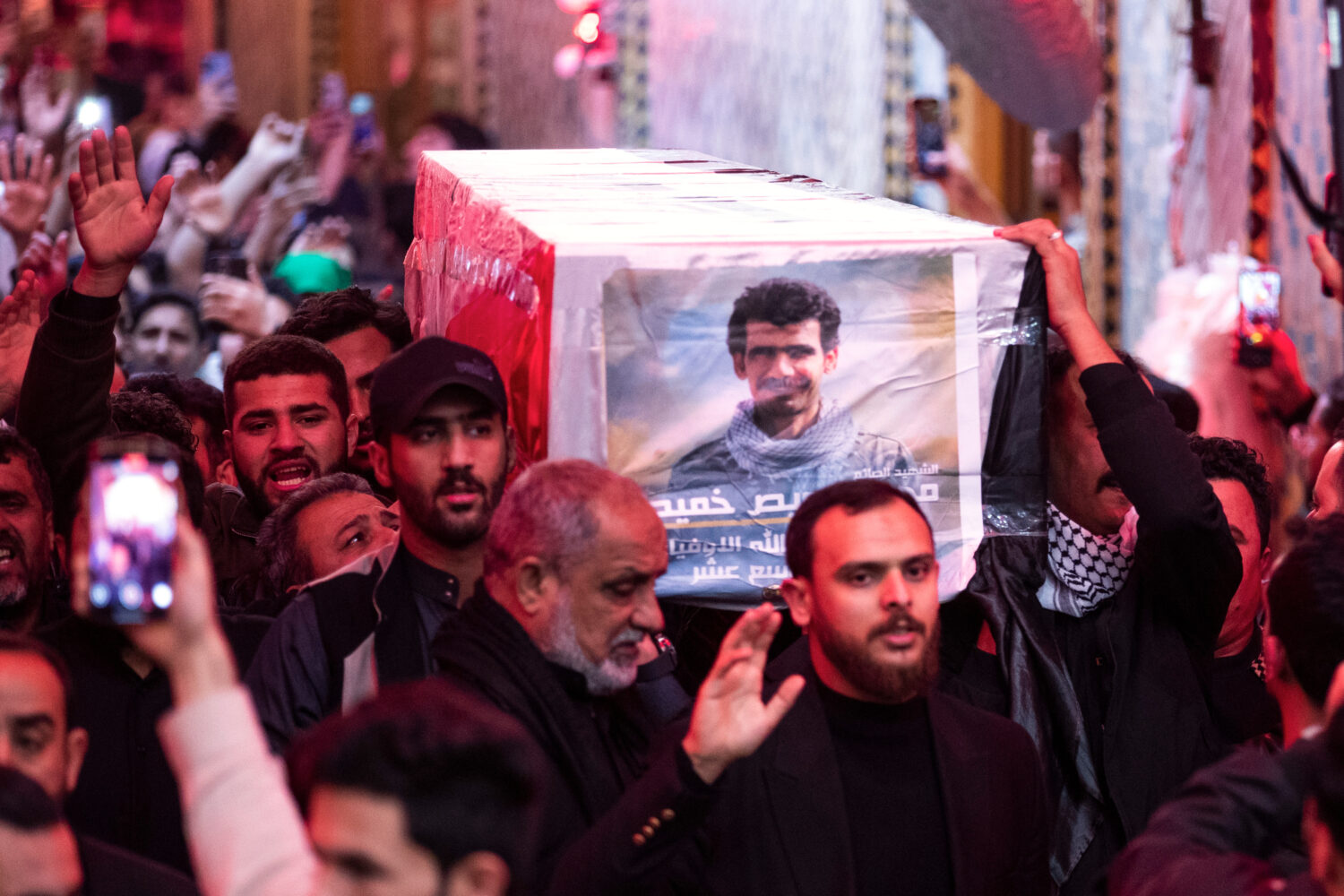
Members of the Popular Mobilization Forces attend a funeral in Najaf, Iraq, Friday, March 13, 2026 for colleagues who were killed in an airstrike in Qaim. (AP Photo/Anmar Khalil)
Credit: ASSOCIATED PRESS
(AP Photo/Anmar Khalil)

IRBIL, Iraq (AP) — Iraq is getting caught in the crossfire of the Iran war as the only country facing strikes from both sides, and that threatens to drag the nation that has so far avoided two years of regional turmoil into a full-blown crisis.
As the war nears two full weeks, Iraq’s situation is growing more desperate. Disruptions to Gulf shipping and strikes on oil fields and infrastructure have all but halted exports, jeopardizing a state that relies on such trade for the bulk of its revenue.
If the shutdown continues, Baghdad could be unable to meet its oversized public‑sector payroll as soon as next month, risking widespread unrest, two Iraqi Kurdish officials said.
The federal government has appealed to northern Kurdish leaders to resume exports via a pipeline to Turkey, but talks remain deadlocked over longstanding domestic issues. The officials spoke to The Associated Press on condition of anonymity to discuss sensitive political matters.
In the meantime, a parallel conflict to the wider war has escalated between Iran-backed Iraqi militia groups and the U.S. Near-daily drone strikes have targeted American interests across the country, while the U.S. has struck back against militia bases to defend its troops.
Since the war began Feb. 28 following a major U.S. and Israeli strike in Iran, drone and missile attacks have targeted American interests in Iraq, including military bases in the Baghdad and Irbil airports, and U.S. diplomatic facilities. Iran and its allied Iraqi militias also have struck oil fields and energy infrastructure to escalate the economic toll.
Unlike other Middle Eastern states touched by the war, Iraq hosts both entrenched Iran-aligned forces and significant U.S. interests. Its economy depends overwhelmingly on oil, so disruptions to production or exports through the Strait of Hormuz could sharply cut government revenue just as a fraught political transition grips Baghdad.
The longer the conflict lasts, the greater the risk that economic shocks, political paralysis and friction with Iran‑backed militias will combine to unravel Iraq’s hard‑won relative stability.
Leaders in Baghdad and Irbil continue to urge caution and insist the war must not be fought on their soil, but the conflict’s trajectory is increasingly slipping beyond their control. The U.S. has communicated assurances to Iraqi leaders that the country won’t be dragged into the regional war, according to the two Kurdish officials who spoke to AP.
In the war’s opening days, drone and rocket strikes by Iran and allied groups began targeting U.S. bases, diplomatic missions and oil facilities. In Irbil, the capital of Iraq’s autonomous Kurdish region, near‑daily drone attacks have targeted not only U.S. military and allied interests but also commercial sites and even hotels.
Iran-backed groups have also struck Kurdish groups based in northern Iraq after reports that Washington planned to arm some of them to press against Tehran. Some Iranian Kurdish leaders have signaled their willingness to mount cross-border operations into Iran if supported by the U.S..
Iraq is operating under a caretaker government after the U.S. opposed the nomination of former Prime Minister Nouri al‑Maliki. Caretaker premier Mohammed Shia al‑Sudani, with even more limited powers, lacks the influence to rein in powerful militia groups.
The U.S. has struck back, striking militia sites across the country, including in Jurf al-Sakhr, south of Baghdad, northern Iraq and in al-Qaim, along the Iraq-Syria border.
As in past upheavals, Iraqis have learned to adapt to daily violence that intrudes on everyday life.
At an Irbil cafe, patrons heard the whine of incoming drones, then a muffled explosion, before a plume of smoke rose on the horizon where it was shot down. A waiter urged calm, saying the strikes were aimed at the U.S. Consulate or airport and posed no direct threat to customers.
The gravest threat to Iraq’s stability is disrupted oil production, which could cripple government revenues. The Kurdish officials said Baghdad warned them that public-sector payrolls could be disrupted as soon as next month.
To alleviate the pressure, Baghdad has asked for exports of at least 250,000 barrels per day of crude from fields in Kirkuk via the pipeline to Ceyhan in Turkey that runs across Kurdish territory. Talks have stalled, however, after Kurdish negotiators conditioned the move on lifting an existing U.S. dollar embargo and restoring economic benefits tied to trade.
Iraq’s government ordered production curtailed from oil fields in southern Iraq, where the majority of its 4.8 million barrels per day is produced, after the war all but stopped traffic through the Strait of Hormuz and militias attacked facilities. Sales from oil account for over 90% of state revenues.
Iraq has one of the world’s largest public‑sector workforces and pensioner rolls, and past payment delays have sparked mass protests.
Production has been halted at oil fields hit by strikes. In the Kurdish region, Canada’s ShaMaran Petroleum and U.S. private firm HKN have suspended output at the Sarsang and Atrush blocks.
“If oil exports are disrupted, the immediate impact would likely be a decline in the value of the Iraqi dinar. This would quickly trigger inflation, and within a short time the prices of basic goods could rise sharply,” said Farhad Soleimanpour, an Iraqi Kurdish political analyst.
“For the Kurdistan region, the situation could be even more difficult because it does not have its own central bank or significant financial reserves. Iraq may be able to withstand the shock for several months, but the Kurdistan Region would likely face immediate financial pressure,” he added.
The war has also battered power supplies.
The Khor Mor gas field in the autonomous Kurdish region is offline, cutting electricity generation by nearly two‑thirds. Where the region once provided 24‑hour power, households now receive just four to six hours a day, said Omed Ahmad, spokesperson for the Kurdistan Region’s Ministry of Electricity.
Since the November 2025 election, Iraq has been without a government after the U.S. opposed the return of al‑Maliki, the former prime minister. The war complicates the fraught transition, forcing a caretaker administration with severely limited powers to manage the fallout.
But that caretaker status also lets Iraqi leaders deflect responsibility by claiming they lack the authority to act, said Iraq analyst Tamer Badawi. “No one wants to take this big responsibility at the moment,” he said.
That would mean taking charge and reining in multiple armed groups, from Iran‑backed militias targeting U.S. interests to Kurdish‑Iranian opposition factions, whose actions deepen fault lines that could spark civil unrest.
Even if some oil is exported via the pipeline, there is no way to assure the infrastructure will not come under attack by militia groups, officials have warned.
Iraq has defied the odds so far, largely avoiding the regional upheaval from the war in Gaza that began in 2023. Political and religious leaders have remained committed to keeping the country out of wider conflict and preserving its stability.
“Iraq faces pressure to maintain neutrality while different political groups inside the country have opposing positions regarding the conflict,” Soleimanpour said. “Some factions support closer relations with Iran, while others prefer stronger cooperation with the United States and Western countries. This internal division increases political tension.”