Nepal floods highlight growing glacier risks in warming Himalayas
Aug 27, 2026, 3:51 AM
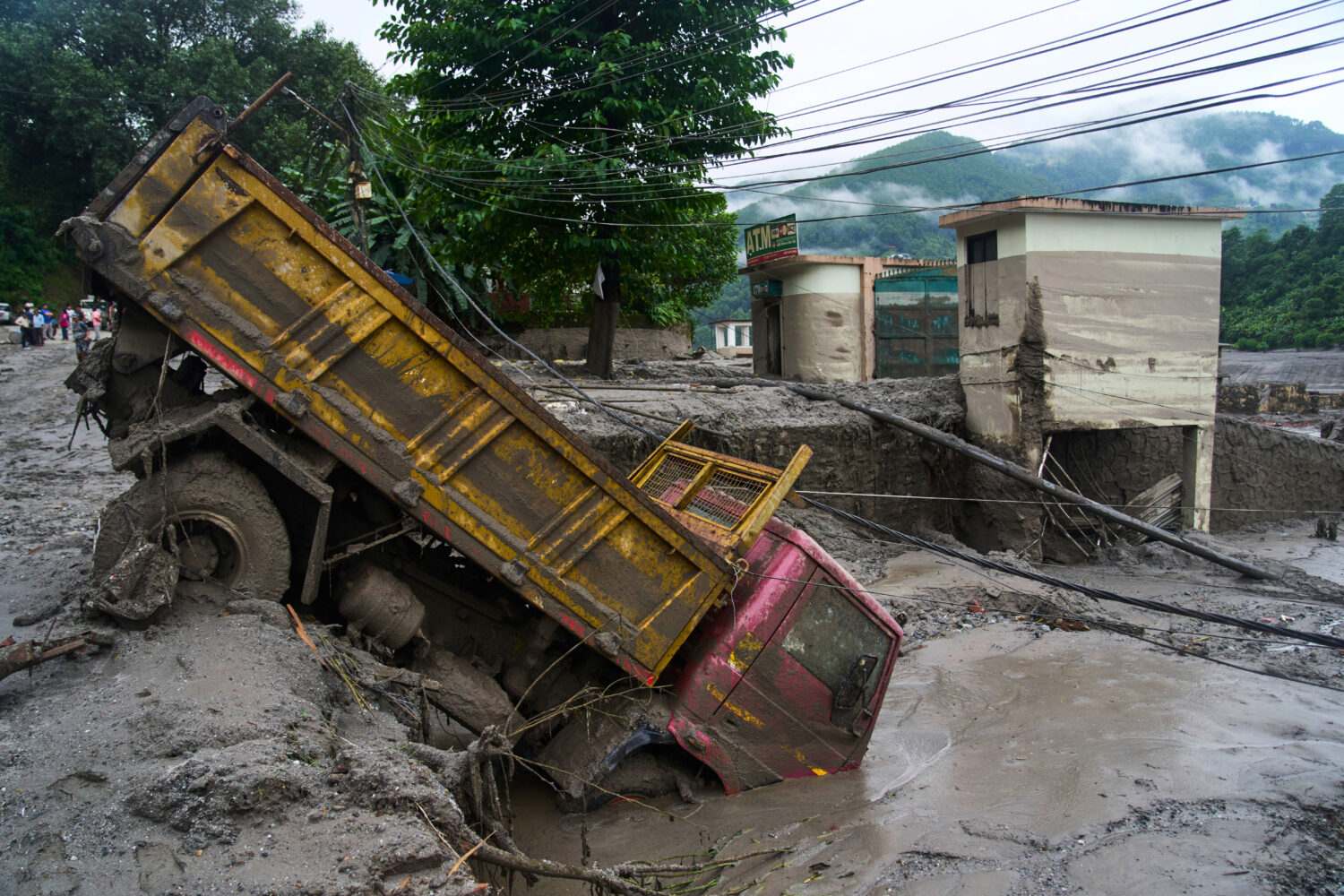
A vehicle is seen in the aftermath of flash floods in Devighat in the Nuwakot district in Nepal, Thursday, Aug. 27, 2026. (AP Photo/Niranjan Shrestha)
Credit: AP Photo/Niranjan Shrestha
(AP Photo/Niranjan Shrestha)

BENGALURU, India (AP) — The deadly flash flood in Nepal on Wednesday was likely caused by a huge chunk of a glacier that broke off and temporarily dammed a river, according to preliminary investigations by scientists. That may have led to the backed-up water surging downstream with enormous force a few hours later, they suggested.
Scientists are still piecing together information from satellite and ground-level data to figure out exactly what happened to cause the flood, which killed hundreds and left many more missing, including foreigners and pilgrims.
The U.S. Geological Survey on Wednesday reported a magnitude 5.2 glacier collapse that sent debris flowing downstream with catastrophic impact on communities. It said its determination was based on data from nearby seismic stations, long period seismic waves and satellite imagery.
“A lower part of a glacier has really come off,” said Jakob Steiner, a geoscientist at the University of Graz in Austria who is currently based in Bangladesh. “If you look at the imagery it’s like someone cut with a huge knife through the whole lower part and it fell off.”
Steiner said a mass of glacial ice dropping from a great height could have felt like a bomb exploding, resulting in the chaos that followed.
Scientists said it is too early to draw a direct connection between global warming and Wednesday’s catastrophe. However, they said that as Earth’s temperature rises because of human activities such as burning oil, gas and coal, the chances of such disasters increase, especially in the Himalayan mountains, which are warming considerably faster than many other parts of the world.
“We have to be cautious and not draw a connection yet. However, rising temperatures are changing the Hindu Kush Himalaya region and melting glaciers,” said Saswat Sanyal, a disaster risk reduction specialist at the Kathmandu-based climate research group International Centre for Integrated Mountain Development.
Hundreds have lost their homes across the Himalayan region, and officials reported large-scale damage to critical infrastructure, including hydropower dams, roads, buildings and bridges in the region.
Water levels in rivers across the flood-affected region rose by as much as 9 meters (29.5 feet) in 30 minutes as a result of the surge from the glacial detachment upstream, researchers at the Kathmandu-based climate research group said.
“It was a huge rise, a huge surge of water that happened suddenly,” said Sanyal.
Preliminary evidence suggests a large volume of ice and rock may have plunged into the Lhende Khola, a tributary of the Bhote Koshi River. Researchers said the collapse could have displaced water and picked up loose sediment and boulders, producing a powerful surge downstream. Researchers are also examining whether debris temporarily dammed the river before the impounded water burst through, magnifying the flood.
Steiner said the area has a history of destructive mountain hazards. Floods originating from a glacial lake struck the same valley in 2025, while an ice and rock avalanche occurred elsewhere in the area in 2024. The broader Langtang region was also hit by devastating avalanches during Nepal’s 2015 earthquake.
The Hindu Kush Himalaya is warming rapidly, driving major changes in glaciers, snow cover, permafrost and mountain slopes, according to climate scientists.
The mountains contain the largest volume of snow and ice outside the polar regions. More than 63,000 glaciers in the area feed at least 10 major Asian river systems and support the food, water, energy and livelihood security of billions of people.
However, around 78% of the glacier area, located between 4,500 and 6,000 meters above sea level, is highly exposed to warming.
“What happened yesterday is unfortunately the new normal. It’s going to get worse from here onwards,” Steiner said.
The last decade was the hottest multi-year period globally since records began, and 2024 was the warmest year ever recorded. United Nations reports have found that between 2000 and 2019, glaciers lost 267 gigatons of ice per year, roughly equivalent to the mass of 46,500 Great Pyramids of Giza.
In a warming world, the reports project the loss of up to 50% of all glaciers — excluding those in Greenland and Antarctica — by 2100, even if global warming can be limited to 1.5 degrees Celsius (2.7 degrees Fahrenheit).
Current global policies put Earth on a trajectory to warm by about 2.8 degrees Celsius (5 degrees Fahrenheit) above preindustrial levels by the end of the century.
Research by the Kathmandu-based group has found that glaciers across these mountains are melting at an accelerating rate, with ice-loss rates doubling since 2000.
Melting glaciers can feed and enlarge glacial lakes, increasing the potential for sudden floods.
As glaciers retreat, mountain rock that was previously insulated and supported by ice becomes exposed to warmer temperatures, rain and repeated freezing and thawing. Permafrost — ground that has remained frozen for years — can also thaw, weakening rock faces and slopes.
“The chances that material starts to move down from mountains increase,” Steiner said.
Sanyal said that may be the kind of cascading hazard behind what happened Wednesday in Nepal: An avalanche or glacier collapse that turns into a debris flow, river blockage and devastating flash flood.
Steiner said about 10% of Nepal’s power production was located in the valley affected by the latest disaster. He said the repeated losses raise questions about whether enough has been done to install warning systems for residents and visitors alike after previous floods and avalanches.
The country’s landscape has long been a draw for tourists, with more than a million people visiting the country annually in recent years.
Scientists say stronger early warning systems, better monitoring and faster cross-border information sharing will be increasingly important as temperatures rise and mountain landscapes become less stable.
But monitoring thousands of glaciers, steep slopes and river valleys across the Himalayan arc is extremely difficult.
And when cascading disasters begin, there may be only minutes to act.
“We don’t have hours,” Sanyal said. “We have sometimes a few minutes to actually prepare.”
Steiner said a “red line” has already been reached where some regions of Nepal are just too risky to live in now.
“We expected previous similar disasters to be a wake-up call for governments in the Himalayan region, but it’s a bit frustrating that the damages never seem to be horrible enough,” Steiner said.
“I’m not super optimistic that from tomorrow onwards there will be clear solutions,” he added. “We know what can be done, but various stakeholders need to coordinate and make things happen.”
___
Arasu can be followed on X at @sibi123. Reach him at sarasu@ap.org
___
The Associated Press’ climate and environmental coverage receives financial support from multiple private foundations. AP is solely responsible for all content. Find AP’s standards for working with philanthropies, a list of supporters and funded coverage areas at AP.org.