Pushing for trade, preparing for war: A document reveals Vietnam’s dual approach toward the US
Feb 2, 2026, 6:29 PM
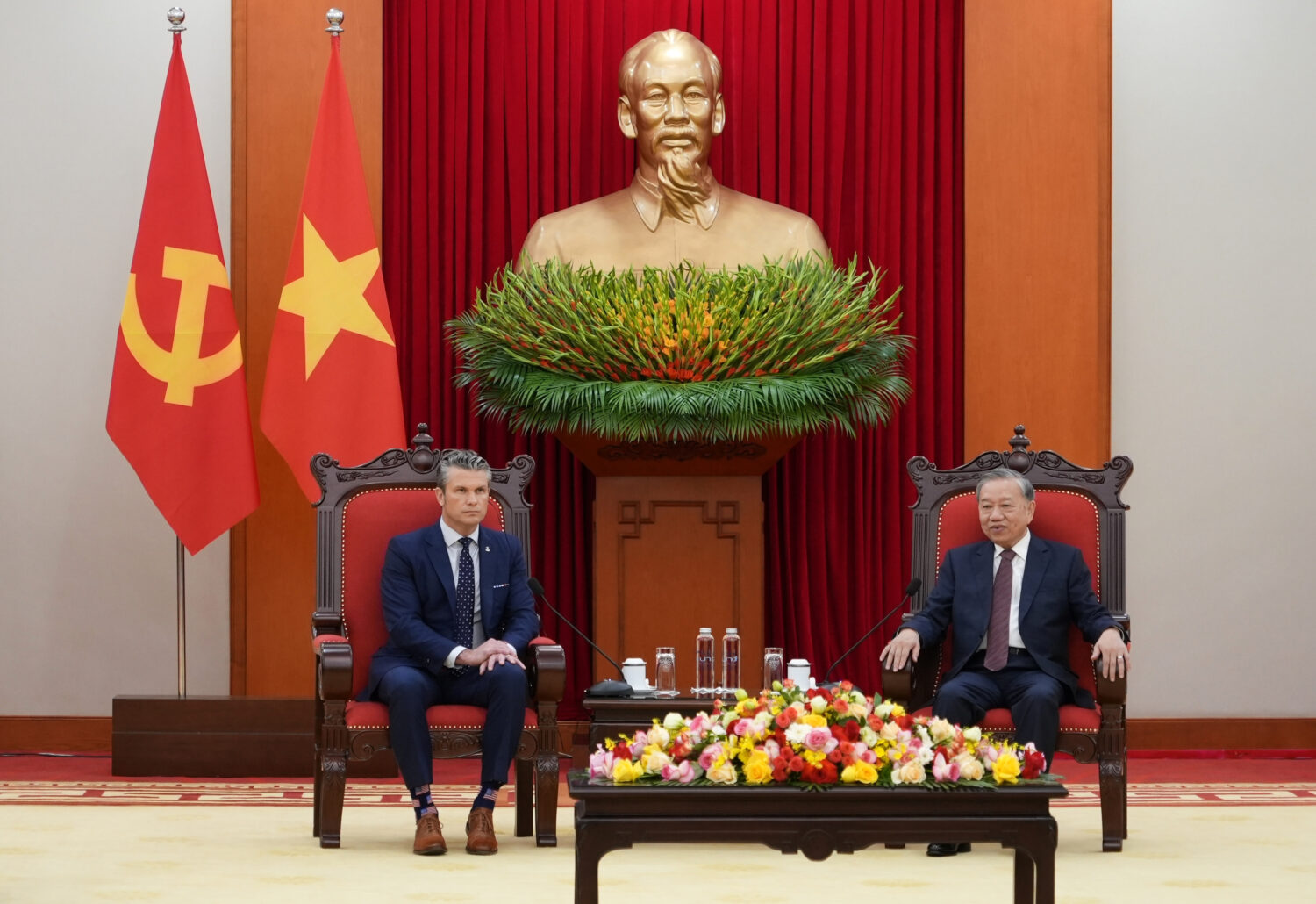
FILE - U.S. Defense Secretary Pete Hegseth, left, and General Secretary of Vietnam's Communist Party To Lam talk during a meeting in Hanoi, Vietnam, Nov. 2, 2025. (AP Photo/Hau Dinh, File)
Credit: ASSOCIATED PRESS
(AP Photo/Hau Dinh, File)

HANOI, Vietnam (AP) — A year after Vietnam elevated its relations with Washington to the highest diplomatic level, an internal document shows its military was taking steps to prepare for a possible American “war of aggression” and considered the United States a “belligerent” power, according to a report released Tuesday.
More than just exposing Hanoi’s duality in approach toward the U.S., the document confirms a deep-seated fear of external forces fomenting an uprising against the Communist leadership in a so-called “color revolution,” like the 2004 Orange Revolution in Ukraine, or the 1986 Yellow Revolution in the Philippines.
Other internal documents that The 88 Project, a human rights organization focused on human rights abuses in Vietnam, cited in its analysis point to similar concerns over U.S. motives in Vietnam.
“There’s a consensus here across the government and across different ministries,” said Ben Swanton, co-director of The 88 Project and the report’s author. “This isn’t just some kind of a fringe element or paranoid element within the party or within the government.”
The original Vietnamese document titled “The 2nd U.S. Invasion Plan” was completed by the Ministry of Defense in August 2024. It suggests that in seeking “its objective of strengthening deterrence against China, the U.S. and its allies are ready to apply unconventional forms of warfare and military intervention and even conduct large-scale invasions against countries and territories that ‘deviate from its orbit.’”
While noting that “currently there is little risk of a war against Vietnam,” the Vietnamese planners write that “due to the U.S.’s belligerent nature we need to be vigilant to prevent the U.S. and its allies from ‘creating a pretext’ to launch an invasion of our country.”
The Vietnamese military analysts outline what they see as a progression over three American administrations — from Barack Obama, through Donald Trump’s first term, and into Joe Biden’s presidency — with Washington increasingly pursuing military and other relationships with Asian nations to “form a front against China.”
In his term, Biden in 2023 signed a “Comprehensive Strategic Partnership” with Vietnam, elevating relations between the nations to their highest diplomatic level on par with Russia and China as “trusted partners with a friendship grounded in mutual respect.”
In the 2024 military document, however, Vietnamese planners said that while the U.S. views Vietnam as “a partner and an important link,” it also wants to “spread and impose its values regarding freedom, democracy, human rights, ethnicity and religion” to gradually change the country’s socialist government.
“The 2nd U.S. Invasion Plan provides one of the most clear-eyed insights yet into Vietnam’s foreign policy,” Swanton wrote in his analysis. “It shows that far from viewing the U.S. as a strategic partner, Hanoi sees Washington as an existential threat and has no intention of joining its anti-China alliance. ”
Vietnam’s Foreign Ministry did not answer emails seeking comment on The 88 Project report or the document it highlighted.
The U.S. State Department refused to comment directly on the “2nd U.S. Invasion Plan,” but stressed the new partnership agreement, saying it “promotes prosperity and security for the United States and Vietnam.”
“A strong, prosperous, independent and resilient Vietnam benefits our two countries and helps ensure that the Indo-Pacific remains stable, secure, free and open,” the State Department said.
Nguyen Khac Giang, of Singapore’s ISEAS–Yusof Ishak Institute research center, said the plans highlighted tensions within Vietnam’s political leadership, where the Communist Party’s conservative, military-aligned faction has long been preoccupied with external threats to the regime.
“The military has never been too comfortable moving ahead with the Comprehensive Strategic Partnership with the United States,” Giang said.
Tensions within the government spilled into the public realm in June 2024, when U.S.-linked Fulbright University was accused of fomenting a “color revolution” by an army TV report. The Foreign Ministry defended the university, which U.S. and Vietnamese officials had highlighted when the two countries upgraded ties.
Zachary Abuza, a professor at the National War College in Washington, said the Vietnamese military still has “a very long memory” of the war with the U.S. that ended in 1975. While Western diplomats have tended to see Hanoi as most concerned by possible Chinese aggression, the document reinforces other policy papers suggesting leaders’ biggest fear is that of a “color revolution,” he said.
Further undermining trust between the U.S. and Vietnam were cuts made to the U.S. Agency for International Development by President Donald Trump’s administration, which disrupted projects such as efforts to clean up tons of soil contaminated with deadly dioxin from the military’s Agent Orange defoliant and unexploded American munitions and land mines.
“This pervasive insecurity about color revolutions is very frustrating, because I don’t see why the Communist Party is so insecure,” said Abuza, whose book “The Vietnam People’s Army: From People’s Warfare to Military Modernization?” was published last year.
“They have so much to be proud of — they have lifted so many people out of poverty, the economy is humming along, they are the darling of foreign investors.”
While China and Vietnam have been at odds over territorial claims in the South China Sea, the documents portray China more as a regional rival than a threat like the U.S.
“China doesn’t pose an existential threat to the Communist Party (of Vietnam),” Abuza said. “Indeed, the Chinese know they can only push the Vietnamese so far, because they’re fearful that the Communist Party can’t respond forcefully to China (and will) look weak and it will cause a mass uprising.”
China is Vietnam’s largest two-way trade partner, while the U.S. is its largest export market, meaning Hanoi needs to perform a balancing act in keeping up diplomatic and economic ties, while also hedging its bets.
“Even some of the more progressive leaders look at the United States, saying, ‘Yes, they like us, they’re working with us, they are good partners for now, but given the opportunity if there were a color revolution, the Americans would support it,’” Abuza said.
Under Vietnamese leader To Lam, who became Communist Party general secretary at around the same time the document was written, the country has moved to strengthen ties with the U.S., especially under Trump, Giang said.
Lam was reappointed general secretary last month and is expected to also assume the presidency, which would make him the country’s most powerful figure in decades.
With Lam at the helm, Trump’s family business has broken ground on a $1.5 billion Trump-branded golf resort and luxury real estate project in northern Hung Yen province. The Vietnamese leader almost immediately accepted Trump’s invitation to join the Board of Peace, which Giang said was an unusually swift decision given that foreign policy moves are typically calibrated with close attention to Beijing’s possible reaction.
But Trump’s military operation to capture former Venezuelan President Nicolás Maduro have given Vietnamese conservatives fresh justification for their unease about closer ties with Washington. Any U.S. military action involving Hanoi’s ally Cuba could upset Vietnam’s strategic balance, Giang added.
“Cuba is very sensitive,” he said. “If something happens in Cuba, it will send shock waves through Vietnam’s political elites. Many of them have very strong, intimate ties with Cuba.”
Overall, the first year of Trump’s second term is likely to have left the Vietnamese happy about the focus on the Western Hemisphere but wondering about other developments, Abuza said.
“The Vietnamese are going to be confused by the Trump administration, which has downplayed human rights and democracy promotion, but at the same time been willing to violate the sovereignty of states and remove leaders they don’t like,” he said.
_____
Rising reported from Bangkok.