Securing Iran’s enriched uranium by force would be risky and complex, experts say
Apr 1, 2026, 12:56 AM
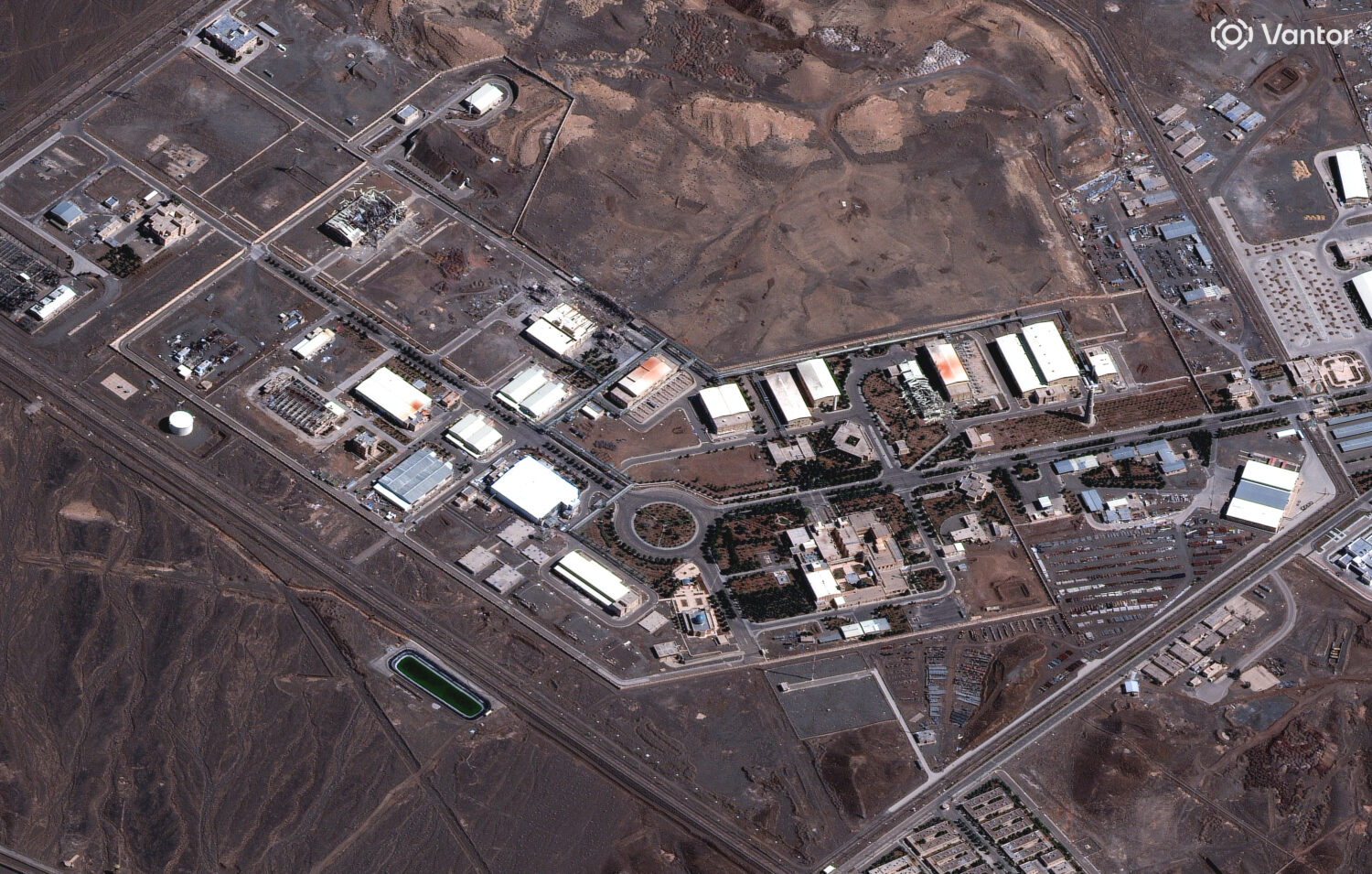
FILE - This satellite image provided by Vantor shows the Natanz nuclear complex in Iran on March 7, 2026, with no new damage seen at the facility or the tunnels. (Satellite image ©2026 Vantor via AP, file)
Credit: ASSOCIATED PRESS
(Satellite image ©2026 Vantor via AP, file)

VIENNA (AP) — Should the U.S. decide to send in military forces to secure Iran’s uranium stockpile, it would be a complex, risky and lengthy operation, fraught with radiation and chemical dangers, according to experts and former government officials.
U.S. President Donald Trump has offered shifting reasons for the war in Iran but has consistently said a primary objective is ensuring the country will “never have a nuclear weapon.” Less clear is how far he is willing to go to seize Iran’s nuclear material.
Given the risks of inserting as many as 1,000 specially trained forces into a war zone to remove the stockpile, another option would be a negotiated settlement with Iran that would allow the material to be surrendered and secured without using force.
Iran has 440.9 kilograms (972 pounds) of uranium that is enriched up to 60% purity, a short, technical step from weapons-grade levels of 90%, according to the International Atomic Energy Agency, the U.N.’s nuclear watchdog agency.
That stockpile could allow Iran to build as many as 10 nuclear bombs, should it decide to weaponize its program, IAEA Director General Rafael Grossi told The Associated Press last year. He added it doesn’t mean Iran has such a weapon.
Iran long has insisted its program is peaceful, but the IAEA and Western nations say Tehran had an organized nuclear weapons program up until 2003.
IAEA inspectors have not been able to verify the near weapons-grade uranium since June 2025, when Israeli and American strikes greatly weakened Iran’s air defenses, military leadership and nuclear program. The lack of inspections has made it difficult to know exactly where it is located.
Grossi has said that the IAEA believes a stockpile of roughly 200 kilograms (about 440 pounds) of highly enriched uranium is stored in tunnels at Iran’s nuclear complex outside of Isfahan. The site was mainly known for producing the uranium gas that is fed into centrifuges to be spun and purified.
Additional quantities are believed to be at the Natanz nuclear site and lesser amounts may be stored at a facility in Fordo, he has said.
It’s unclear whether additional quantities could be elsewhere.
U.S. Director of National Intelligence Tulsi Gabbard told a House hearing March 19 that the U.S. intelligence community has “high confidence” that it knows the location of Iran’s highly enriched uranium stockpiles.
Iran’s stockpile of highly enriched uranium fits into canisters each weighing about 50 kilograms (110 pounds) when full. The material is in the form of uranium hexafluoride gas. Estimates on the number of canisters range from 26 to about twice that number, depending on how full each cylinder is.
The canisters carrying the highly enriched uranium are “pretty robust” and are designed for storage and transport, said David Albright, a former nuclear weapons inspector in Iraq and founder of the nonprofit Institute for Science and International Security in Washington.
But he warned that “safety issues become paramount” should the canisters be damaged — for example, due to airstrikes — allowing moisture to get inside.
In such a scenario, there would be a hazard from fluorine, a highly toxic chemical that is corrosive to skin, eyes and lungs. Anyone entering the tunnels seeking to retrieve the canisters “would have to wear hazmat suits,” Albright said.
It also would be necessary to maintain distance between the various canisters in order to avoid a self-sustaining critical nuclear reaction that would lead to “a large amount of radiation,” he said.
To avoid such a radiological accident, the canisters would have to be placed in containers that create space between them during transport, he said.
Albright said that the preferred option for dealing with the uranium would be to remove it from Iran in special military planes and then “downblend” it — mix it with lower-enriched materials to bring it to levels suitable for civilian use.
Downblending the material inside Iran probably is not feasible, given that the infrastructure needed for the process may not be intact due to the war, he added.
Darya Dolzikova, senior research fellow at the Royal United Services Institute, agreed.
Downblending the material inside Iran is “probably not the most likely option just because it’s a very complicated and long process that requires specialized equipment,” she said.
Securing Iran’s nuclear material with ground troops would be a “very complex and high risk military operation,” said Christine E. Wormuth, who was secretary of the Army under former U.S. President Joe Biden.
That’s because the material is probably at multiple sites and the undertaking would “probably take casualties,” added Wormuth, now president and CEO of the Washington-based Nuclear Threat Initiative.
The scale and scope of an operation at Isfahan alone would easily require 1,000 military personnel, she said.
Given that tunnel entrances are probably buried under rubble, it would be necessary for helicopters to fly in heavy equipment, such as excavators, and U.S. forces might even have to build an airstrip nearby to land all the equipment and troops, Wormuth said.
She said special forces, including perhaps the 75th Ranger Regiment, would have to work “in tandem” with nuclear experts who would look underground for the canisters, adding that the special forces would likely set up a security perimeter in case of potential attacks.
Wormuth said the Nuclear Disablement Teams under the 20th Chemical, Biological, Radiological, Nuclear, Explosives Command would be one possible unit that could be employed in such an operation.
“The Iranians have thought this through, I’m sure, and are going to try to make it as difficult as possible to do this in an expeditious way,” she said. “So I would imagine it will be a pretty painstaking effort to go underground, get oriented, try to discern … which ones are the real canisters, which ones may be decoys, to try to avoid booby traps.”
The best option would be “to have an agreement with the (Iranian) government to remove all of that material,” said Scott Roecker, former director of the Office of Nuclear Material Removal at the National Nuclear Security Administration, a semiautonomous agency within the U.S. Department of Energy.
A similar mission occurred in 1994 when the U.S., in partnership with the government of Kazakhstan, secretly transported 600 kilograms (about 1,322 pounds) of weapons-grade uranium from the former Soviet republic in an operation dubbed “Project Sapphire.” The material was left over from the USSR’s nuclear program.
Roecker, now vice president for the Nuclear Materials Security Program at the Nuclear Threat Initiative, said the Department of Energy’s Mobile Packaging Unit was built from the experience in Kazakhstan. It has safely removed nuclear material from several countries, including from Georgia in 1998 and from Iraq in 2004, 2007 and 2008.
The unit consists of technical experts and specialized equipment that can be deployed anywhere to safely remove nuclear material, and Roecker said it would be ideally positioned to remove the uranium under a negotiated deal with Iran. Tehran remains suspicious of Washington, which under Trump withdrew from a nuclear agreement and has twice attacked during high-level negotiations.
Under a negotiated solution, IAEA inspectors also could be part of a mission. “We are considering these options, of course,” the IAEA’s Grossi said March 22 on CBS’ “Face the Nation” when asked about such a scenario.
Iran has “a contractual obligation to allow inspectors in,” he added. “Of course, there’s common sense. Nothing can happen while bombs are falling.”
___
The Associated Press receives support for nuclear security coverage from https://apnews.com/projects/the-new-nuclear-landscape/