Zambia blasts the US over a $2 billion health deal in exchange for critical minerals
May 5, 2026, 5:39 AM
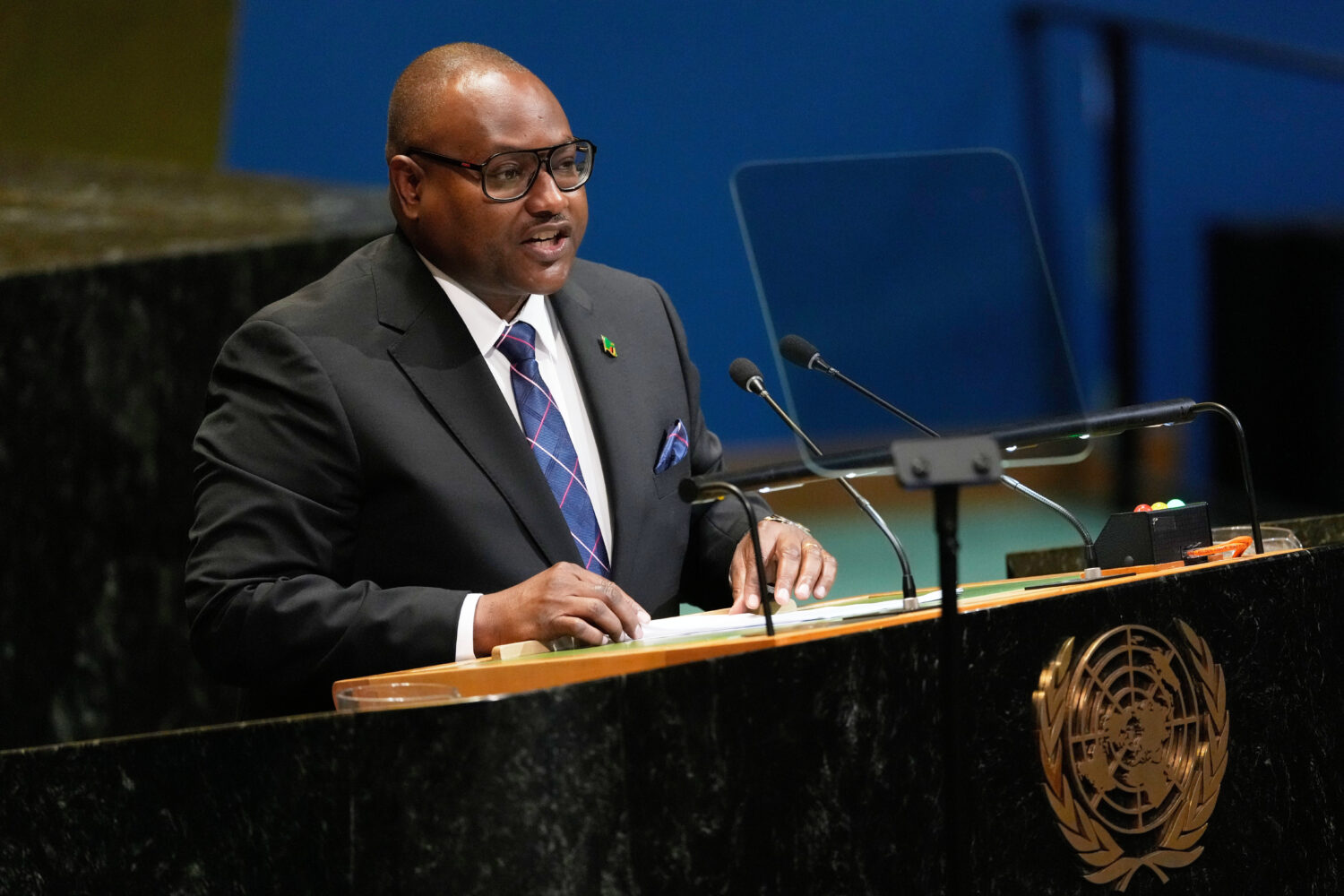
FILE - Mulambo Hamakuni Haimbe, Minister for Foreign Affairs of Zambia, addresses the 80th session of the United Nations General Assembly at United Nations headquarters, Monday, Sept. 29, 2025. (AP Photo/Seth Wenig, File)
Credit: ASSOCIATED PRESS
(AP Photo/Seth Wenig, File)

HARARE, Zimbabwe (AP) — Zambia is accusing the United States of tying a $2 billion deal for critical health assistance to access to the southern African nation’s rich mineral assets, and calling the outgoing U.S. ambassador’s allegations of corruption “mischievous” and “undiplomatic.”
The comments by Zambia’s foreign affairs minister, Mulambo Haimbe, on Monday brought into the open simmering tensions over President Donald Trump’s “America First” strategy, which is reshaping aid to Africa into transactional agreements.
Some African leaders and health experts have criticized the new U.S. stance and its demands for sensitive health data in exchange for badly needed support for health systems strained by the Trump administration’s dismantling of foreign aid. Some say they would not receive access to health innovations like vaccines in return.
The U.S. is also seeking to challenge China, a dominant player in Zambia and much of Africa, whose minerals are critical to the green energy transition, including inputs for solar panels, electric vehicle batteries and energy storage systems.
In a statement, Haimbe described the accusations of Zambian graft and negotiation inertia by outgoing U.S. ambassador Michael Gonzales as “mischievous” and “deeply regrettable, undiplomatic and inconsistent with the spirit of mutual respect.”
Haimbe also accused the U.S. of tying access to critical minerals to the conclusion of the health deal, which Gonzales earlier dismissed as “alarmist allegations” that he called “disgusting” and “absolutely and patently false.”
Negotiations have continued for months to conclude the deal, one of dozens the Trump administration is pursuing in some of the world’s most aid-dependent countries.
Gonzales in late April said Zambian leaders had “abdicated their responsibilities, letting the United States pay for healthcare while officials diverted government funds to their own pockets.” He said Zambian authorities had “ignored” U.S. overtures to conclude a new deal.
But Haimbe said negotiations had stalled over “unacceptable” data-sharing demands “in violation of our citizens’ right to privacy” and “the insistence on preferential treatment of U.S companies over Zambia’s critical minerals.”
Zambia “takes the view, first and foremost, that Zambians must have a say on how her critical minerals are used, and second that no one strategic partner is to be treated preferentially to others,” he said.
The U.S. Embassy did not immediately respond to a request for comment.
The U.S. approach replaces decades of engagement anchored in the PEPFAR.
In their place, U.S. officials are negotiating country-by-country agreements that recast aid as a transaction, tying funding to conditions including commercial provisions, domestic financing commitments, disease surveillance, pathogen sharing and even religion.
Since late last year, the U.S has signed agreements with about 30 countries, many in Africa. Washington says the approach is meant to reduce donor dependency, promote local ownership and safeguard American interests, including against an aggressive China that dominates trade in Africa but contributes less aid.
There has been pushback.
Ghana last week said it had rejected a proposed deal over provisions granting broad access to sensitive health data without safeguards. Zimbabwe walked away from a $367 million package over similar concerns. In Kenya, a $2.5 billion agreement signed in December has been put on hold after a court challenge arguing it violates data protection laws.
In Lesotho, draft U.S. proposals sought 25 years of access to health data and biological samples before local officials secured a shorter five-year deal.
Critics say the data-sharing demands tilt toward U.S. interests and warn the information-sharing would largely go in just one direction: toward Washington.
The new agreements aim to ensure the flow of disease surveillance data and biological samples, but through bilateral channels, after the U.S withdrew from the World Health Organization in January, said Asia Russell, executive director of advocacy group Health GAP.
Countries currently report disease outbreaks primarily through the WHO, which coordinates responses and is negotiating new frameworks on pathogen-sharing and equitable access to vaccines.
The U.S, now outside those talks, is pursuing direct access instead.
“They (the U.S.) want to understand what’s actually happening,” said Jen Kates, a senior vice president at the Washington-based non-profit KFF. “But they are trying to do it in a very different way.”
Health advocates say this risks creating a parallel global health system. In Zimbabwe, a government spokesperson in February said the government terminated negotiations because the U.S. was not offering a “corresponding guarantee of access to any medical innovations — such as vaccines, diagnostics, or treatments — that might result from that shared data.”
“That raises serious concerns about who benefits,” said Atilla Kisla of the Southern Africa Litigation Center.
Advocates point to the harsh experience of the COVID-19 pandemic, when African countries contributed data and samples but were largely last in line for vaccines.
The agreements with the U.S. are drawing criticism for closed-door negotiations and limited public scrutiny.
“Secrecy is at the center of this. That puts accountability for results at risk,” said Health GAP’s Russell. “It’s impossible to evaluate these deals properly without seeing the full terms. Part of what made PEPFAR successful was transparency. Now that’s been taken away.”
The deals also come with tighter financial conditions. Many include reduced funding compared to previous levels of U.S. assistance, while requiring countries to increase domestic health spending, with aid at risk if targets are not met.
“These are going to be very heavy lifts,” said KFF’s Kates. “Countries are already under strain.”
Critics say some agreements also advance U.S. commercial and political interests, blurring the line between aid and transactional diplomacy.
“When health becomes a bargaining chip, everyone becomes less safe,” Russell warned.
___
Keketso Phakela in Maseru, Lesotho, contributed to this report.
___
For more on Africa and development: https://apnews.com/hub/africa-pulse
The Associated Press receives financial support for global health and development coverage in Africa from the Gates Foundation. The AP is solely responsible for all content. Find AP’s standards for working with philanthropies, a list of supporters and funded coverage areas at AP.org.