Everyone has a story. What's yours?
Linda Thomas
twitter: @TheNewsChick
About Linda
Linda is the morning news anchor and features reporter for KIRO Radio. This is her local news blog, with an emphasis on social media, technology, Northwest companies, education, parenting, and anything else that grabs her attention.

If you have a news tip or story idea, I'd love to hear from you...

To leave a voice message for Linda about any of her stories call toll free 1-855-251-2363

Follow Me on Pinterest


spd_police_jonathonyoung_donotuse.jpg
A former local police officer, who resigned after being arrested for a DUI in 2003, proposes a "Return to Work Contract" for any police officers who have problems with alcohol. The agreement outlines aggressive treatment, monitoring, and clear intent to terminate if or when the contract is not honored. (Photo by Jonathan Young)

The blurred blue line - when cops become alcoholics

Mark Mann still doesn't remember what he did or said during a boozy haze that landed him in jail next to a prostitute he'd arrested.

He has since read the one-inch thick police report on his DUI the day after Christmas in 2003.

"What shocked me was the level of alcohol in my blood stream. It was a .31 and a .33 right in there. (Legal limit in Washington is .08) The time of day - noon. Noon," Mann says in disbelief. "I woke up in a jail cell and the most bizarre feeling of all was the realization that it was over."

"It was over" meaning both his career as an officer, and his refusal to get treatment for alcoholism.

Mann was a respected Tacoma Police officer and the department's spokesman for many years through the 1980s and 90s. After that, he was a high-ranking commander in the Chelan County Sheriff's Office.

He was also an alcoholic.

Growing up in the Tri-Cities area, Mann was intrigued by public safety since he was 10 years old.

"I was probably one of the kids that ran to the edge of the road any time I heard a siren," he says.

It was his sister Cheryl's addiction to heroin that led him to a life pursuing justice as a police officer. And it was his brother Richard's death - in a head-on suicide accident with a semi - that changed him.

Mann, the self-described "big, tough Tacoma cop" was asked to identify the body in a makeshift morgue.

"I unzipped that bag and discovered it was in fact him. I decided at that point no one in the family will see this, and I never shared with anyone what I saw," he recalls. "It just became one of those many secrets or pains that's locked up forever."

Although it was out of character, he went home after identifying his brother's body and drank.

"Black Velvet. Black Velvet is what I drank and there had been a half gallon of Black Velvet with dust all over the bottle in a cupboard for ages," says Mann.

He found himself turning to alcohol to deal stress from his past, from his job, from anything.

How common is alcohol abuse for cops, and should drunk cops be fired?

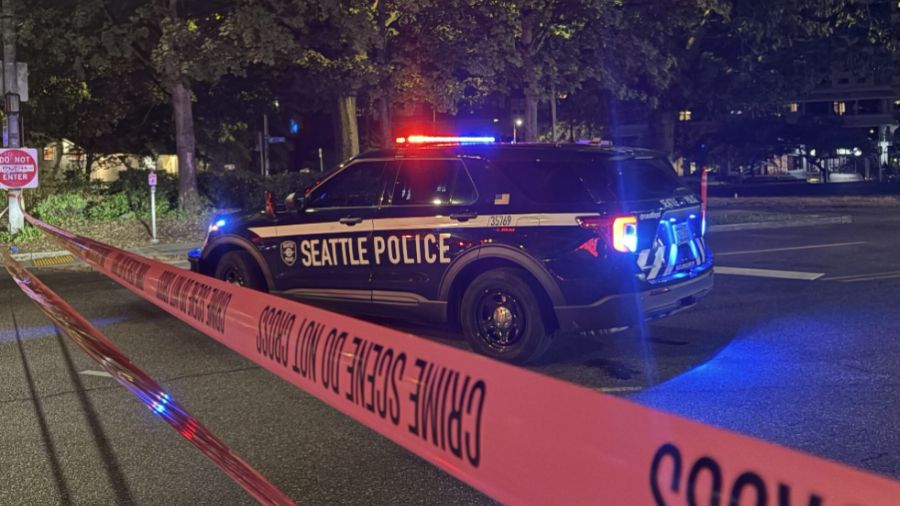
Recently, two Seattle police officers were arrested for drunk driving after crashing a vehicle into a light pole and leaving the scene.

The female officer repeatedly swore at the arresting officers and appeared "extremely intoxicated." Two breath tests came back with a blood alcohol level of .234 and .247 from the December incident. The male officer was also above the limit.

Two officers in Bellevue were demoted after their drunk and disorderly conduct at a Seahawks game in September. A month later, another Bellevue officer covered up for a fellow cop who was intoxicated and attempting to drive drunk.

"We take people who are incredibly sharp and we test and hire them because of their sensitivity and intuitive nature - their compassion - and then we're blown away when five years later they're drunk as a skunk. That seven, 10 years later they are in the gutter drunk," Mann says. "I'm not surprised at all."

Mann hasn't touched alcohol for the past nine years. He's now working with other cops who have problems substance abuse.

"I own my past behavior related to drinking. I own my deception. What I won't own is a system that consistently handles or mishandles the alcoholic cop," he says.

By Mann's estimation 15 to 20 percent of law enforcement officers abuse alcohol.

Alcohol abuse with cops is hard to verify. Many incidents don't get reported until there is a DUI or some other crime that forces a public record of the mostly private behavior.

Seattle Police Sergeant Rich O'Neill says the range seems high to him.

The Seattle Police Officer's Guild president says there are only two or three DUIs involving Seattle cops each year, out of about 1,200 officers.

"Police officers are human. Until we stop recruiting from the human race we're going to be dealing with human problems," says O'Neill. "One of those problems is people going out and having a little too much to drink."

Studies show police officers have higher rates of alcoholism, divorce, and drug abuse, than the average American. They also have life expectancies ten years less than the average person, mostly due to suicides.

While some citizens think cops who get in trouble with alcohol should be thrown off the force, O'Neill says "that's not a solution."

"Why would we want to invest all of this training and money and experience to have a quality employee, who then goes out and makes a mistake - a terrible choice - and we're just going to throw them out like they're a replaceable widget of some kind?"

Mann does not think officers who get in trouble with alcohol or drugs should be fired either.

Instead he's proposing they go back to work with a special contract - in addition to their deal from the police union. that outlines their requirements in order to get clean and sober and work again on the streets.

The "Return to Work Contract" outlines aggressive treatment, monitoring, and clear intent to terminate if or when the contract is not honored.

He is calling for drug or alcohol testing of officers too, saying behavior and performance changes are easy to feign for the alcoholic cop, but the blood and breath can't lie.

"Some of the best police officers I've ever met are those who succeeded in recovery. They are hot on the street," says Mann. "They are really good at what they do."

By LINDA THOMAS


MyNorthwest.com - Purpose of Comments statement
Bonneville Media encourages site users to express their opinions by posting comments. Our goal is to maintain a civil dialogue in which readers feel comfortable. At times, the comments can descend to personal attacks. Please do not engage in such behavior. We encourage your thoughtful comments which: have a positive and constructive tone, are on topic, are respectful toward others and their opinions. Bonneville reserves the right to remove comments which do not conform to these criteria.

Comments (26)


  • Add A Comment

  • ron prevost wrote...
    Cops are human. .. Let me say this again - COPS ARE HUMAN.
    And if 10% of the population is prone to addiction - and another 5-10% prone to at least occasional problem drinking, why shouldn't we expect some cops to be alcoholics?

    The problem is intensified, however, when (1) the public (and perhaps PD leaders) see addiction as a character fault rather than a physical/genetic disease and (2)fellow cops (and often those same PD leaders) enable addiction by excusing it or accommodating impaired officers - on and off duty. ........ Such views and accommodations discourage - or provide excuses - officers from seeking the help they need to fight their addictions.

    As has been said time and again, the only thing wrong with addiction is doing NOTHING about it. Departments need to both tolerate and encourage officers seeking help. And the general public (including media and talk show hosts) needs to understand that seeking help is not a sign of weakness - but of STRENGTH.

    An officer with an addiction (and, BTW. it's not JUST booze) should be proud to seek and get help. Never ashamed.

    { "Thumbs Up":"1","Thumbs Down":"-1" }
  • Chuck Gould wrote...
    The problem arises when we make moral judgments instead of just clinically do a job...
    If we think of people who get arrested for DUI as "bad people", instead of "people who were arrested for DUI" we make it a lot tougher on all parties concerned.

    I expect a certain number of cops to be drunks. A certain number will beat their wives, abandon their kids, and commit petty (or even major) crimes. What percentage will that be? Well, look at society in general and that should suggest an answer.

    Can a guy be a drunk and still arrest other drunks? Absolutely, as long as he or she is merely doing their job of enforcing the law and not trying to make some sort of moral judgment.

    It's like going to a doctor who smokes and could stand to lose a few pounds. You really ought to listen when he or she says "you need to knock of smoking and get back closer to your college weight". In most cases where such advice is given, the doctor is probably right. If the doctor said, "Hey, I'm really cool, even though I need to lose some weight and smoke a pack a day- but you're a total loser because you have 20 pounds to shed and you smoke with friends at lunch break" that would be ridiculous.

    { "Thumbs Up":"1","Thumbs Down":"-1" }
  • ron prevost wrote...
    Unless I'm missing a point here, the post is NOT about how duink cops can do their job.............
    It's about how this is a problem than needs solutions. ... Again, acceptance by PDs that addiction is a disease - and a TREATABLE disease is a strong step. And treatment should not be stigmatized. So long as officers willingly seek heap, addiction should be no more a 'moral' problem than, say cancer.

    Yes, I know. Some WILL pass moral judgement on a lung cancer patient who has smoked, but those are the people whose own lives are 'without fault'. But some condemn broken bones as well.

    { "Thumbs Up":"1","Thumbs Down":"-1" }
  • Seattle is a cesspool wrote...
    Okay Linda...
    What happened to the Curley Show? Give us the skinny on the internal workings of Kiro.
    { "Thumbs Up":"1","Thumbs Down":"-1" }
  • TheNewsChick wrote...
    Seattle is a cesspool (I disagree with that btw)
    I don't know the inner workings of KIRO, I just know that I'm back on Seattle's Morning News with Dave Ross.
    { "Thumbs Up":"1","Thumbs Down":"-1" }
  • sportsguru wrote...
    I am calling BS

    It's not the departments and/or City to deal with the dopefiends addiction. It's the addicts responsibility to deal with his own addiction. Federal, state, county and/or local government and/or unions are not going to get that dopefiend cop sober, only the dopefiend cop can take responsibility and get sober.

    I know people who quit there jobs to get SOBER!!!!! If a person truly wants to get sober and they are in a job that has a high propensity for drug abuse. That's the same as a crackhead getting clean and then going to live in a crack house,lol.

    "Studies show police officers have higher rates of alcoholism, divorce, and drug abuse, than the average American. They also have life expectancies ten years less than the average person, mostly due to suicides."

    I find it comical that we have the police guild on one hand denying the FACTS and an officer who lost his job saying that we need to help these officers with PUBLIC MONEY, but on another thread these same sorry officers complaining about not being able to prosecute dopefiends in Seattle while asking that we don't prosecute and fire dopefiend police officers and oh by the way, LET'S KEEP THEM ON THE JOB,LOL. Talk about hyprocrisy

    { "Thumbs Up":"1","Thumbs Down":"-1" }
  • CH wrote...
    Flounder or whoever you are Quit it now ! . . . .
    Why do they not do random Drug test on Kops? They should not use drugs. I'm more worried about their GUNS than alcohol.
    { "Thumbs Up":"1","Thumbs Down":"-1" }
  • CH wrote...
    see i told you the bookerkeep hacked my account . . . .
    I got something you can hack on flounder.
    { "Thumbs Up":"1","Thumbs Down":"-1" }
  • CH wrote...
    I just know that I'm back on Seattle's Morning News with Dave Ross?
    when did this happen? Every thing is up side down. Its the bookkeeps fault since she hijacked everyone's accounts.
    { "Thumbs Up":"1","Thumbs Down":"-1" }
  • ron prevost wrote...
    Was John Curley........
    the real hijacker ???????
    { "Thumbs Up":"1","Thumbs Down":"-1" }
  • Cameron wrote...
    So Linda...
    What was the reasoning behind the switch on the Morning News? Curley was far better than Radke, Ross is far worse than Curley. Your programming decisions are questionable at best. The methods of implementing these changes lack transparency and leads to speculation as to the intelligence of station management.
    { "Thumbs Up":"1","Thumbs Down":"-1" }
  • HPD 5-0 wrote...
    With all you mentally deranged rantings I'm back to calling you spurts.
    Why so angry? Saw your first paycheck and now realize how much more Owebama is costing you?
    { "Thumbs Up":"1","Thumbs Down":"-1" }
  • Annie (1) wrote...
    What's Up?
    Hey-Gentlemen-could you take a moment & fill me in on what's happened to the KIRO lineup? From your conversation it looks as if John Curley is gone( his photo is even off the home page)-I know many didn't care for him-but I did-- now it seems he's gone from KIRO entirely. I haven't been listening to the radio the last week-so if he said goodbye I didn't hear it. So who is doing morning news now. Sorry this is off topic-but KIRO never posts any changes.
    { "Thumbs Up":"1","Thumbs Down":"-1" }
  • { "Thumbs Up":"1","Thumbs Down":"-1" }