Seattle’s new bikeshare companies prove they are relevant
Dec 22, 2017, 6:56 AM | Updated: 9:00 am


Seattle may not know exactly how to park them, stay safe while using them, or ride them up a hill, but the slew of stationless bikeshare rides around town are defying naysayers.
RELATED: Bellevue inviting Seattle-style bikeshares into town
The city attempted to gear up its own bikeshare, Pronto, but the effort was short-lived and ended in early 2017.
Since then, three private bikeshare companies quickly arose in the wake of Pronto’s demise — ofo, SPIN, and Limebike. The city tested their unique stationless system for about six months. While the pilot program will wrap up at the end of 2017, the companies will continue to operate.
Despite Seattle’s challenges, the bikeshares have kept moving and winning over locals. Even a Libertarian changed his mind about the form of transportation. And the numbers seem to back this up. The Seattle Bike Blog reports that data from the pilot shows the companies have done quite well since they started in July.
When the Seattle Department of Transportation reported bikeshare usage statistics in September, there were around 120,000 trips already taken. By the end of November, Seattleites had taken a total of 347,300 rides. That means in the roughly three cold, rainy months, 227,300 trips were taken on bikes from one of three companies. It also means that in six months, the private bikeshare companies provided more trips in Seattle than Pronto did in its 2.5 years.
Stationless bikeshares have provided an average of 2,711 rides every day. The bike blog points out that the average daily ridership of the current bikeshares is more than the First Hill streetcar (1,600) and the South Lake Union streetcar (1,400).
Private bikeshare success
Much of the success could be credited to the private nature of the bikeshares. The companies don’t have to wait for a council vote to make a decision. The city may have helped, however, by showing how not to operate a bikeshare. The companies are demonstrating that when you embrace modern technology and trends, the business model can work.
Stationless bikeshares are point-to-point systems; a factor that rideshares have already proven popular. They only cost $1 to use; cheaper than a bus, rideshare, or the now-defunct Pronto.
The fervor for bikes already exists in the region. Depending on who you ask, statistics range from 3 percent of 250,000 downtown workers, to 3.4 percent of all 350,000 Seattle workers. If you break that down, it means that between 7,500-11,900 commuters use a bike in Seattle. That’s a lot of people putting two wheels on the road despite hills and rain. The Cascade Bicycle Club alone has more than 17,000 members from throughout the region.
When you add that up, you get a valuation of $200 million — what Limebike was estimated to be worth after operating in town for about two months. Limebike chose Seattle as its first major city to launch its bikes.
Before the stationless pilot was even over, Seattle’s own bikeshare official jumped ship to go work at SPIN.
Pronto contrast
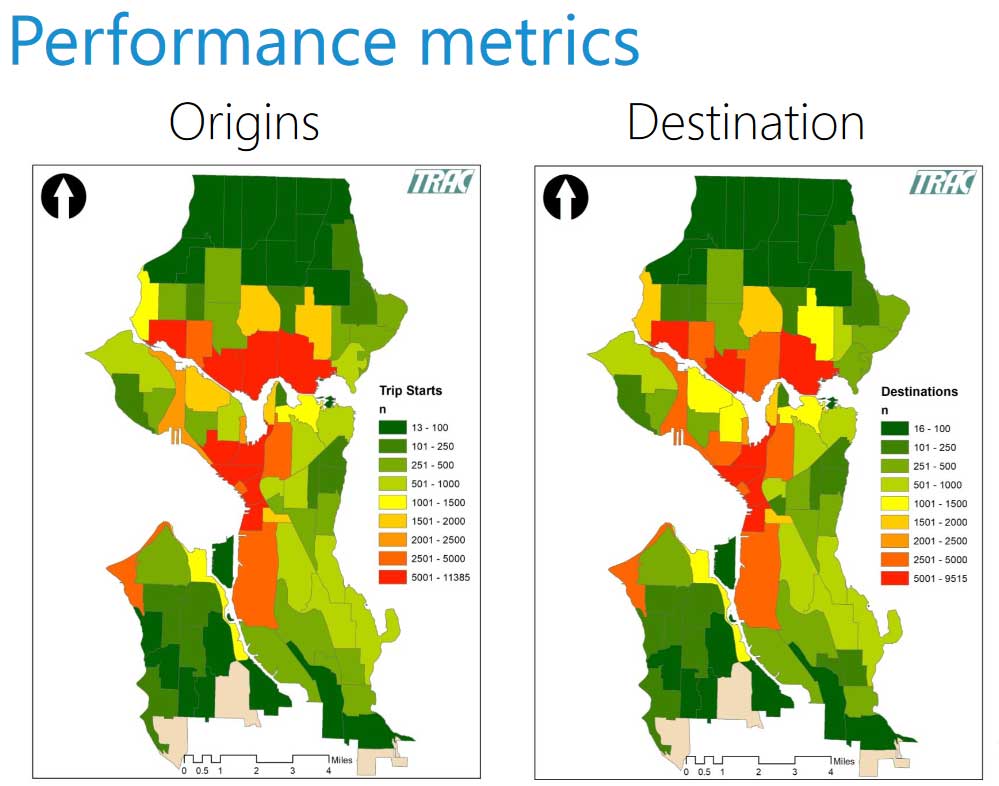
Stationless bikeshare usage after two months in Seattle. (SDOT)
Seattle’s Pronto was a very limited system with only 500 bikes. The stationless bikeshares launched with 1,000 units and worked to add 9,400 permitted bikes by the end of November. Pronto required users to go from station-to-station. Therefore, Pronto had to get permission to place stations around private property.
The stations were also inconveniently placed. They only covered downtown, Capitol Hill, and part of the University District. Pronto was more of a carnival ride for tourists and tech workers taking downhill trips from Capitol Hill to South Lake Union.
RELATED: 3 days commuting via a stationless bikeshare
Seattle quickly found out that — aside from the expected downtown ridership — people will use the bikes all over the city. Capitol Hill and downtown may boast a dense population, but there was considerable usage in the parts of the city where people live and likely commute — Ballard through Wallingford and the U-District. Areas surrounding those neighborhoods experienced significant usage, too. Not to mention parts of West Seattle.