Seattle oil train derailment further fuels concerns, opposition
Jul 24, 2014, 2:44 PM | Updated: 5:01 pm
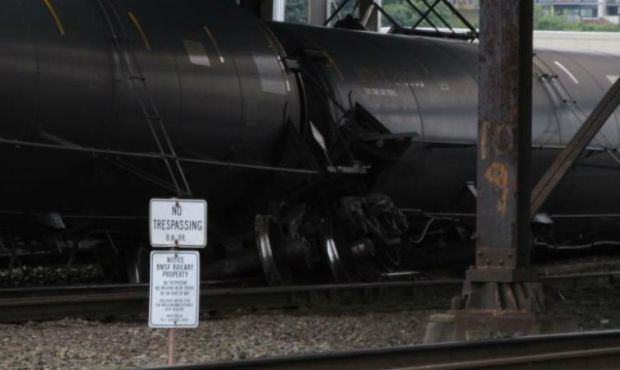

While no oil spilled when a train carrying crude oil through Seattle derailed Thursday morning, local officials say it’s a dangerous wake up call that can’t be ignored.
The train, with 100 tanker cars of Bakken crude oil, was heading for a refinery at Anacortes and pulling out of the Interbay rail yard at 5 mph when five cars derailed early Thursday morning, said Burlington Northern Santa Fe spokesman Gus Melonas.
They included one of the locomotives, a buffer car loaded with sand and three tankers. The locomotive, buffer car and one tanker remained upright. Two of the tankers tilted. One leaning at a 45-degree angle had to be pumped out and taken elsewhere for repairs, Melonas said.
No one was injured in the accident and a railroad hazardous material crew was on the scene in five minutes, he said.
King County Executive Dow Constantine said the incident underscores the need for federal regulators to take action immediately on new rules to protect the public.
“I’m very concerned that large volatile oil trains pose significant risk for derailment, fire, explosion, loss of property and life.”
Constantine tells KIRO Radio he finds it troubling that local governments have little say or control over what passes through their communities while facing potential dangers.
Concerns about oil trains have grown significantly as production of domestic oil continues to increase. More people became aware of oil train dangers when a runaway train exploded in 2013 in the Quebec town of Lac-Megantic, killing 47 people.
Washington Gov. Jay Inslee cited safety and environmental risks in June when he directed state agencies to evaluate oil transport in Washington.
The derailment comes just one week after Constantine convened a group of elected leaders from across the Northwest and British Columbia to examine what he calls “the true costs and impacts of coal and oil trains on our communities.”
“We need to have a conversation about what is appropriate to ship through these heavily populated areas and what kind of notice people deserve that these shipments are taking place,” Constantine said.
On Wednesday, the Seattle City Council sent a letter to U.S. Transportation Secretary Anthony Foxx supporting a petition filed by environmental groups seeking an emergency ban on shipments of Bakken and other highly flammable crude oil in old style tankers known as DOT-111 cars.
“The city of Seattle is deeply concerned about the threat to life, safety and the environment of potential spills and fires from the transport of petroleum by rail,” the letter said.
The government proposed rules Wednesday that would phase out tens of thousands of older tank cars that carry increasing quantities of crude oil and other highly flammable liquids through America’s towns and cities.
The tankers involved in the Seattle accident hold about 27,000 gallons of oil and are a newer design with enhanced safeguards.
“The cars performed as designed,” Melonas said. “There was no release of product.”
It was the first incident in the state involving an oil train, he said.
“We have an outstanding safety record, and derailments have declined in Washington state over 50 percent on BNSF main lines in the past decade,” he said.
But Seattle City Councilman Mike O’Brien tells KIRO Radio he wants far greater assurance.
“As far as which steps need to be taken before I’m comfortable, I don’t have an answer for that yet. But I’m really disappointed that people aren’t taking those steps immediately,” he said.
The Seattle accident occurred on the same day the Corps of Engineers is holding a hearing in Seattle on a draft environmental statement for a pier that BP built at its Cherry Point refinery north of Bellingham to handle oil tankers and oil trains. Environmental groups planned a rally before the hearing.
“This is a warning of how dangerous this could be,” says Kerry McHugh, communications director for the Washington Environmental Council.
She noted the train derailed near Puget Sound, under Seattle’s Magnolia Bridge, the main connection to one of the city’s neighborhoods.
“The potential for environmental damage, economic damage and the disruption of people’s lives is huge,” she says.
The Associated Press contributed to this report.