SEATTLE NEWS ARCHIVES & FEATURES
Second opinion: What would police outside Seattle do about the Jungle?
Jun 3, 2016, 7:17 AM | Updated: 8:53 am
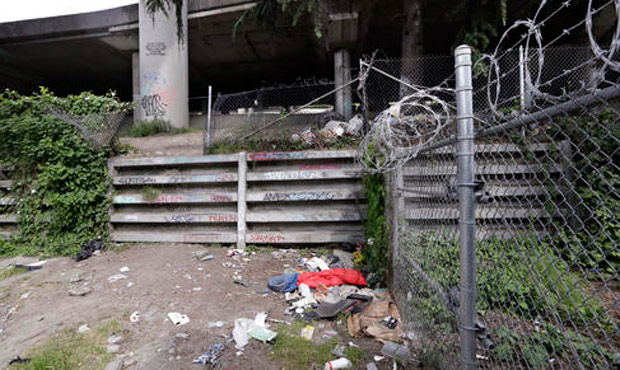
Pierce County Sheriff Detective Ed Troyer told KIRO Radio's Don O'Neill that there's no way deputies would allow an area in their jurisdiction to get as bad as Seattle's "Jungle."(AP)
(AP)
There’s no way Pierce County deputies would allow an area in their jurisdiction to get as bad as Seattle’s infamous encampment known as the “Jungle,” Pierce County Sheriff Detective Ed Troyer told KIRO Radio’s Don O’Neill.
“We wouldn’t let it get that far,” Troyer, spokesperson for the sheriff’s office, said. “We take care of business. We don’t ask for permission from politicians to go and enforce (the law).”
Related: Seattle police, the homeless crisis, crime and mixed messages
Troyer noted that one big difference between the two counties is that Pierce County has an elected law enforcement officer, while Seattle has a lot of officials and politicians stepping in. Yet Pierce County faces similar encampment issues along rivers and other areas, and Troyer said that they have procedures in place to deal with them.
“We bring people in to give them services if they will take them but the majority of them won’t,” Troyer said. “Then we tell them what time we are coming back and what is going to happen. And we would clean it up. We would use dump trucks and bulldozers and we would clean it up, take everything out, and move them on.”
But Troyer stresses there is an important thing to understand when he talks about clearing out encampments.
“This is not the group of people that are homeless, living in their car with kids and want services, or they’re out of a job,” he said. “These are a group of homeless people that are committing crimes.”
“I almost think there should be a different title,” Troyer continued. “There are homeless people that are homeless and not by choice. And there are homeless people that build their own little cities and want to live that way and they sustain themselves by stealing other peoples’ items, being addicted to drugs, and robbery. That’s the people we go after. Whenever we do, we find stolen bikes, stolen tools, stolen stuff out of cars, other peoples’ IDs.”
So how would Troyer deal with a place like the Jungle?
“Get all the resources together, make a plan, and we would be able to (clear it out),” he said. “There would be places for people to go. But what do you do when you have people that don’t want to go. It sounds like (Seattle) has been offering people shelters, but they just don’t want to go. If they don’t want to go, and you offer them everything, what’s your next step? You just can’t let a group of people get together and create a large group of criminals. That’s what happens in some of our homeless encampments — not all of them.”
According to law enforcement, it appears that the Jungle has more criminal activity than homeless activity — stolen bikes, drug use, fights, and violence. Troyer recommends allowing police officers to enforce laws around that criminal activity.
“I’ve talked to a lot of (police) up here whose hands are tied. It’s not the police work,” Troyer said. “If you got the administrators and politicians and everybody saying ‘go do this,’ they would get the job done. I’m sure they are frustrated taking the same reports over and over, every day on the same thieves and criminals.”
Follow @https://twitter.com/DyerOxley