SEATTLE NEWS ARCHIVES & FEATURES
King County Sheriff John Urquhart touts bravery over political correctness
Jun 13, 2016, 2:08 PM | Updated: Jun 14, 2016, 5:29 am
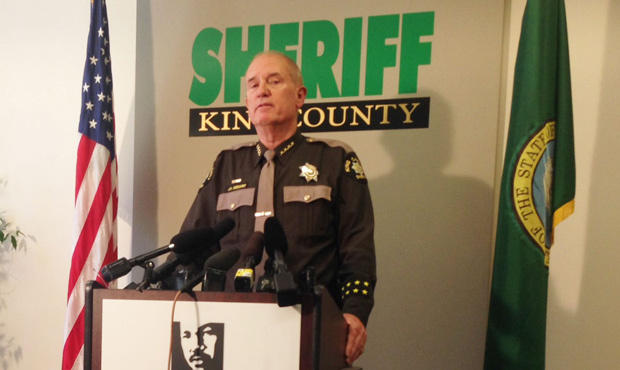
"Do you want to be politically correct or do you want to stop a situation like happened over the weekend?" (KIRO Radio file photo)
(KIRO Radio file photo)
King County Sheriff John Urquhart knows they are clichés, but he has two primary pieces of advice following the mass shooting at an Orlando nightclub: Don’t let terrorism win and if you see something, say something.
“Don’t let terrorism win or scare you into doing anything,” Urquhart told KIRO Radio’s Dori Monson. “You go to any damn bar you want to go to.”
Related: Redmond mosque receives direct threat after Orlando massacre
While that may be true, it’s that latter perspective that Monson is less sold on. Dori believes that it has become increasingly difficult to report suspicious circumstances without being branded a hate monger. He says political correctness has silenced many people who might otherwise be at the front line of vigilance.
“That could be true,” Urquhart said. “My response would be: Do you want to be politically correct or do you want to stop a situation like what happened over the weekend? We need to all be brave, if you will, and throw caution to the wind and call the police. Let people know. (Police) will handle the political correctness attitude that some people may feel they will be branded with.”
Ed Terzanski, a national security and counter-terrorism expert with the Foreign Policy Research Institute –a right-leaning think tank based in Philadelphia — told Dori that there were plenty of clues for the FBI that should have been red flags about the accused killer, Omar Mateen. And the FBI was, in fact, aware of him. Thus, the question: Why was he still walking around free?
A co-worker told media outlets that he never reported Mateen because he was Muslim. Terzanski believes political correctness at the workplace trickled down to greater violence.
“In not moving against his employment, you also didn’t move against his right to buy weapons,” he said. “You got the result that no one can say was entirely unpredictable.”
“There is the practical harm that people keep to themselves and don’t point out things that should be properly brought forward,” Terzanski added. “But it’s even worse. What happens is you build resentment among the general populous who say there is an exempt class and no matter what happens, I can’t say anything because I’ll be the one to pay the price. It will be my employment, my Twitter account, my social media presence, my reputation that suffers as a result of my pointing something out. And don’t think the other side doesn’t recognize it and doesn’t play this to their advantage every opportunity they get.”
Related: SPD Chief Kathleen O’Toole: No specific threat to Seattle but expect more police
Urquhart believes the Orlando police did a “good job” with a “textbook response” for what was a miserable situation.
“This guy was heavily armed, he had an assault rifle, he had hostages,” he said. “It just doesn’t get any more difficult than that. And the fact that it happened at 2 o’clock in the morning and typically all you have out there are patrol officers that are not equipped with the right kind of gear to go in and take out a shooter like this.”
Law enforcement officials around the country are evaluating their threat matrix. Urquhart said Puget Sound officials are looking where the threats are coming from. President Barack Obama said the gunman was inspired by extremist information over the Internet. Urquhart says terrorist concerns are increasingly not coming from overseas.
“What the FBI is afraid of, and I concur, is a homegrown extremist,” Urquhart said. “We have seen this at Fort Hood, at the naval yard in (Washington) D.C., in San Bernadino, now we’ve seen it in Orlando. These are United States citizens. They were people that were born here. They were not some Syrian refugee that was able to sneak across the border either from Canada or Mexico. And yet they were still able to wreak havoc, to kill all these people because they were inspired by ISIS.”
Dori suggested that immigrants coming from problem areas bring a greater chance of radicalization. Urquhart disagrees, saying it is American citizens living under the radar who are the real threats.
“I think we have a risk with anyone who has mental issues and this guy clearly had mental issues,” he said. “… I don’t think it’s a question of where they’re born, where they come from, what their religion is, but they are susceptible to what ISIS is spewing and until we deal with ISIS that’s still going to happen.”
In a different vein, Terzanski says not speaking openly and honestly about Islamic terror builds problems.
“Those Muslims who are peaceful, law-abiding need the help of those of us who recognize Islamist extremism is a problem,” he said. “Extremist Islam is the problem, moderate Islam is the solution. But if you won’t mention the word Islam, you’re never going to get to that point of wisdom.”
Follow @http://twitter.com/Mynorthwest