SEATTLE NEWS ARCHIVES & FEATURES
Attorney: Seattle created ‘dangerous situation’ leading to CHOP murder
Oct 17, 2022, 5:17 PM | Updated: Oct 19, 2022, 11:40 am
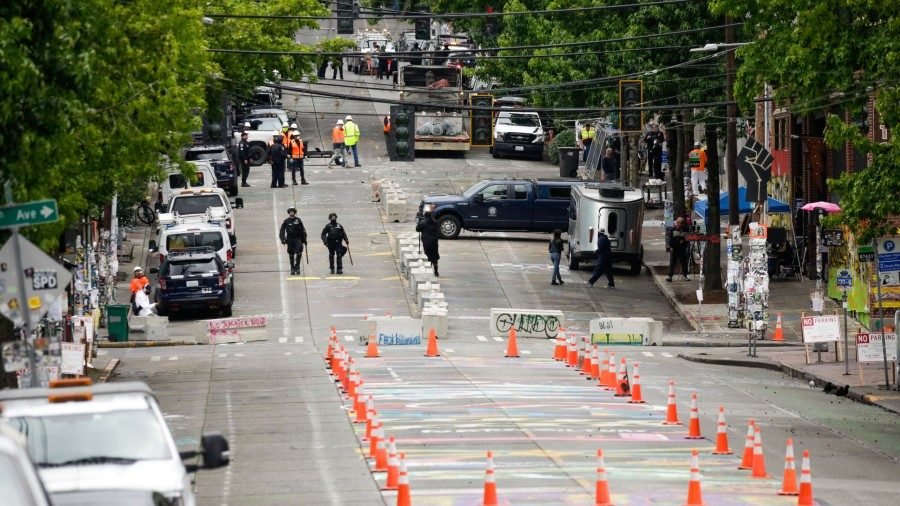
An empty Capitol Hill Occupied Protest (CHOP) is pictured after Seattle Police cleared the CHOP and retook the department's East Precinct in Seattle, Washington on July 1, 2020. (Photo by Jason Redmond / AFP via Getty Images)
(Photo by Jason Redmond / AFP via Getty Images)
Updated: 12:00 noon Oct. 19, 2022
On June 20, 2020, a 19-year-old man was killed inside the city’s Capitol Hill Organized Protest (CHOP) zone, an area that formed after protests took over Seattle over the death of George Floyd in Minneapolis.
On surveillance video, the man, Lorenzo Anderson, was seen being shot. Marcel Long has been charged with the crime and is awaiting trial.
Now, a lawsuit is being filed by Lorenzo’s family against the city of Seattle.
Lawsuit seeks to hold the city accountable
Phil Talmadge, a former Washington state Supreme Court justice, and Mark Lindquist, a former Pierce County District Attorney, are representing Donnitta Sinclair, Anderson’s mother. They said the city should be held accountable for the shooting.
Family of teen shot, killed in CHOP zone files claim against Seattle
The case is being heard in the Ninth Circuit Court of Appeals.
Key points of the prosecution’s case
On the Dori Monson Show Monday, Dori asked Lindquist what the key points of his case were.
“Number one, the city created a dangerous situation by abandoning this entire section of the city,” Lindquist said. “And number two, the city failed to prepare for the inevitable violence. Lorenzo was bleeding out for 15 to 20 minutes, and the city failed to get him medical assistance.”
Dori recalled, “The warlords who had taken over that part of Capitol Hill, they weren’t allowing the police in. I’ve watched a lot of the video that night, and there were very active efforts to keep the cops from going in and escorting the medical personnel.”
Lindquist: ‘The city had no plan’
Dori asked if that mitigated exposure.
“No, because the city had no plan in place to deal with its inevitable violence,” Lindquist explained. “It’s going to erupt when you have an entire area of lawlessness. It’s on the city, they need to have a plan.”
Dori said it was a mistake for six square blocks to be turned over to people with “anarchist ideals.”
“Of course, the police knew this. (Seattle Mayor) Jenny Durkan knew this,” Dori said. “When she goes on CNN and declares it a possible ‘Summer of Love.’ I just cannot believe the unfathomable stupidity of her saying something like that at the beginning of this.”
“That was a point actually, that Phil (Talmadge) made to the judges, which not only did the city create this danger, they downplayed the danger,” Lindquist responded. “And beyond that, they refer to it as a ‘Summer of Love’ and a block party. And Lorenzo is a special needs teenager. And that’s what he thinks he’s getting into.”
Dori: “It’s impossible to defend anything that the city did. And what makes [this] even more outrageous is that things that might have explained the decision making, giving up the East Precinct to not show any resistance to these domestic terrorists.” Dori said conversations probably existed at one time in text messages, that Jenny Durkin, then-Seattle Police Chief) Carmen Best, and (Seattle Fire Chief Harold) Scoggins, as well as a bunch of other city leaders, destroyed.
‘Evidence disappearing’ is frowned upon
Dori went on to say that he thought city leaders were going to get off “scot-free and that it is a felony to destroy things that are subject to public records acts.”
“You know, I don’t know if they’re gonna get off scot-free,” Lindquist said. “One of the judges noticed that this had happened. And he was talking about this as spoliation. In other words, this is evidence that can be used against the city, in this lawsuit and in other lawsuits as well. It’s a major problem for the city. Judges take a dim view of evidence disappearing, obviously.
“Our only avenue for accountability (for the shooting) is through this lawsuit. But there are other avenues of accountability for the disappearance of these text messages, which were on government phones, so they’re public records. This is being investigated.”
Dori wanted to know what the city’s defense would be.
“Initially, the city tried to defend CHOP and that obviously wasn’t going over with the judges,” said Lindquist. “The danger was not specific towards this victim. In other words, it’s okay to create a danger as long as you don’t target a specific individual. I don’t think that’s the law. And if it is the law, that’s horrible public policy.”
Next stage is discovery
Dori asked about what the next stage will be.
“The next stage is we’ll be getting into discovery,” explained Lindquist. “That means that I’ll be able to depose and interview some of the city officials involved and will request those text messages that apparently disappeared and we’ll gather evidence and see what we can [get]. Part of our goal here is justice, obviously, and accountability.
“But also, we want to flush out the truth.”
Editor’s note: Some quotes in the original story were misattributed. This has been corrected.
Listen to Dori Monson weekday afternoons from noon – 3 p.m. on KIRO Newsradio, 97.3 FM. Subscribe to the podcast here.