Northern lights visited Washington again this week; what causes them
Oct 11, 2024, 11:45 AM | Updated: Oct 12, 2024, 9:20 am

The northern lights can be seen from a neighborhood in Lake Stevens late on Thursday, Oct. 10, 2024. (Photo: Sam Campbell, KIRO Newsradio)
(Photo: Sam Campbell, KIRO Newsradio)

Washington residents had a chance to see the dazzling phenomenon that is the northern lights Thursday night and they didn’t disappoint. For those who missed it, there was another chance to see them Friday night.
The National Oceanic and Atmospheric Administration (NOAA) predicted a level 3 geomagnetic storm again Friday night, with the aurora moving over Washington.
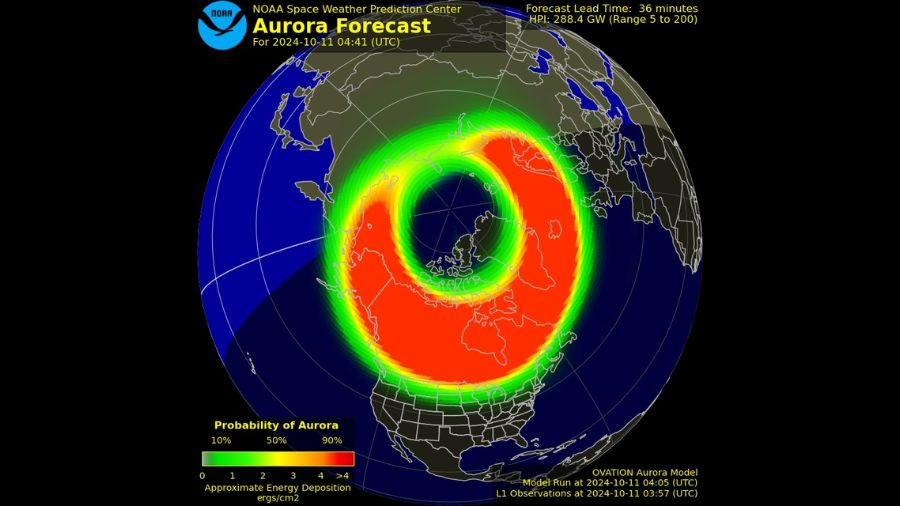
This is the aurora prediction for Friday, Oct. 11, 2024. (Image courtesy of NOAA)
However, NOAA stated via X, the storm will continue to diminish into the weekend, with a G1 watch in place for Saturday.
A G3 Watch remains in effect for 11 Oct as CME effects continue to diminish. A G1 Watch is in place for 12 Oct due to lingering effects. Stay up to date with the latest aurora forecast at https://t.co/Z2haj3XhDP. pic.twitter.com/0NdxMpQqEy
— NOAA Space Weather Prediction Center (@NWSSWPC) October 11, 2024
According to NOAA, a geomagnetic storm is a temporary disturbance of the Earth’s atmosphere caused by solar wind. When the energized particles reach Earth’s magnetic field, they interact with gases in the atmosphere to create those different colored lights in the sky.
Northern lights dazzled Washington skies Thursday
The National Weather Service Seattle posted several photos Thursday night, including one from the vantage point of its office and another one in Kirkland.
We’ve got some low clouds approaching the office so our views might be gone soon. But this flare up of the the #aurora was easily spotted without any optical assistance around 12:45 AM PST. #wawx pic.twitter.com/bfwClFilal
— NWS Seattle (@NWSSeattle) October 11, 2024
More weather: Western WA does not have to worry about hurricanes, just bomb cyclones
KIRO Newsradio’s Sam Campbell also captured a photo of the lights in Lake Stevens late Thursday night. (That photo is at the top of this story.)
Other than creating the northern lights, geomagnetic storms can affect power grids, satellite ops and GPS, outlined NOAA.
“Geomagnetic activity can vary considerably during storm progression with intermittent periods of escalation or weakening as the major disturbance in the solar wind continues,” NOAA stated.
The aurora, according to NOAA, moved over New York to north Iowa and Washington Thursday night.
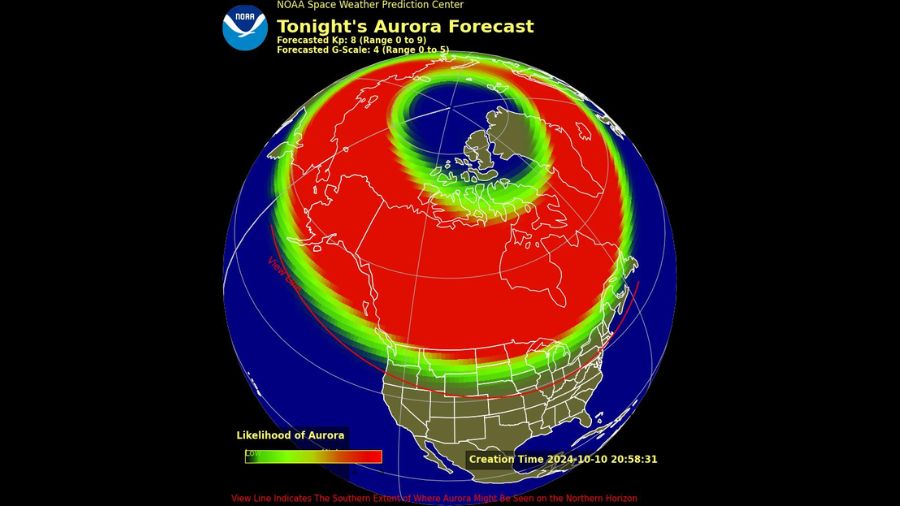
This is the aurora prediction for Thursday, Oct. 10, 2024. (Image courtesy of NOAA)
To best view the lights, Aurora Academy’s website suggested fans head outside of the city, away from light pollution. It recommended Deception Pass State Park, Mt. Rainier National Park and the North Cascades National Park. It also said the best time to view the lights in the Seattle-area was from 10 p.m. to 3 a.m.
NOAA also advises those who hope to see the northern lights to get away from city lights.
The best viewing time is usually within an hour or two before or after midnight, and the agency says the best occasions are around the spring and fall equinoxes due to the way the solar wind interacts with Earth’s magnetic field.
The last notable geomagnetic activity was Sept. 12, which was also a level G3.
Local news: Another earthquake hits Pacific Northwest bringing total to 87 in past month
What causes northern lights?
The sun sends more than heat and light to Earth — it sends energy and charged particles known as the solar wind. But sometimes that solar wind becomes a storm. The sun’s outer atmosphere occasionally “burps” out huge bursts of energy called coronal mass ejections. They produce solar storms, also known as geomagnetic storms, according to NOAA.
The Earth’s magnetic field shields us from much of it, but particles can travel down the magnetic field lines along the north and south poles and into Earth’s atmosphere.
When the particles interact with the gases in our atmosphere, they can produce light — blue and purple from nitrogen, green and red from oxygen.
Dahl said this storm generated a particularly vibrant display when it hit because the orientation of the storm’s magnetism lined up well with the Earth’s. “We stayed well connected,” he said.
Why have there been so many solar storms lately?
Solar activity increases and decreases in a cycle that last about 11 years, astronomers say. The sun appears to be near the peak of that cycle, known as a solar maximum.
In May, the sun shot out its biggest flare in almost two decades. That came days after severe solar storms pummeled Earth and triggered auroras in unaccustomed places across the Northern Hemisphere.
There will likely be more to come. Dahl said we remain “in the grip” of the solar maximum and it isn’t likely to start to fade until early 2026.
“We’re in for more of the experiences we had last night,” he said.
Send your photos our way
If you capture some spring pictures or do get to see the northern lights, please share your photos with MyNorthwest on our Share With Us page.
Editors note: This story was originally published on Oct. 10, 2024. It has been updated and republished multiple times since then.
Contributing: The Associated Press; Steve Coogan, MyNorthwest
Julia Dallas is a content editor at MyNorthwest. You can read her stories here. Follow Julia on X here and email her here.