Mount St. Helens just got a lot more mysterious
Nov 2, 2016, 2:19 PM | Updated: Nov 3, 2016, 7:24 am

Mount St Helens erupted in 1980. (File, Associated Press)
(File, Associated Press)




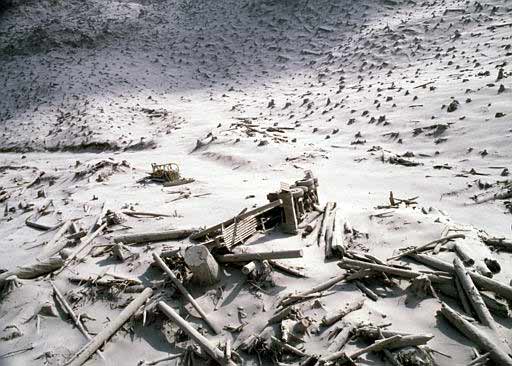
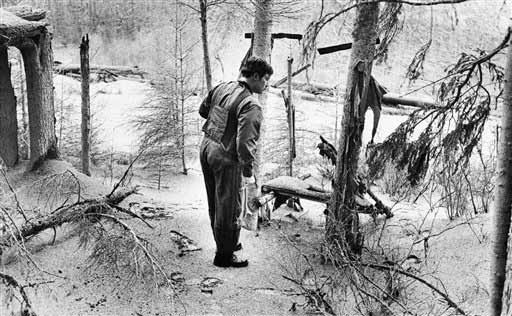
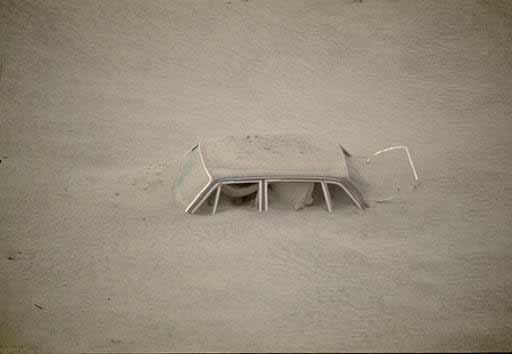

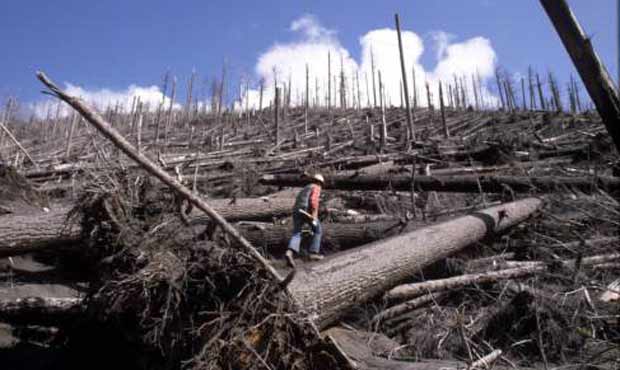

What we know is that in 1980, Mount St. Helens filled with magma and erupted. What we don’t know — still — is where that magma came from.
And a recent study on the volcano produced some answers but, in turn, created more of a mystery about the cold-hearted mountain.
3.8 earthquake jolts SW Washington
Most of the mountains in the Cascade range were formed atop hot magma forced up from far below the earth. They sit on what’s called a continental arc, which feeds hot magma to the line of volcanoes in the range. But Mount St. Helens is different. It’s cold.
According to a study published Nov. 1 in “Nature Communications,” geologists began studying Mount St. Helens in 2014 to determine the magma’s origin. In short, they set off explosions all over the mountain and used the resulting vibrations to create a picture of what’s underground. They found some answers, but as the report states, Mount St. Helens now presents a “thermal paradox.”
PBS sums up what scientists have found:
The study’s measurement suggest the ground underneath Mount St. Helen is a cold mantle wedge, a geologic structure with a bit of a misnomer. The Cascadia volcanic arc produces magma at temperatures above 1,470-degrees Fahrenheit. But the temperature of this Mount St. Helens’ underlying wedge is under 1,300 degrees-Fahrenheit — too cold to produce molten rock. The cooler temperatures are caused by ocean water pouring into the Earth at the subduction zone west of Mount St. Helens and reacting with minerals in the mantle to form cold rocks called serpentine crystals.
If you want to read that explanation in science-speak, check the bottom of this article.
The remaining mystery of Mount St. Helens
While Mount St. Helens does not get its magma from the exact same source as its neighbors in the Cascade range, the mountain is still somehow connected to its neighbors (scientists can prove that the mountains are connected electrically). So where does it all come from? Where did Mount St. Helens get all that material for the 1980 eruption? The volcano became active again in 2004-08 — where did that come from?
Those are among the questions left over from the study. One theory is that Mount Adams — about 37 miles away — could be sending a stream of magma to Mount St. Helens. The problem with that theory is that the two mountains are chemically different — they aren’t producing the same magma.
Here are some findings directly from the study:
Mount St. Helens therefore presents a thermal paradox because it lies directly adjacent to the cold mantle wedge and yet still produces arc derived magmatism which requires elevated temperatures. For example, Mount St. Helens primarily erupts dacites that are produced in the lower crust by either partial melting of a mafic source and/or partial crystallization of mantle derived basalts. Analysis of melt inclusions from the 1980 and 2008 eruption cycles indicate that magma temperatures were 860–900 °C, consistent with thermal models of arc lower crust (800–1,000 °C). Additionally, analysis of young (post-Miocene) mantle derived basalts from southern Washington suggest melt segregation temperatures that range ∼1,200–1,450 °C. A hot mantle wedge directly beneath Mount St. Helens is incongruent with the presence of a cold (<∼700 °C) serpentinized uppermost mantle just west of the volcano.
One way this dilemma can be resolved is if the lower crustal source region resides east of the volcano, towards the hotter axial region of the volcanic arc, and the ascending melts migrate laterally in the crust towards the forearc region. Magnetotelluric results indicate that Mount St Helens is electrically connected to a region of high conductivity in the mid-crust, which is located near the southern terminus of the Southern Washington Cascades Conductor. This feature extends east to Mount Adams and has been interpreted as a layer of partial melt, which could thus provide a pathway for the westward migration of melts derived from the lower crust towards the cold forearc. However, dacites erupted at Mount St Helens have notably different geochemistry than those found at Mount Adams which suggests that the melt source regions for these two volcanos are not the same.
Follow @https://twitter.com/DyerOxley