Attorney General Bob Ferguson: Trump conceded defeat
Mar 6, 2017, 12:38 PM | Updated: 1:05 pm
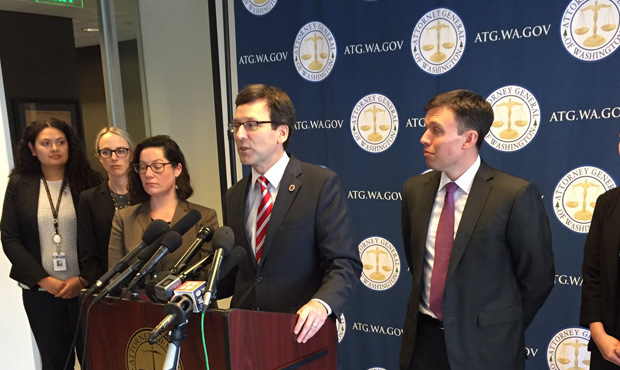
Washington Attorney General Bob Ferguson addressed President Trump's revised travel ban on Monday. (Josh Kerns, KIRO Radio)
(Josh Kerns, KIRO Radio)
Washington Attorney General Bob Ferguson said his office will be carefully reviewing Donald Trump’s revised travel ban and says that while it has been substantially narrowed in focus, he still has concerns about the president’s “intent.”
President Trump signed a revised travel ban Monday morning that halts entry to the U.S. for people from six Muslim-majority nations who are seeking new visas and suspends the country’s refugee program. The ban will have an effective date of March 16.
Ferguson said in a press conference Monday that the new executive order is akin to Trump conceding defeat as it is drastically narrowed from the original ban. He said his office is reviewing the new ban carefully and “still have concerns of the new order.” He said his team would be taking a “thoughtful approach” and anticipated having a determination about how to move forward from a legal standpoint later this week.
“Those original concerns about intent of the executive order, the original executive order, I’m still concerned about that,” Ferguson said at the press conference.
Ferguson said he and his staff will be looking into whether the revised travel ban would lead to economic harm or difficulties in Washington state. He said they will go through the same process as they did before, except that now they will have more time to scrutinize it.
“By rescinding his earlier Executive Order, President Trump makes one thing perfectly clear: His original travel ban was indefensible — legally, constitutionally and morally,” Ferguson said in a press release. “The President has capitulated on numerous key provisions blocked by our lawsuit, including bans on Green Card holders, visa holders and dual citizens, an indefinite ban on Syrian refugees, and explicit preferences based on religion. We are carefully reviewing the new Executive Order to determine its impacts on Washington state and our next legal steps.”
When asked what lessons the Trump administration should take from this defeat, Ferguson responded that “we are a nation of laws …” and added that the original order lacked the kind of thought or consultation that the American people should not only expect from the president, but any governor or mayor of any town in the county.
Old and revised travel ban
The original order, Executive Order 13769, barred all visitors from those seven countries — Iran, Iraq, Libya, Somalia, Sudan, Syria and Yemen — for 90 days. U.S. District Court Senior Judge James L. Robart issued an injunction halting the order after Ferguson filed his lawsuit on Jan. 30 challenging key provisions as illegal and unconstitutional.
Ferguson said the following were the effects of President Trump’s original Executive Order compared to his new, revised order:
Lawful Permanent Residents (“Green Card” Holders)
• Original order: Restricted the international travel of about 500,000 current Green Card holders who are citizens of the seven targeted countries. Conflicting guidance from the Administration regarding Green Card holders contributed to widespread confusion in the days following the order’s issuance.
• Revised order: Deleted.
Dual Citizens
• Original order: The Trump Administration initially said that dual citizens — those who hold a passport from one of the seven countries and either a U.S. passport or a passport from another non-banned country — were not permitted to enter the United States for 90 days. Again, shifting Administration guidance contributed to the chaos.
• Revised order: Deleted.
Visa Holders
•Original order: Halted, for 90 days, U.S. entry by citizens of the targeted countries with valid visas to visit the U.S. Tens of thousands of previously issued visas were revoked.
•Revised order: Deleted.
Syrian Refugees
• Original order: Suspended entry of refugees from Syria indefinitely.
• Revised order: Syrian refugees treated like those from other countries. Following a 120-day moratorium, refugees may be admitted to the U.S. following standard vetting process.
Religious Minorities
• Original order: Prioritized religious-persecution claims by refugees only for minority religions in countries of origin (i.e., non-Muslims in the targeted countries).
• Revised order: Does not explicitly prioritize refugees based on religion.
Affected Countries
• Original order: Applied to travelers from Iran, Iraq, Libya, Somalia, Sudan, Syria and Yemen.
• Revised order: No longer includes Iraq.
Effective Date
• Original order: Went into effect immediately, causing widespread chaos and confusion at airports around the world.
• Revised order: Takes effect March 16, 2017.
Follow @http://twitter.com/Mynorthwest