Before Bertha: The mysteries of Battery Street
Apr 3, 2017, 2:53 PM | Updated: 6:10 pm

As Bertha nears the finish line at the north end of the new tunnel that will replace the Alaskan Way Viaduct in Seattle, it’s worth pausing a moment to consider the lowly Battery Street Subway.
The what? The Battery Street Subway?
That’s what the Battery Street Tunnel was originally known as while it was being designed back in the late 1940s and early 1950s. When it opened in 1954, the name of the Battery Street Subway became official. The unusual name stuck for much of the decade and was even used as recently as the 1970s in local newspaper articles.
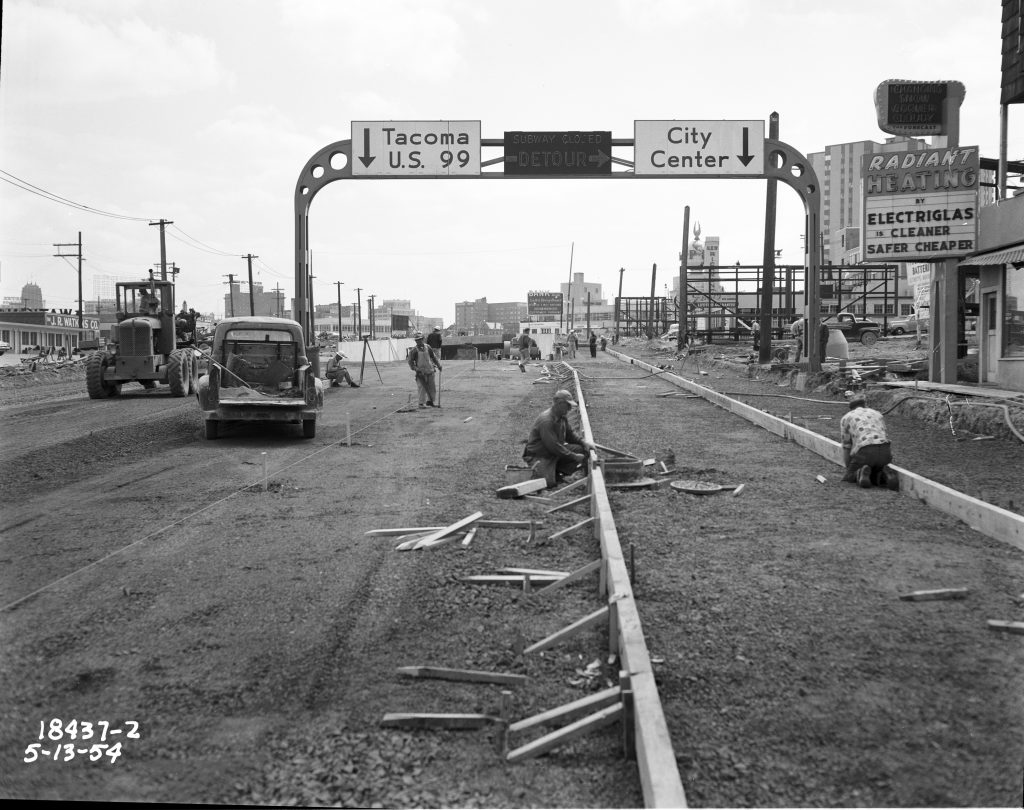
Exact origins of the “subway” term for the tunnel are not quite clear, though original plans for that stretch of the road did not call for a tunnel. The early designs were described as a “depressed roadway.”
It was “depressed” in the sense that the road surface was lower than the surrounding terrain, like a “cut and cover” tunnel without the cover. The “subway” would have been mostly open to the sky, other than where north-south avenues would have crossed on overpasses. In the early “subway” designs, cantilevered sidewalks lined the sides of the roadway as it cut through Belltown.
Related: Sidewalk artifact is relic of forgotten Seattle company
That part of the route – whatever you call it – was the final phase of the years-long viaduct project to improve old traffic patterns through Seattle. The Battery Street Subway was a critical means of bypassing surface streets, and moving traffic smoothly between downtown and the stretch of Highway 99 north of the city, including the Aurora Bridge.
Mimi Sheridan is a historian who prepared a detailed history of the Alaskan Way Viaduct and the Battery Street Tunnel for the “Historic American Buildings Survey (HABS) and the Historic American Engineering Record (HAER),” a project of the Library of Congress to document the history of the built environment.
Sheridan says the “subway” (or depressed roadway) design for the Battery Street Tunnel fell by the wayside when authorities realized the cost of condemning all that private streetscape.
“The condemnation costs exceeded the costs of the [covered tunnel] decking,” Sheridan said.
Sheridan also says that the Battery Street Subway was something of a technical marvel for its ventilation system. Covering up that depressed roadway meant that the tunnel design required some help to get all of the vehicle exhaust out of the tunnel and exchanged for fresh air.
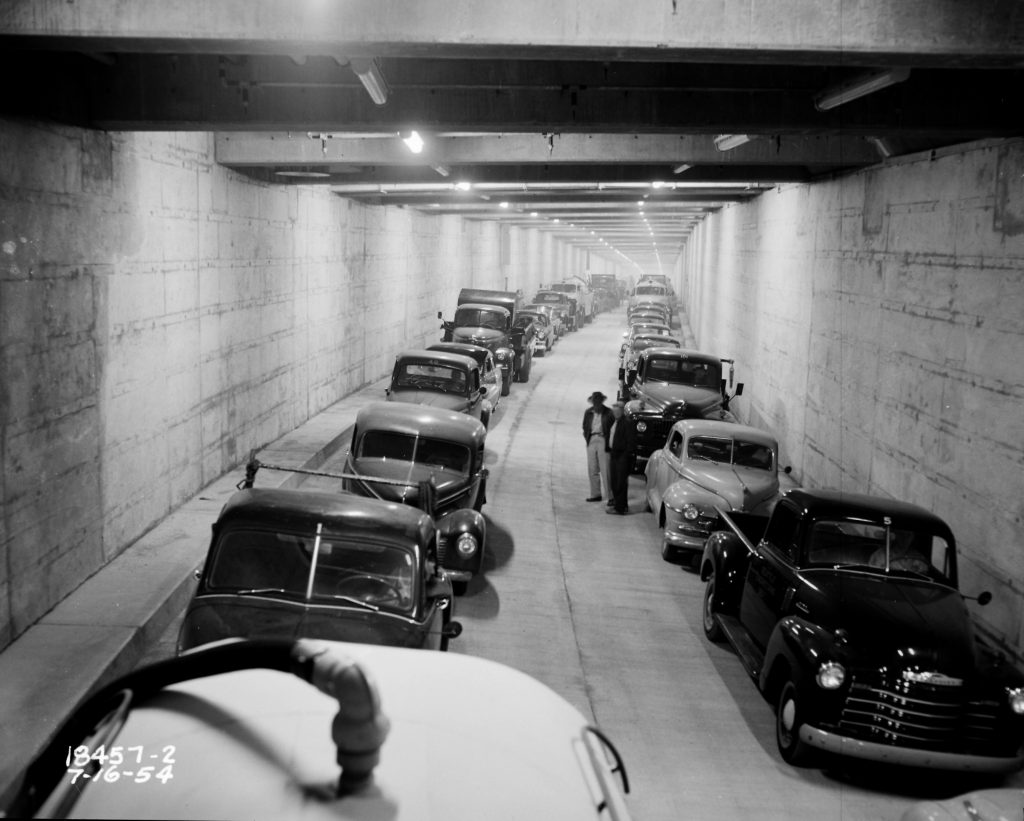
Engineers designed a system that included ventilation strips (still visible in the middle of Battery Street), exhaust fans, and an automatic sensor that measured carbon monoxide levels. In the event that the air inside the tunnel became toxic, the sensors would trigger illuminated signs at each end of the tunnel warning motorists that the tunnel was closed. Tests of the system featured a tunnel full of 1940s and 1950s vintage cars, parked, with their motors running and exhaust pipes pumping out smoke and invisible gasses.
The Battery Street Subway opened officially to the public on Saturday, July 24, 1954. KING-TV covered the opening ceremonies live, and that year’s Seafair Queen (and other Seafair “royalty”) figured heavily in the festivities. It was summer in Old Seattle, after all, and years before the 1962 World’s Fair, and then all those professional sports teams, captured the public’s warm-weather attention.
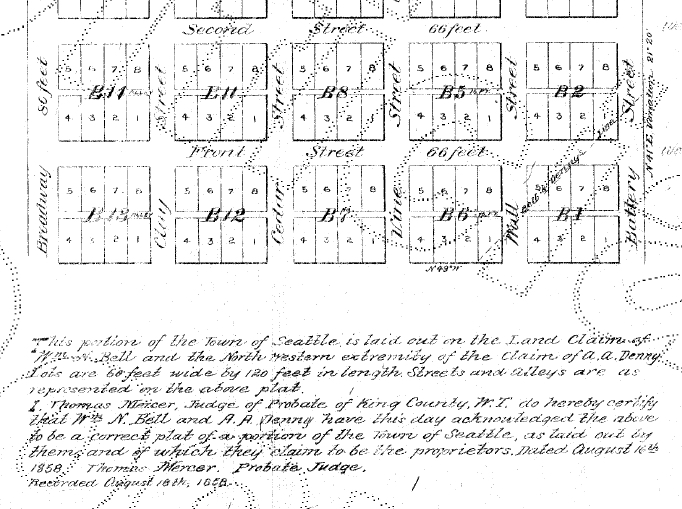
One mystery still remains around the Battery Street Subway – and the Battery Street Tunnel, for that matter – the source of the “Battery” part of its name.
First stop for all questions about the origin of Seattle street names is a 1937 book by pioneer daughter Sophie Frye Bass called “Pig-tail Days in Old Seattle.” Bass speculates that the Battery Street name is related somehow to an alternate name for Alki Point – “Battery Point” – which came from an American survey in the 1850s.
Historian and journalist Paul Dorpat theorizes that the link between Battery Street, which originally terminated at the edge of Elliott Bay with a bluff, and Battery Point, all the way across Elliott Bay, is a perhaps a visual connection.
“Have you thought about going to Google Earth? That’s what I would do,” Dorpat said.
“Run a line from Alki Point to the foot of Battery Street, or the bluff of Battery Street,” Dorpat explained. “It may be the point of sight or close to it where you can first see Alki Point from the east side of the bay.”
Dorpat-inspired experiments with Google Earth proved inconclusive, but his theory is certainly tantalizing and plausible.
Dorpat also suggested speaking with Greg Lange, an archivist at the King County Archives who’s also researched and written extensively about 19th century Seattle.
“The best that I could come up with in thinking about that name is that it could perhaps have been a place where the Native Americans had a defense [position],” Lange said, in order to repel other natives who sometimes came down from what’s now Canada to attack natives who lived around Puget Sound.
Lange says that the government surveyors who came up with the name “Battery Point” for what’s now Alki Point did so because that area looked like a battery – that is, a defensive position designed to repel a waterborne enemy attack or landing.
“But I don’t believe that was the situation at the foot of Battery Street,” Lange said. “I don’t think the terrain was such that that looked like a battery.”
That’s my best guess on what Battery Street could be,” Lange said. “I can’t think of anything else.”
Mimi Sheridan also has a theory about Battery Street, and it, too, points to Seattle’s martial past.
“One thought I have is the Armory was not too far away,” Sheridan said, referring to a 19th-century building that was destroyed by an arsonist in 1962. “The Armory was at the north end of Pike Place Market where there’s still a street there called Armory Place.”
The origins of “Battery” may be one mystery of Seattle that’s never satisfyingly solved.
In the meantime, there’s no mystery about what will happen to the Battery Street Tunnel.
Once the new tunnel opens to traffic, the old tunnel will be officially retired. Plans call for it to be filled with debris and permanently closed off.
Follow @https://twitter.com/feliksbanel