Sew What? American Made is Tough To Achieve When No One Knows How To Sew
Oct 3, 2013, 4:59 PM | Updated: Oct 11, 2024, 10:43 am
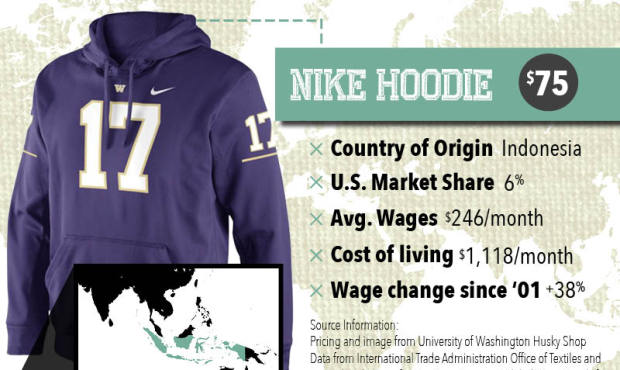
Graphic courtesy of the Seattle Globalist
Most people don’t pay much attention to where their clothes were made. But a quick look at the tags in your closet will reveal the same countries over and over again: Made in China, Indonesia, India.
Alex Stonehill, editor of the Seattle Globalist, wanted to know exactly where the popular, purple UW sweatshirts come from. So he headed to the University Bookstore.
“This is a Nike jersey with a hood, made in Indonesia, $75,” says Alex in a video he made for the website. “Okay, we’re going to send this off to our correspondent in Indonesia and see if we can find out a little bit more about where it came from and who made it.”
The sweatshirt was sent to reporter Branden Eastwood in Jakarta, Indonesia. He had a surprisingly easy time tracking down the exact factory.
“It was a Nike jersey and they, in response to some pressure from consumers, have this really great feature on their website where you can track down which factories they have, where, that are making what apparel, whether its Converse or Nike label or whether it collegiate apparel and stuff like that,” Alex says.
Branden was able to connect with Anissa, a 24-year-old woman who makes the sweatshirts.
“It turns out she earns about $190 a month sewing thousands of items like my hoodie, which retails in Seattle for $75,” Branden says.
Branden asks Anissa if that’s enough for her family and Alex translates her answer:
“They basically said, well, we’re making it work for now,” says Alex. “But the woman was three months pregnant and she said, ‘Once we have this baby, it’s not going to be enough.’ People make it work because they have to. But that doesn’t mean that it’s fair or their lives are good.”
A few days after I did this interview, I read a story in The New York Times about how more Americans are demanding that companies manufacture their goods in the US. They know about the horrific fire at a Bangladesh sweatshop that killed 100 people last year and about the long hours, low wages and poor working conditions.
But here’s the thing – the factories opening in the US, and the ones that have already been operating here, are having a really hard time finding workers because, since these jobs moved abroad, no one knows how to sew anymore.
Filson, the maker of high-end outdoor clothes and gear, has been manufacturing its products in Seattle for 116 years. CEO Alan Kirk:
“Ninety-five percent of our sewing operators are immigrants that have come in, mostly Vietnamese or Chinese. They’re been here for many years, but the new generation of potential sewing operators is more challenging. We’ve had to go to significant lengths to find the right talent or the right number of employees.”
Right now, he’s working with South Seattle Community College to launch Filson Academy.
“To try and encourage people to come in to the sewing industry,” Alan explained. “The idea was to create a three-month, six-month, one-year training school where you have a certificate. We put them through the sewing, leather crafting and then we open them up to a future within the company where you go from sewing operator to product development manager. So we’re offering them a longer term career and we’re hoping that will encourage more people to join us.”
At Filson, all workers earn above minimum wage and there are health benefits.
“We made a decision to put in a kitchen with a really nice cafeteria in two of our factories. That wasn’t the case before. It was OK, but it certainly wasn’t particularly nice. And then we spend a lot of time trying to make a community where we’re talking to the operators, working with them, giving them incentives, and encouraging them to tell their friends that it’s actually a nice place to be and it’s an interesting career.”
But if there aren’t enough people to sew the clothes, there is no way that companies are going to move their factories back to the US. Not to mention:
“I think it would be very difficult for a lot of brands to come back to the US,” Alan said. “It is much more expensive. The labor and the sewing is five, six, seven, eight times, depending on the product. They would need to increase their prices 50, 75, 100 percent to be able to survive.”
Anissa, the factory worker in Indonesia, says she doesn’t want to lose her job, she just wants to be be paid a fair wage. So it’s a Catch-22. How do we encourage American-made and avoid overseas sweatshops when Americans don’t want to pay high prices or work at the factories?