Can Seattle communities solve modern segregation?
Mar 30, 2018, 6:47 AM | Updated: 8:18 am
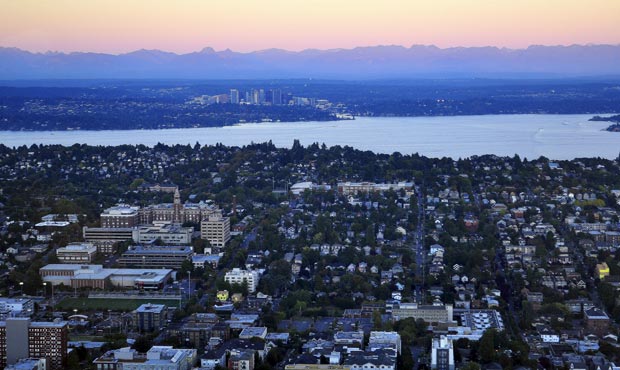
Seattle's Central District overlooking Lake Washington and the Eastside. (Joe Wolf, Flickr)
(Joe Wolf, Flickr)
University of Washington Sociology Professor Kyle Crowder says segregation remains a part of modern America’s social networks.
RELATED: Seattle’s segregated housing history remains to this day
“When you investigate places to live, your social network, [and] your friends and family are really important sources of that information,” Crowder told KIRO Radio’s Dave Ross. “And since our friends and family are racially circumscribed – in other words, whites tend to have social networks dominated by whites, African Americans have African American social networks – and those groups tend to be segregated already. We tend to have access to neighborhoods that are also racially isolated.”
In other words, social networks are often isolated by ethnicity, race, etc. When those groups don’t talk to each other, they share information about different places to live. They might also provide negative impressions about places they are not familiar with, or where they don’t know anybody.
This is what Crowder has studied in Chicago. It led to his book, “Cycle of Segregation.” The problem largely stems from where people lived in the past, their daily social circles (family, friends), and where they spend their days (work, school).
“We found that reliance on those three big social sources of information led to information asymmetries,” Crowder said. “So African Americans, Latinos, Asians, and whites all said they knew about different sets of neighborhoods. There were neighborhoods that whites said they knew well and could tell you characteristics about, and African Americans said they knew nothing about them.”
Seattle segregation
This is true when considering modern Seattle. Historians can point to geographical features like the canal as one line where race determined your neighborhood. The city’s Central District was also known as a red-lined area where black residents were placed to live. More obvious forms of discrimination may not be as prevalent today. But Crowder says that more subtle discrimination still exists.
The Central District is a good example. Seattle’s black community has existed there for generations after redlining. Communities can become a visual representation of systematic segregation at the structural and governmental level, Crowder said.
“In Seattle you see it,” Crowder said. “Not in terms of the intentional, overt claims that we should be investing in some areas and not others. But you see differences in areas that receive transit, which areas receive policing – over-policed in some cases. Those are the kinds of investments and disinvestment. Certainly, in terms of where mortgages are made and where sub-prime mortgages are made.”
“That’s why we care about segregation,” he said. “It creates very big disparities in exposure to pollution, exposure to crime, job opportunities, educational opportunities, and those kinds of things … I totally get ‘the black neighborhood should stay black,’ but in the context of historical disinvestment in black neighborhoods, I think there is an interest in trying to create more equitable neighborhoods. And that is very difficult to effect without racial integration.”
Four solutions
Crowder says this sort of word-of-mouth segregation has some solutions.
“The things that perpetuate segregation are very complex,” Crowder said. “We can throw up our hands and say it’s too complex to overcome. On the other hand, that complexity points to a bunch of different levers we could be pulling. I’ll point out four of them.”
- Individuals: Online tolls are a good example. What can be done to online housing search tools that can correct the issue?
- Integrate social networks: Combine communities through work, school, and community activities.
- Community: Communities should do a better job of advertising opportunities in their area. They can also look at zoning laws, the mixture of housing (or lack thereof) that can act as a barrier to integration.
- Address disinvestment in communities of color.
“We can’t even reasonably talk about integrating communities of color in a lot of metropolitan areas because they have been so dramatically disinvested in that very few people would want to live there,” Crowder said. “The challenge is how to reinvest in those communities to make them attractive and not displace people … put in provisions that make sure the population that wants to stay in that area gets to stay in that area while investing in the quality of that area.”
Listen to the entire conversation here.
Follow @http://twitter.com/Mynorthwest