Northwest high-speed rail would be ‘game changer’ says advocates
Feb 5, 2019, 2:22 PM | Updated: 4:22 pm
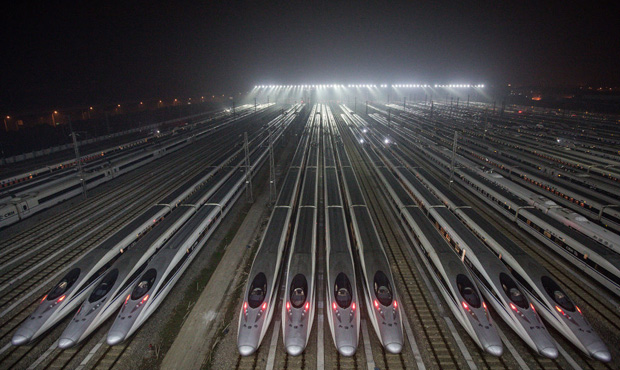
(Wang He/Getty Images)
(Wang He/Getty Images)
A push for a high-speed rail in the Pacific Northwest took a step forward last week, when a briefing was delivered to Washington State’s House Transportation Committee on its relative viability, popularity, and execution.
RELATED: Bill introduced for high-speed rail authority in Northwest
The briefing laid out the basics of the proposed system: It would link Seattle, Portland, and Vancouver, BC, with trains that would hit speeds up to 250 miles per hour. It also said that “significant” work would be needed for tunneling, elevated tracks, and bridges, paid for by both public and private money.
No such train currently operates in the United States.
Polling interest among travelers, a survey conducted in 2018 found found that 74 percent of 2,400 respondents would “definitely try” a high-speed rail system.
Perhaps even more significantly, a survey of business leaders asked about a high-speed rail concluded that respondents “can’t imagine” the region without it in the next 30 to 50 years, when accounting for the region’s congestion and population growth.
Presenting before the House Transportation Committee on Jan. 30, WSDOT Secretary Roger Millar detailed the reasoning behind a possible high-speed rail system.
Building a high-speed rail transportation system between Seattle and Portland to the south, and Vancouver, BC to the north, is about much more than transportation; it’s about creating opportunities and connections that will carry this mega-region into the future. Better access to jobs, to affordable housing, the ability to share resources, to increase collaboration, and advance economic prosperity for the entire region.
Millar went on to label a high-speed rail system a “game changer,” asking for funding to “explore governance, community outreach, and financing options that might be available.”
Presenting after Millar was WSDOT Director of Rail, Freight, and Ports, Ron Pate, who said that construction costs for this project could range somewhere between $24 and $42 billion.
He also noted that a high-speed rail could create upwards of 200,000 new jobs, increase gross domestic product by as much as $388 billion over 20 years, and reduce greenhouse gas emissions by 28,000 metric tons per year. Estimates for potential annual ridership were pegged somewhere between 1.7 and 2.1 million.
This comes just a couple weeks after a bill was introduced in the Washington State Legislature to establish a high-speed rail authority in the Pacific Northwest.
The bill would allocate a total of $3.25 million to develop an authority that would preside over Washington, Oregon, and British Columbia, working in tandem with each area’s local government.
In July 2018, the Province of British Columbia, the Oregon Department of Transportation, and Microsoft announced a $750,000 contribution toward studying a high-speed line. That was in addition to the $750,000 the Washington State Legislature had already approved for the study, for a total of $1.5 million.
RELATED: Millions to be spent on studying high-speed rail for Washington
The study is expected to be completed by July 2019.
Follow @http://twitter.com/Mynorthwest